
[论文解读] Unveiling Dark Matter free-streaming at the smallest scales with high redshift Lyman-alpha forest
本研究通过分析红移 z=4.2–5.0 的高分辨率类星体光谱中的高红移莱曼-α森林流量功率谱,改进了对温暗物质(WDM)的约束。采用基于模拟的似然函数的贝叶斯推断框架,建立了热退耦合 WDM 粒子质量的 95% 可信下限为 5.7 keV,由于统计样本增大并探测更小尺度(k_max = 0.2 km⁻¹s),该结果显著优于以往结果。
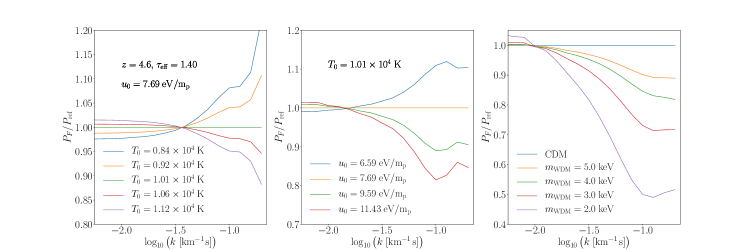
This study introduces novel constraints on the free-streaming of thermal relic warm dark matter (WDM) from Lyman-$α$ forest flux power spectra. Our analysis utilises a high-resolution, high-redshift sample of quasar spectra observed using the HIRES and UVES spectrographs ($z=4.2-5.0$). We employ a Bayesian inference framework and a simulation-based likelihood that encompasses various parameters including the free-streaming of dark matter, cosmological parameters, the thermal history of the intergalactic medium, and inhomogeneous reionization, to establish lower limits on the mass of a thermal relic WDM particle of $5.7\;\mathrm{keV}$ (at 95\% C.L.). This result surpasses previous limits from the Lyman-$α$ forest through reduction of the measured uncertainties due to a larger statistical sample and by measuring clustering to smaller scales ($k_{ m max}=0.2\;\mathrm{km^{-1}\,s}$). The approximately two-fold improvement due to the expanded statistical sample suggests that the effectiveness of Lyman-$α$ forest constraints on WDM models at high redshifts are limited by the availability of high-quality quasar spectra. Restricting the analysis to comparable scales and thermal history priors as in prior studies ($k_{ m max}<0.1\;\mathrm{km^{-1}\,s}$) lowers the bound on the WDM mass to $4.1\;\mathrm{keV}$. As the precision of the measurements increases, it becomes crucial to examine the instrumental and modelling systematics. On the modelling front, we argue that the impact of the thermal history uncertainty on the WDM particle mass constraint has diminished due to improved independent observations. At the smallest scales, the primary source of modeling systematic arises from the structure in the peculiar velocity of the intergalactic medium and inhomogeneous reionization.
研究动机与目标
- 通过利用高红移莱曼-α森林数据探测宇宙学最小尺度上的暗物质自由流,以收紧对温暗物质(WDM)的约束。
- 通过利用 z=4.2–5.0 范围内更大、更高品质的高分辨率类星体光谱样本,减少 WDM 质量限制的不确定性。
- 评估仪器系统误差和建模不确定性(特别是本征速度结构和热历史)对 WDM 约束的影响。
- 评估莱曼-α森林在小尺度上作为暗物质物理探针的有效性,特别是在未来巡天的背景下。
提出的方法
- 采用基于模拟的似然函数的贝叶斯推断框架,联合约束 WDM 自由流、宇宙学参数、星际介质(IGM)热历史以及非均匀再电离过程。
- 分析覆盖红移 z=4.2–5.0 的 HIRES 和 UVES 光谱仪获取的高分辨率、高信噪比类星体光谱,以探测至 k_max = 0.2 km⁻¹s 的小尺度流量功率谱。
- 使用包含真实物理过程(如辐射加热、再电离)的先进流体动力学模拟,对 IGM 和流量功率谱进行建模。
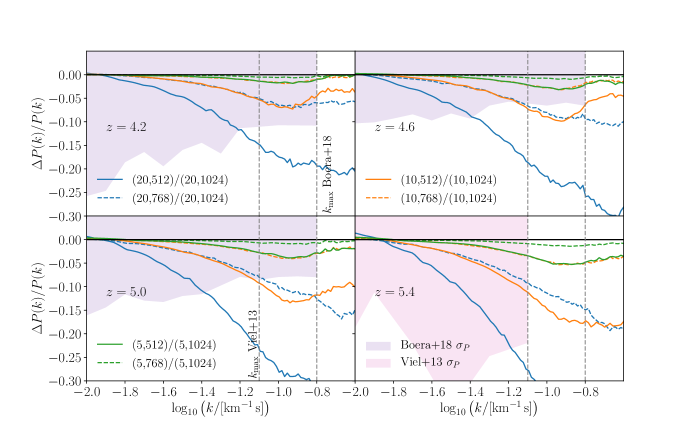
- 通过测试流量噪声低估(最高达 40%)以及本征速度结构对 WDM 约束的影响,量化系统误差。
- 通过在不同热历史先验和尺度截断(如 k_max < 0.1 km⁻¹s)下比较结果,评估结果对建模假设的稳健性和敏感性。
- 在验证系统性检查可靠性的前提下,应用小尺度(k > 0.1 km⁻¹s)带来的 50% 更强约束能力。
实验结果
研究问题
- RQ1利用高红移莱曼-α森林数据在最小可观测尺度上,对热退耦合温暗物质粒子质量的最紧约束是什么?
- RQ2仪器噪声和流量测量不确定性在高 k 模式(k > 0.1 km⁻¹s)下如何影响 WDM 约束?
- RQ3IGM 热历史和非均匀再电离的不确定性在多大程度上影响推断出的 WDM 质量限制?
- RQ4重子气体中的本征速度结构如何影响小尺度流量功率谱和 WDM 约束?
- RQ5与其它天体物理和宇宙学约束相比,高红移莱曼-α森林能否作为暗物质自由流的有效探针?
主要发现
- 基准分析得出热退耦合温暗物质粒子质量的 95% 可信下限为 5.7 keV,显著优于以往约束。
- 当限制在 k_max < 0.1 km⁻¹s 且热历史先验相当时,WDM 质量下限为 4.1 keV(95% C.L.),比早期研究紧了两倍。
- 小尺度(k > 0.1 km⁻¹s)带来的 50% 更强约束能力具有鲁棒性,尽管数据中流量噪声可能被低估高达 40%,这可能导致约束变弱。
- 由本征速度结构和非均匀再电离引起的建模不确定性,可使 WDM 质量约束能力降低最多达 25%。
- 在所有分析选择下,2.5 keV 的 WDM 粒子质量被超过 5σ 排除,3 keV 被超过 3σ 排除;在合理的热历史先验下,3 keV 被 5σ 排除。
- 本研究表明,高红移莱曼-α森林对 WDM 约束的主要限制因素是高质量类星体光谱的可获得性,而非理论建模。
更好的研究,从现在开始
从阅读论文到最终审阅,大幅缩短您的研究时间。
无需绑定信用卡
本解读由 AI 生成,并经人工编辑审核。