
[论文解读] Urban Generative Intelligence (UGI): A Foundational Platform for Agents in Embodied City Environment
本文提出了城市生成智能(Urban Generative Intelligence, UGI),这是一个基础性平台,将大型语言模型(LLMs)与城市数字孪生技术相结合,以实现复杂城市任务中具身化、基于语言的智能体。通过利用CityGPT——一个基于多源城市数据微调的领域专用大型语言模型——UGI支持通过知识图谱和城市模拟器实现交互式、基于自然语言的城市系统仿真,从而推动可扩展、开放式的城市智能研究与应用。
Urban environments, characterized by their complex, multi-layered networks encompassing physical, social, economic, and environmental dimensions, face significant challenges in the face of rapid urbanization. These challenges, ranging from traffic congestion and pollution to social inequality, call for advanced technological interventions. Recent developments in big data, artificial intelligence, urban computing, and digital twins have laid the groundwork for sophisticated city modeling and simulation. However, a gap persists between these technological capabilities and their practical implementation in addressing urban challenges in an systemic-intelligent way. This paper proposes Urban Generative Intelligence (UGI), a novel foundational platform integrating Large Language Models (LLMs) into urban systems to foster a new paradigm of urban intelligence. UGI leverages CityGPT, a foundation model trained on city-specific multi-source data, to create embodied agents for various urban tasks. These agents, operating within a textual urban environment emulated by city simulator and urban knowledge graph, interact through a natural language interface, offering an open platform for diverse intelligent and embodied agent development. This platform not only addresses specific urban issues but also simulates complex urban systems, providing a multidisciplinary approach to understand and manage urban complexity. This work signifies a transformative step in city science and urban intelligence, harnessing the power of LLMs to unravel and address the intricate dynamics of urban systems. The code repository with demonstrations will soon be released here https://github.com/tsinghua-fib-lab/UGI.
研究动机与目标
- 解决先进城市仿真技术与实际应对复杂城市挑战之间的系统性鸿沟。
- 开发一个统一、开放的平台,通过自然语言支持,实现多样化城市任务中智能、具身化智能体的构建。
- 将大型语言模型与城市数字孪生及知识图谱相集成,以模拟真实、动态的城市交互行为。
- 通过提供可扩展、开放的环境,促进跨学科协作,支持城市研究人员与开发者的创新。
- 通过在真实城市环境中构建可扩展、基于语言的智能体系统,实现对城市涌现行为的仿真。
提出的方法
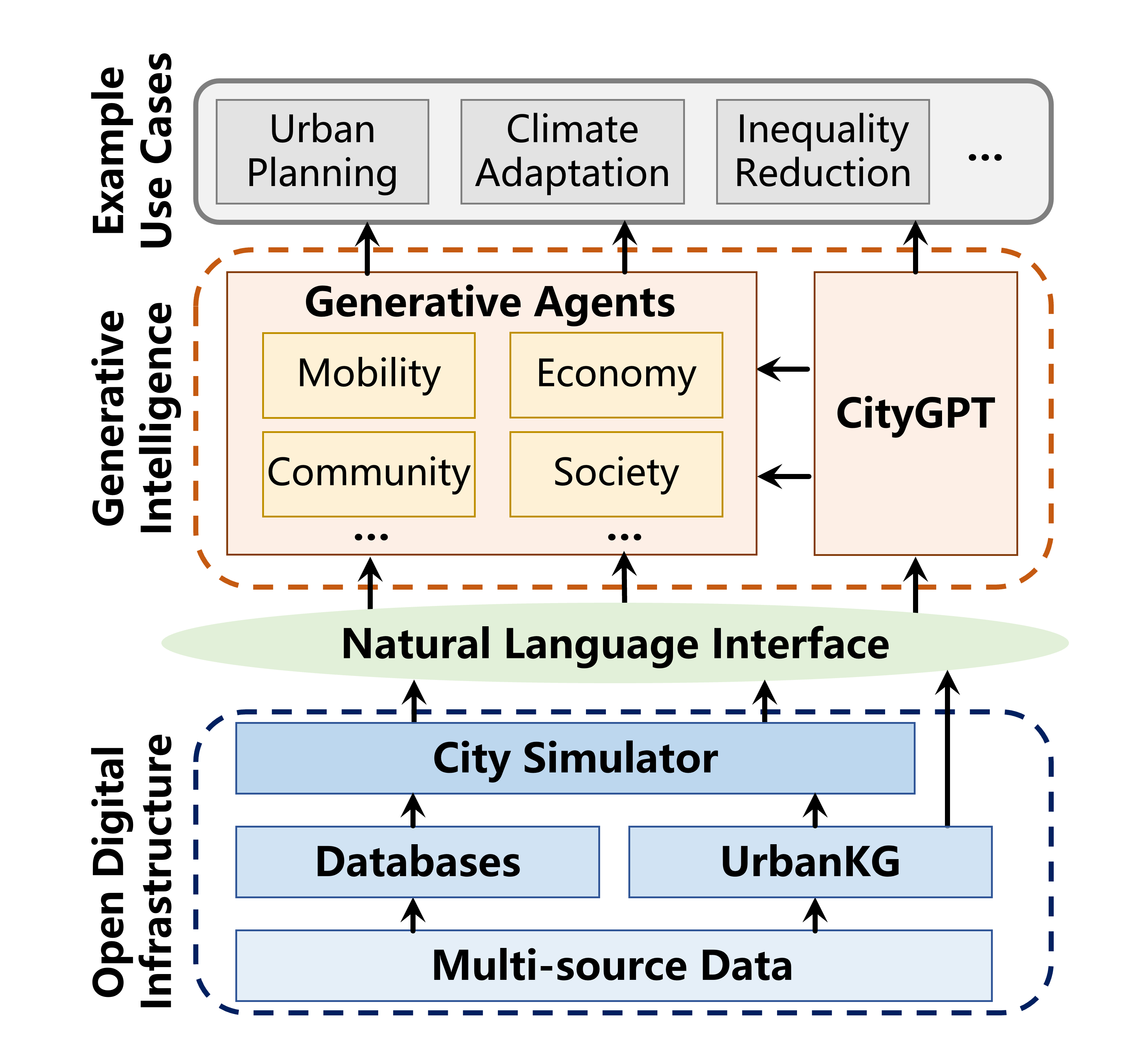
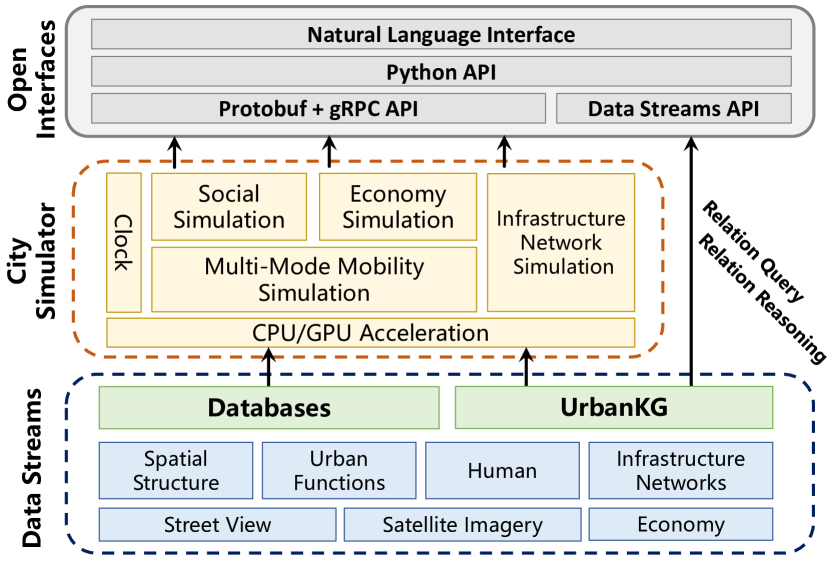
- 提出UGI作为基础平台,整合城市模拟器、UrbanKG知识图谱与自然语言接口,用于城市仿真。
- 提出CityGPT,一种在通用文本及高质量领域特定城市数据(包括城市知识与任务求解过程)上预训练的基础模型。
- 采用基于语言的接口,实现与城市环境的自然语言交互,支持通过提示词或代码开发智能体。
- 利用批量提示(batch prompting)与消息池架构(受MetaGPT启发),提升多智能体仿真中的推理效率并降低资源消耗。
- 支持对城市空间结构、土地利用、基础设施与数据源的开放式修改,实现可定制的城市仿真。
- 支持用户接入自定义算法或数据源,以在新型城市配置下生成人类活动与城市动态。
实验结果
研究问题
- RQ1如何有效将大型语言模型集成到城市数字孪生中,以实现智能、具身化智能体的行为?
- RQ2构建一个能够跨多样化城市领域进行推理的基础模型(CityGPT)所需的架构与训练策略是什么?
- RQ3基于语言的智能体在真实、交互式城市环境中,能在多大程度上模拟复杂、涌现的城市动态?
- RQ4开放、可扩展的基础设施如何支持城市仿真与智能体开发中的跨学科创新?
- RQ5在大规模城市仿真中部署基于LLM的智能体时,会面临哪些性能与可扩展性权衡?
主要发现
- UGI支持开发具身化、基于语言的智能体,使其可通过与仿真城市环境的自然语言交互完成多样化城市任务。
- 基础模型CityGPT通过在多源城市数据(包括任务求解过程与领域特定知识)上预训练,展现出跨城市领域的涌现推理能力。
- 该平台通过城市模拟器、UrbanKG与语言接口的结合,支持城市系统的实时、交互式仿真,实现动态反馈与智能体自适应。
- UGI中的批量提示技术将推理速度提升最高达5倍,显著提高成本效率,大幅增强多智能体城市仿真场景的可扩展性。
- 开放可扩展的架构使用户能够修改城市空间结构、基础设施与数据源,支持可定制、可复现的城市实验。
- 平台通过支持城市数据科学家、仿真工程师、LLM研究人员与城市领域专家的共同参与,促进跨学科开发者社区的发展。
更好的研究,从现在开始
从阅读论文到最终审阅,大幅缩短您的研究时间。
无需绑定信用卡
本解读由 AI 生成,并经人工编辑审核。