
[论文解读] User Behavior Simulation with Large Language Model based Agents
本文提出了一种基于大语言模型(LLM)的智能体框架,通过利用LLM的世界知识和推理能力,在推荐系统和社交网络等多种交互环境中模拟逼真的用户行为。该方法在零样本设置下实现了接近人类水平的行为保真度,从而能够以高保真度研究信息茧房和从众等社会现象。
Simulating high quality user behavior data has always been a fundamental problem in human-centered applications, where the major difficulty originates from the intricate mechanism of human decision process. Recently, substantial evidences have suggested that by learning huge amounts of web knowledge, large language models (LLMs) can achieve human-like intelligence. We believe these models can provide significant opportunities to more believable user behavior simulation. To inspire such direction, we propose an LLM-based agent framework and design a sandbox environment to simulate real user behaviors. Based on extensive experiments, we find that the simulated behaviors of our method are very close to the ones of real humans. Concerning potential applications, we simulate and study two social phenomenons including (1) information cocoons and (2) user conformity behaviors. This research provides novel simulation paradigms for human-centered applications.
研究动机与目标
- 解决传统用户行为模拟方法依赖简化决策模型和真实世界数据的局限性。
- 通过利用LLM实现零样本用户行为生成,克服模拟中的'先有鸡还是先有蛋'问题。
- 构建一个跨环境的模拟框架,捕捉用户行为在不同情境下的相互依赖关系。
- 通过真实、基于LLM的用户智能体研究信息茧房和从众等涌现社会现象。
- 建立一种新型模拟范式,用于基于LLM智能体的人本AI应用研究。
提出的方法
- 设计一个沙盒环境,模拟现实世界中的用户交互场景,包括推荐系统和社交媒体平台。
- 训练并部署基于LLM的智能体,利用自然语言推理和世界知识模拟用户决策。
- 实现关键行为的模板:购买电影、浏览页面、搜索、离开、产生情绪、发起对话以及在社交媒体上发帖。
- 通过提示工程引导智能体以符合上下文的方式行动,确保与观察到的用户行为模式一致。
- 集成多轮交互逻辑,模拟跨环境的动态、演化的用户交互。
- 利用预训练LLM实现零样本模拟,无需对真实用户数据进行微调。
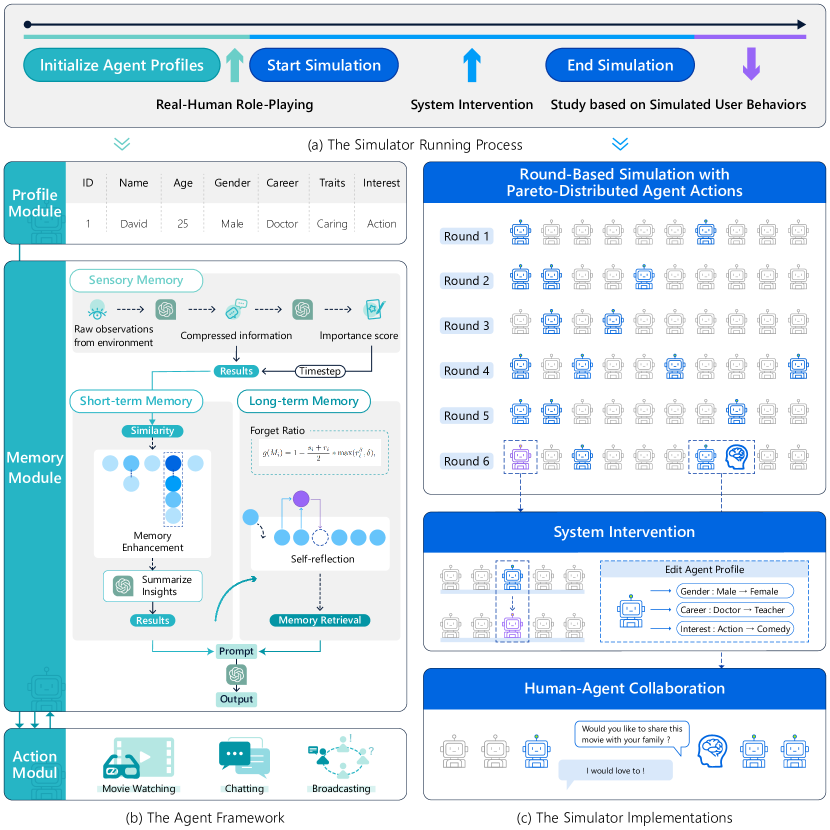
实验结果
研究问题
- RQ1基于LLM的智能体能否在多环境设置下生成与真实人类行为无法区分的行为?
- RQ2在没有真实世界训练数据的情况下,LLM智能体在多大程度上能够模拟信息茧房和从众等复杂社会现象?
- RQ3与依赖真实数据的传统模拟方法相比,基于LLM的智能体在零样本模拟中的表现如何?
- RQ4LLM智能体能否在多种交互模式(如观看、聊天、发帖)中保持行为一致性和上下文相关性?
- RQ5在共享模拟环境中部署多个LLM智能体时,可观察到哪些涌现的社会动态?
主要发现
- 基于LLM的智能体所模拟的行为高度逼真,在推荐系统和社交网络中均与真实人类行为高度相似。
- 该框架支持零样本模拟,即无需任何真实世界训练数据即可生成合理的用户行为。
- 智能体成功模拟了信息茧房和用户从众等复杂社会现象,展示了真实社会动态的涌现。
- 智能体表现出上下文感知的决策能力,包括对社交线索的恰当回应、情绪反思以及有针对性的内容搜索。
- 该模拟框架支持多模态和多环境交互,能够真实建模跨平台用户行为。
- 该方法优于依赖简化模型和真实数据依赖的传统模拟技术,为以人为本的AI研究提供了更广泛的应用潜力。

更好的研究,从现在开始
从阅读论文到最终审阅,大幅缩短您的研究时间。
无需绑定信用卡
本解读由 AI 生成,并经人工编辑审核。