
[论文解读] User Modeling and User Profiling: A Comprehensive Survey
This paper surveys the evolution, taxonomy, and future directions of user modeling and profiling, highlighting trends like implicit data, graph-based methods, privacy, explainability, and ethics.
The integration of artificial intelligence (AI) into daily life, particularly through information retrieval and recommender systems, has necessitated advanced user modeling and profiling techniques to deliver personalized experiences. These techniques aim to construct accurate user representations based on the rich amounts of data generated through interactions with these systems. This paper presents a comprehensive survey of the current state, evolution, and future directions of user modeling and profiling research. We provide a historical overview, tracing the development from early stereotype models to the latest deep learning techniques, and propose a novel taxonomy that encompasses all active topics in this research area, including recent trends. Our survey highlights the paradigm shifts towards more sophisticated user profiling methods, emphasizing implicit data collection, multi-behavior modeling, and the integration of graph data structures. We also address the critical need for privacy-preserving techniques and the push towards explainability and fairness in user modeling approaches. By examining the definitions of core terminology, we aim to clarify ambiguities and foster a clearer understanding of the field by proposing two novel encyclopedic definitions of the main terms. Furthermore, we explore the application of user modeling in various domains, such as fake news detection, cybersecurity, and personalized education. This survey serves as a comprehensive resource for researchers and practitioners, offering insights into the evolution of user modeling and profiling and guiding the development of more personalized, ethical, and effective AI systems.
研究动机与目标
- 提供从早期模型到现代技术的用户建模与画像发展的历史概览。
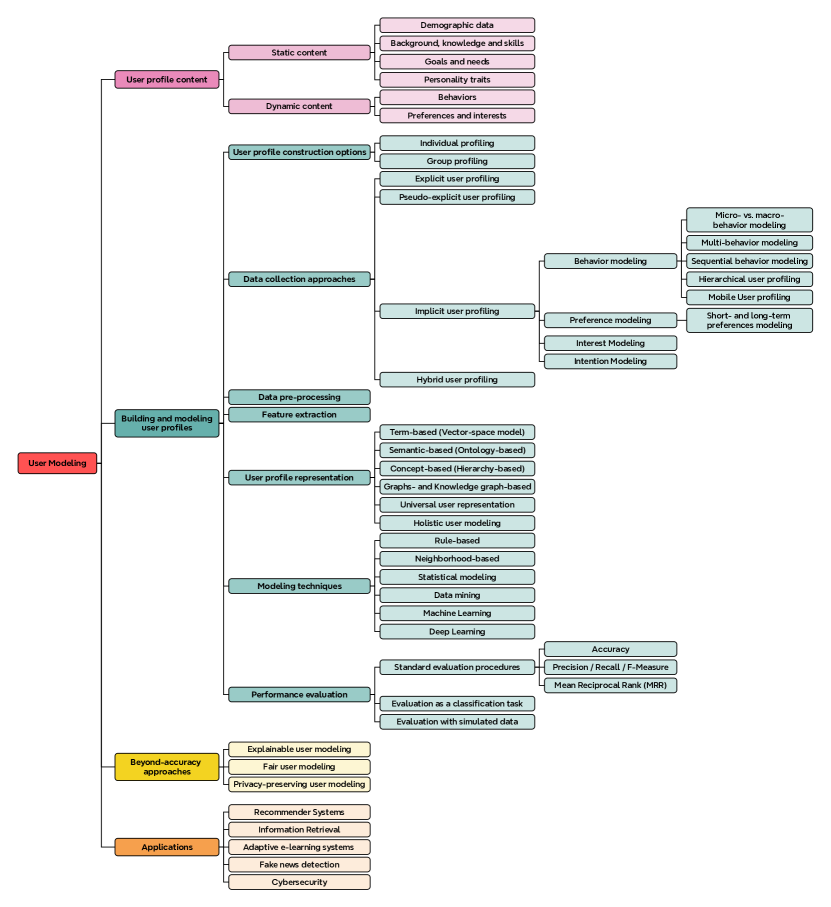
- 提出一个涵盖该领域活跃议题和最新趋势的全新分类法。
- 突出向隐性数据收集、多行为建模和基于图表示的范式转变。
- 讨论用户建模中的隐私保护方法、可解释性与公平性。
- 探讨在假新闻检测、网络安全和个性化教育等领域的应用。
提出的方法
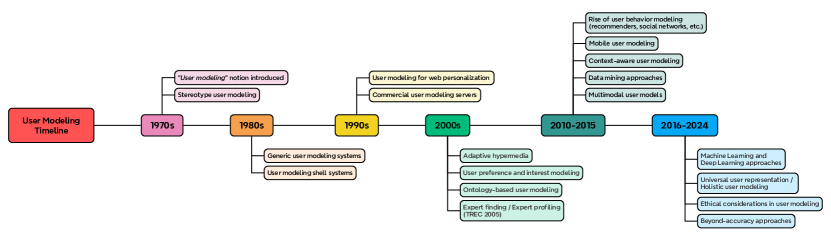
- 文献综合研究其从刻板印象模型到基于深度学习的用户模型的演变。
- 提出一个新的百科全书式术语定义框架,以减少歧义。
- 讨论隐私保护方法,包括联邦化用户建模和可审计的模型。
- 审视伦理考量与公平性,以引导以人为本与包容性设计。
实验结果
研究问题
- RQ1用户建模与画像技术的历史轨迹是什么,它们是如何演变的?
- RQ2当前的活跃议题有哪些,应该如何整理成一套完整的分类法?
- RQ3隐私、可解释性与公平性考量如何影响现代用户建模方法?
- RQ4用户建模技术已被应用于哪些领域,未来的研究方向是什么?
主要发现
- 从早期的刻板印象模型向包括隐性数据收集和多行为建模在内的复杂画像方法的转变。
- 图数据结构、跨平台模型和多模态数据正被越来越多地用于提升用户表示。
- 隐私保护技术和联邦学习在平衡个性化与隐私方面越来越重要。
- 可解释性与公平性正在成为用户建模的核心设计目标,以提高透明度并减少偏见。
- 该领域涵盖广泛的应用,包括假新闻检测、网络安全和个性化教育。
更好的研究,从现在开始
从论文设计到论文写作,大幅缩短您的研究时间。
无需绑定信用卡
本解读由 AI 生成,并经人工编辑审核。