
[论文解读] V2X-Seq: A Large-Scale Sequential Dataset for Vehicle-Infrastructure Cooperative Perception and Forecasting
V2X-Seq 提供了首个大规模真实世界序列数据集,用于车辆-基础设施协同(VIC)感知与预测,包含15,000帧用于感知任务,210,000个场景用于轨迹预测,数据覆盖672小时。本文提出了三项新任务——VIC3D追踪、在线-VIC预测与离线-VIC预测,并建立了基准。实验表明,融合基础设施数据可提升追踪与预测性能,其中FF-Tracking在300ms延迟下相较早期融合方法实现最高4%的MOTA提升。
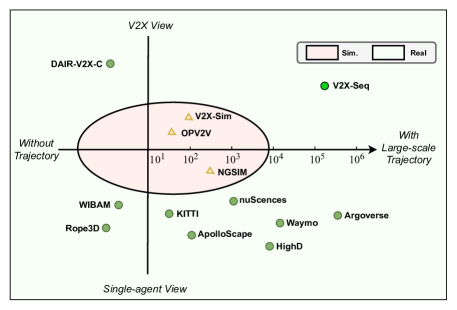
Utilizing infrastructure and vehicle-side information to track and forecast the behaviors of surrounding traffic participants can significantly improve decision-making and safety in autonomous driving. However, the lack of real-world sequential datasets limits research in this area. To address this issue, we introduce V2X-Seq, the first large-scale sequential V2X dataset, which includes data frames, trajectories, vector maps, and traffic lights captured from natural scenery. V2X-Seq comprises two parts: the sequential perception dataset, which includes more than 15,000 frames captured from 95 scenarios, and the trajectory forecasting dataset, which contains about 80,000 infrastructure-view scenarios, 80,000 vehicle-view scenarios, and 50,000 cooperative-view scenarios captured from 28 intersections' areas, covering 672 hours of data. Based on V2X-Seq, we introduce three new tasks for vehicle-infrastructure cooperative (VIC) autonomous driving: VIC3D Tracking, Online-VIC Forecasting, and Offline-VIC Forecasting. We also provide benchmarks for the introduced tasks. Find data, code, and more up-to-date information at \href{https://github.com/AIR-THU/DAIR-V2X-Seq}{https://github.com/AIR-THU/DAIR-V2X-Seq}.
研究动机与目标
- 解决自动驾驶领域中车辆-基础设施协同(VIC)感知与预测缺乏真实世界序列数据集的问题。
- 通过提供大规模真实世界数据集并同步多模态数据,推动协同追踪与行为预测研究。
- 提出三项新任务——VIC3D追踪、在线-VIC预测与离线-VIC预测,以推进基于VIC的自动驾驶系统发展。
- 基于来自28个路口的672小时真实世界数据,建立公平的基准以评估VIC感知与预测模型。
- 开发并验证一种新型FF-Tracking框架,提升在可变延迟条件下的追踪鲁棒性。
提出的方法
- 从95个真实世界场景中采集并标注大规模序列化V2X数据集(V2X-Seq),包含基础设施与车辆侧图像、点云、3D检测结果、矢量地图及交通灯信号。
- 设计并实现三项新任务:VIC3D追踪(协同3D目标追踪)、在线-VIC预测(利用实时基础设施与本车数据进行行为预测)与离线-VIC预测(从历史基础设施数据中蒸馏知识)。
- 提出FF-Tracking,一种基于晚期融合的框架,通过在特征层面融合车辆与基础设施输入,提升追踪精度与延迟鲁棒性。
- 开发PP-VIC,一种分层感知-预测框架,在将轨迹输入TNT与HiVT等轨迹模型前,融合基础设施与本车轨迹。
- 在80,000条基础设施视角轨迹上预训练轨迹预测模型(TNT、HiVT),以提取适用于离线预测的通用知识。
- 在轨迹预测数据集上采用5:2:3的训练/验证/测试划分,确保所有基线方法与所提方法的公平评估。
实验结果
研究问题
- RQ1基础设施数据能否显著提升协同感知系统中3D目标追踪的准确率与鲁棒性?
- RQ2相较于仅依赖本车数据的模型,实时访问基础设施轨迹在多大程度上能提升在线轨迹预测性能?
- RQ3从历史基础设施轨迹中提取的知识能否改善离线轨迹预测性能?
- RQ4在不同延迟条件下,所提出的FF-Tracking框架与早期融合基线相比,追踪性能如何?
- RQ5在仅基于基础设施的轨迹上进行预训练,对提升下游预测模型泛化能力有何影响?
主要发现
- 在300ms延迟下,FF-Tracking相较早期融合方法在MOTA上最高提升4%,证明其对通信延迟具有更强鲁棒性。
- 在200ms延迟下,FF-Tracking实现最佳追踪性能,证实其在实时协同感知中的有效性。
- 使用在线基础设施轨迹可使minADE降低3.74(TNT)与0.28(HiVT),相较于仅本车数据基线,证明其在实时预测中的价值。
- 在80,000条基础设施视角轨迹上进行预训练,可使TNT的minADE降低7.65,HiVT降低0.03,表明离线知识提取具有显著优势。
- PP-VIC框架的minADE与minFDE均低于仅本车数据模型,证实融合基础设施与车辆轨迹可提升预测精度。
- V2X-Seq数据集实现了首次大规模真实世界VIC感知与预测评估,涵盖50,000个协同视角场景与672小时数据,为该领域树立了新基准。
更好的研究,从现在开始
从阅读论文到最终审阅,大幅缩短您的研究时间。
无需绑定信用卡
本解读由 AI 生成,并经人工编辑审核。