
[论文解读] Valence Bonds in Random Quantum Magnets: Theory and Application to YbMgGaO4
本文提出,在自旋-1/2量子自旋玻璃中,如 YbMgGaO4,冻结无序不可避免地会形成一个拓扑缺陷网络,该网络束缚着自旋-1/2激发,使系统转变为具有独特低能激发的强随机自旋网络。该理论预测无序会破坏价键固体序,并导致非平凡的量子行为,包括分数幂律比热和异常热导率,这些结果与 YbMgGaO4 中的实验观测一致。
We analyze the effect of quenched disorder on spin-1/2 quantum magnets in which magnetic frustration promotes the formation of local singlets. Our results include a theory for 2d valence-bond solids subject to weak bond randomness, as well as extensions to stronger disorder regimes where we make connections with quantum spin liquids. We find, on various lattices, that the destruction of a valence-bond solid phase by weak quenched disorder leads inevitably to the nucleation of topological defects carrying spin-1/2 moments. This renormalizes the lattice into a strongly random spin network with interesting low-energy excitations. Similarly when short-ranged valence bonds would be pinned by stronger disorder, we find that this putative glass is unstable to defects that carry spin-1/2 magnetic moments, and whose residual interactions decide the ultimate low energy fate. Motivated by these results we conjecture Lieb-Schultz-Mattis-like restrictions on ground states for disordered magnets with spin-1/2 per statistical unit cell. These conjectures are supported by an argument for 1d spin chains. We apply insights from this study to the phenomenology of YbMgGaO$_4$, a recently discovered triangular lattice spin-1/2 insulator which was proposed to be a quantum spin liquid. We instead explore a description based on the present theory. Experimental signatures, including unusual specific heat, thermal conductivity, and dynamical structure factor, and their behavior in a magnetic field, are predicted from the theory, and compare favorably with existing measurements on YbMgGaO$_4$ and related materials.
研究动机与目标
- 理解由于几何阻挫而倾向于局域单重态形成的量子自旋玻璃中,冻结键无序的影响。
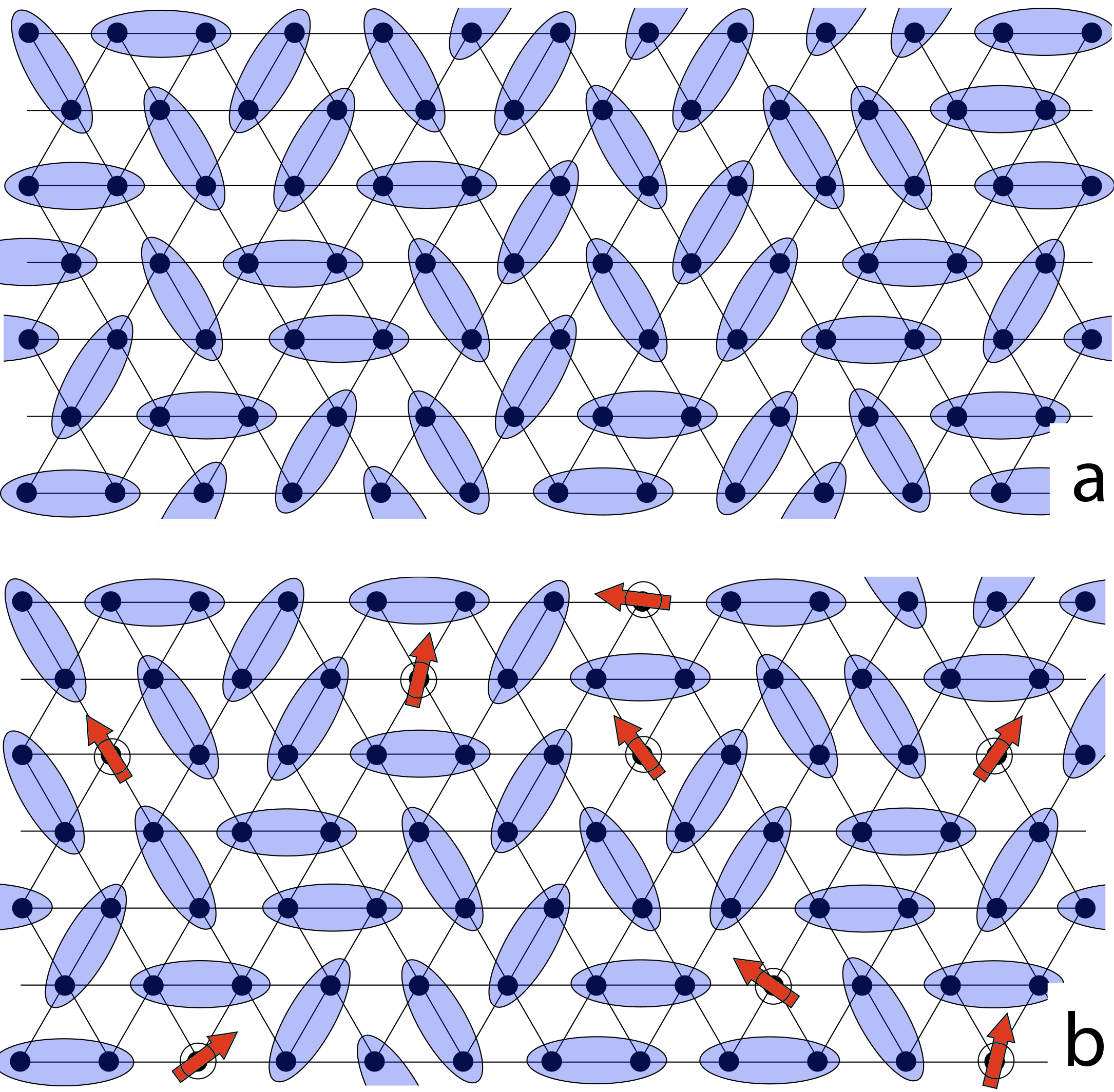
- 解释当价键固体(VBS)序被弱无序破坏时,具有自旋-1/2激发的拓扑缺陷如何出现。
- 将分析扩展至强无序区域,其中假设的价键玻璃态对缺陷增殖不稳定。
- 为每个晶胞含自旋-1/2的无序自旋玻璃提出类似 Lieb-Schultz-Mattis 的约束条件。
- 将该理论应用于解释 YbMgGaO4 中的实验异常现象,如幂律比热和异常的动力学结构因子。
提出的方法
- 利用重整化群(RG)流和缺陷场论分析二维价键固体中的弱键无序。
- 通过将 VBS 映射为具有任意子凝聚的 Z2 自旋液体,描述缺陷形成与拓扑序。
- 应用经典双聚体的随机能量模型,研究强无序下的缺陷统计与自旋玻璃冻结。
- 构建一个最小有效模型,包含短程随机取向的单重态,并调节次近邻关联以匹配中子散射数据。
- 利用纠缠结构与自旋能隙分析,在一维链中推导自旋关联的约束条件。
- 使用自旋-轨道耦合哈密顿量,包含赝偶极项与 Kitaev 类项,对 YbMgGaO4 进行微观分析,以模拟交换各向异性的行为。
![Figure 1: Spin–1/2 defects in a valence bond solid. The Valence Bond Solid (VBS) patterns on the triangular lattice shown here [top] admit two types of defects: point defects (vortices) and line defects (domain walls). Each vortex hosts a protected spin–1/2 in its core. A particular type of domain w](https://ar5iv.labs.arxiv.org/html/1710.06860/assets/Figures/disorderedVBSfig.png)
实验结果
研究问题
- RQ1弱冻结无序如何破坏几何阻挫量子自旋玻璃中的价键固体序?
- RQ2当无序引发拓扑缺陷(涡旋与畴壁)时,其低能激发为何种形式?
- RQ3在强无序下,价键玻璃态是否能保持稳定,还是总会因缺陷增殖而不稳定?
- RQ4涌现的自旋-1/2激发对低能物理与热力学响应有何影响?
- RQ5YbMgGaO4 中观测到的幂律比热与异常热导率,能否通过无序单重态网络来解释?
主要发现
- VBS相中的弱无序不可避免地会形成一个稀疏的拓扑缺陷网络,每个缺陷均束缚一个受保护的自旋-1/2激发。
- 由此产生的系统演化为强随机自旋网络,具有长程随机单重态,并在低温下可能呈现自旋玻璃冻结。
- 该理论预测比热呈分数幂律行为,C(T) ∼ T^0.7,与 YbMgGaO4 中实验数据在 60 mK 以下高度一致。
- 由于随机自旋网络与局域自旋激发的散射,热导率被预测为异常低。
- 动力学结构因子在低能区域表现出宽广、非相干的谱权重,与中子散射数据一致。
- 磁场被预测会诱导自旋激发谱的交叉转变,具体表现为比热与结构因子随磁场变化。
更好的研究,从现在开始
从论文设计到论文写作,大幅缩短您的研究时间。
无需绑定信用卡
本解读由 AI 生成,并经人工编辑审核。