
[论文解读] Variational Bayesian Context-aware Representation for Grocery Recommendation
该论文提出VBCAR,一种变分贝叶斯上下文感知模型,用于杂货推荐。该模型在贝叶斯Skip-gram框架内使用近似变分推断,学习用户和物品的概率嵌入。通过将潜在表征建模为高斯分布并整合购物篮上下文信息,VBCAR在真实世界数据上的推荐性能显著优于最先进方法,相较于Triple2vec在NDCG@10指标上最高提升31%。
Grocery recommendation is an important recommendation use-case, which aims to predict which items a user might choose to buy in the future, based on their shopping history. However, existing methods only represent each user and item by single deterministic points in a low-dimensional continuous space. In addition, most of these methods are trained by maximizing the co-occurrence likelihood with a simple Skip-gram-based formulation, which limits the expressive ability of their embeddings and the resulting recommendation performance. In this paper, we propose the Variational Bayesian Context-Aware Representation (VBCAR) model for grocery recommendation, which is a novel variational Bayesian model that learns the user and item latent vectors by leveraging basket context information from past user-item interactions. We train our VBCAR model based on the Bayesian Skip-gram framework coupled with the amortized variational inference so that it can learn more expressive latent representations that integrate both the non-linearity and Bayesian behaviour. Experiments conducted on a large real-world grocery recommendation dataset show that our proposed VBCAR model can significantly outperform existing state-of-the-art grocery recommendation methods.
研究动机与目标
- 解决现有杂货推荐模型将用户和物品表示为嵌入空间中确定性点的局限性,此类表示限制了模型的表达能力与鲁棒性。
- 通过将非线性表征学习与贝叶斯不确定性建模统一于一个框架中,提升推荐性能。
- 利用用户-物品交互中的购物篮上下文信息,学习更具个性化和上下文感知的用户与物品表征。
- 开发一种基于近似变分推断的高效推理机制,使其可扩展至大规模杂货数据集。
- 在真实世界Instacart数据集上,通过多种评估指标和数据规模验证所提模型的有效性。
提出的方法
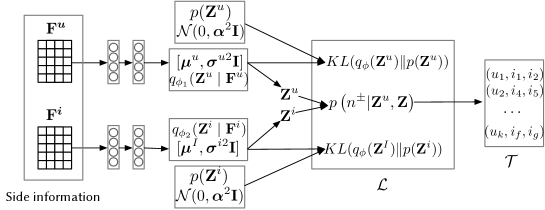
- VBCAR模型采用贝叶斯Skip-gram框架,将用户和物品嵌入联合学习为高斯分布,实现具有不确定性感知的表征。
- 通过神经网络应用近似变分推断,将用户和物品交互直接映射到后验分布,避免了每样本的高成本推断。
- 通过优化变分下界(ELBO)重建购物篮内的物品三元组,同时整合用户偏好与物品共现模式。
- 使用RMSprop进行随机优化更新潜在表征,并应用负采样以提升大规模数据上的训练效率。
- 推荐得分通过用户和物品高斯嵌入的点积计算,推理过程中整合不确定性信息。
- 模型在序列化购物篮数据上端到端训练,保留物品之间的时序与上下文关系。
实验结果
研究问题
- RQ1与确定性点估计相比,变分贝叶斯方法是否能提升杂货推荐中用户和物品嵌入的表达能力与鲁棒性?
- RQ2在上下文感知的Skip-gram框架中引入近似变分推断,是否能提升泛化能力,尤其是在训练数据有限的情况下?
- RQ3在不同数据规模下,VBCAR相较于SOTA模型(如Triple2vec)在NDCG@10和Recall@10指标上的表现如何?
- RQ4当在较小数据子集上训练时,模型是否仍保持优越性能,表明其具备更好的样本效率?
主要发现
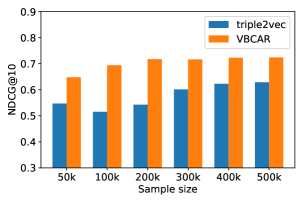
- VBCAR在所有评估数据集规模下均显著优于Triple2vec,在100%数据子集上NDCG@10指标相对提升达31%。
- 在5%数据子集上,VBCAR的Recall@10达到0.748,而Triple2vec为0.708,差异具有统计显著性(p < 0.01)。
- VBCAR与Triple2vec的性能差距在小样本数据中最大(如5%和10%),表明其具有更优的样本效率。
- 随着训练数据规模增加,VBCAR的NDCG@10与Recall@10持续提升,表明其学习过程稳定且可扩展。
- 在不同K值(如K=5, 10, 20)下,模型均保持强劲性能,证实其在Top-K推荐任务中的鲁棒性。
- 使用具有贝叶斯推断的概率嵌入,带来了更具表达力和泛化能力的表征,体现在两项指标上的一致性提升。
更好的研究,从现在开始
从阅读论文到最终审阅,大幅缩短您的研究时间。
无需绑定信用卡
本解读由 AI 生成,并经人工编辑审核。