
[论文解读] Variational Quantum Linear Solver
本文提出了一种混合量子-经典变分算法(VQLS),用于在近端量子设备上求解线性系统,具备可操作的终止条件并提供可扩展性性能的证据。
Previously proposed quantum algorithms for solving linear systems of equations cannot be implemented in the near term due to the required circuit depth. Here, we propose a hybrid quantum-classical algorithm, called Variational Quantum Linear Solver (VQLS), for solving linear systems on near-term quantum computers. VQLS seeks to variationally prepare $|x angle$ such that $A|x angle\propto|b angle$. We derive an operationally meaningful termination condition for VQLS that allows one to guarantee that a desired solution precision $ε$ is achieved. Specifically, we prove that $C \geq ε^2 / κ^2$, where $C$ is the VQLS cost function and $κ$ is the condition number of $A$. We present efficient quantum circuits to estimate $C$, while providing evidence for the classical hardness of its estimation. Using Rigetti's quantum computer, we successfully implement VQLS up to a problem size of $1024 imes1024$. Finally, we numerically solve non-trivial problems of size up to $2^{50} imes2^{50}$. For the specific examples that we consider, we heuristically find that the time complexity of VQLS scales efficiently in $ε$, $κ$, and the system size $N$.
研究动机与目标
- 在 circuit depth 受限的 NISQ 设备上解决线性系统的动机。
- 提出一个变分混合量子-经典框架来近似解 A x = b。
- 定义代价函数,其数值能证明与真解的接近程度并指导终止。
- 提供高效的量子电路来估计代价并展示实际的缩放洞见。
提出的方法
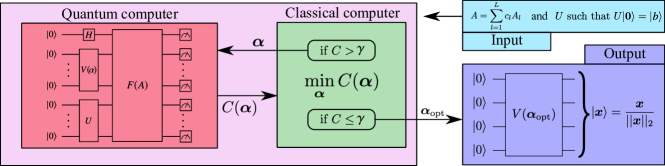
- 将 A 表示为一个单位算子的线性组合 A = sum_l c_l A_l,其中 A_l 可高效实现。
- 使用一个可训练的变分电路 V(alpha) 来制备 x(alpha) = V(alpha)|0>。
- 定义代价函数 C_G 和 C_L(以及它们未归一化的版本),量化 A|x> 距离 |b> 的距离,从而在 C ≤ gamma 时终止。
- 通过 Hadamard 测试和 Hadamard-Overlap 测试电路来估计代价函数值,以避免对成本昂贵子电路的控制。
- 提供固定结构(分层)的硬件高效解法以及诸如 QAOA 风格或可变结构的近似。
- 讨论一种概率误差抵消(PEC)缓解方法,以在噪声下证明终止。
实验结果
研究问题
- RQ1VQLS 能否在近端量子硬件上制备一个与 A|x> = |b> 的解成正比的态 |x>?
- RQ2在 κ 和 C 的条件下,代价函数量化地界定解的误差 ε 吗?
- RQ3代价估计任务是否在经典上很硬,从而为 VQLS 提供量子优势?
- RQ4不同的解猜结构如何影响训练性和对系统规模 n 的缩放?
- RQ5在实际测试中,随 κ、ε 和 N 的时间-解的观测缩放规律如何?
主要发现
- 确立了一个终止条件:C ≥ ε^2 / κ^2 确保所需精度 ε。
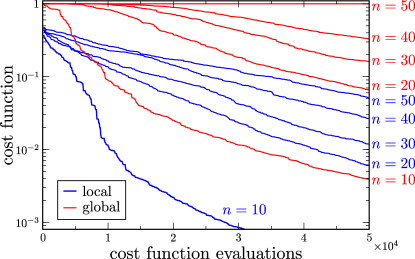
- 局部代价函数(C_L)在大 n 时比全局代价函数(C_G)更易训练,能够扩展到 2^50 维。
- 在 Rigetti 硬件上的实验解决了一个 1024×1024 的问题;仿真显示 κ、ε、和 N 的缩放在测试示例中至多线性于 κ、对 1/ε 的对数线性以及对 N 的多对数线性。
- 代价函数估计在经典层面上被证明是 DQC1 阶难度,强调了 VQLS 的量子优势。
- VQLS 对全局去极化噪声(OPR)的参数鲁棒性在归一化代价下达到最优;PEC 在噪声下可以以多项式开销证明终止。
更好的研究,从现在开始
从论文设计到论文写作,大幅缩短您的研究时间。
无需绑定信用卡
本解读由 AI 生成,并经人工编辑审核。