
[论文解读] VERITE: A Robust Benchmark for Multimodal Misinformation Detection Accounting for Unimodal Bias
本文提出了 VERITE,一个针对多模态虚假信息检测的稳健基准,通过使用真实世界数据、排除非对称多模态虚假信息并强制模态平衡,有效缓解了单模态偏差。同时,本文提出了 CHASMA 方法,用于生成保留跨模态关系的硬性、真实感强的合成训练数据,在基线模型基础上使 VERITE 上的准确率提升了 9.2%。
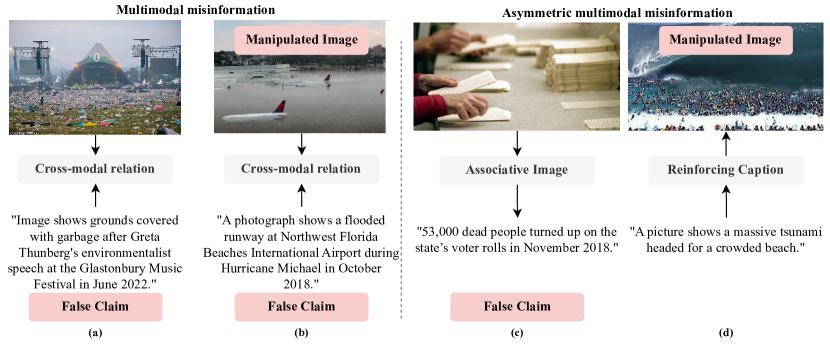
Multimedia content has become ubiquitous on social media platforms, leading to the rise of multimodal misinformation (MM) and the urgent need for effective strategies to detect and prevent its spread. In recent years, the challenge of multimodal misinformation detection (MMD) has garnered significant attention by researchers and has mainly involved the creation of annotated, weakly annotated, or synthetically generated training datasets, along with the development of various deep learning MMD models. However, the problem of unimodal bias has been overlooked, where specific patterns and biases in MMD benchmarks can result in biased or unimodal models outperforming their multimodal counterparts on an inherently multimodal task, making it difficult to assess progress. In this study, we systematically investigate and identify the presence of unimodal bias in widely used MMD benchmarks, namely VMU-Twitter and COSMOS. To address this issue, we introduce the “VERification of Image-TExt pairs” (VERITE) benchmark for MMD which incorporates real-world data, excludes “asymmetric multimodal misinformation” and utilizes “modality balancing”. We conduct an extensive comparative study with a transformer-based architecture that shows the ability of VERITE to effectively address unimodal bias, rendering it a robust evaluation framework for MMD. Furthermore, we introduce a new method—termed Crossmodal HArd Synthetic MisAlignment (CHASMA)—for generating realistic synthetic training data that preserve crossmodal relations between legitimate images and false human-written captions. By leveraging CHASMA in the training process, we observe consistent and notable improvements in predictive performance on VERITE; with a 9.2% increase in accuracy.
研究动机与目标
- 识别并解决现有多模态虚假信息检测(MMD)基准(如 VMU-Twitter 和 COSMOS)中的单模态偏差问题。
- 开发一个可靠、稳健的 MMD 评估框架,防止因数据集偏差导致单模态模型在性能上超过多模态模型。
- 提出一种名为 CHASMA 的新方法,用于生成保留图像与误导性标题之间真实跨模态关系的合成训练数据。
- 证明模态平衡评估与合成数据生成能显著提升多模态模型在真实世界基准上的表现。
提出的方法
- VERITE 使用真实世界图像-标题配对构建,排除了单个模态占主导地位的非对称多模态虚假信息。
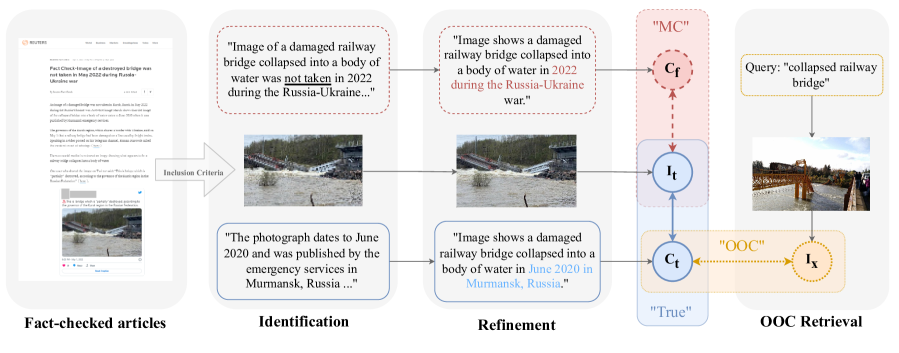
- 模态平衡确保每个图像和标题各出现两次——一次在真实配对中,一次在误导配对中——迫使模型同时考虑两种模态。
- CHASMA 通过利用预训练的跨模态对齐模型,生成具有挑战性且真实感强的图像与虚假人类撰写标题之间的错位数据。
- 该方法使用大规模预训练模型,确保生成的虚假标题在语义上合理,并与对应图像保持跨模态一致性。
- 模型使用真实数据与 CHASMA 生成的合成数据相结合进行训练,并通过消融实验比较不同数据组合下的性能表现。
- 采用基于 Transformer 的架构进行评估,性能在 VERITE 上通过多分类准确率和偏差分析进行衡量。
实验结果
研究问题
- RQ1现有 MMD 基准(如 VMU-Twitter 和 COSMOS)在多大程度上表现出单模态偏差?这种偏差如何影响模型评估?
- RQ2像 VERITE 这样的模态平衡评估基准,能否有效防止单模态模型在性能上超过多模态模型?
- RQ3CHASMA 在生成能提升多模态检测性能且保留真实跨模态关系的合成训练数据方面效果如何?
- RQ4在包含 CHASMA 生成数据的情况下,是否能降低训练模型中的单模态偏差,特别是在真实世界基准(如 VERITE)上?
主要发现
- 使用 CHASMA 生成数据进行训练时,VERITE 的多分类准确率达到 52.1%,相比基线模型 CLIP-NESt + NC-t2t 提升了 9.2%。
- 使用 CHASMA 训练的模型始终优于未使用 CHASMA 的模型,其中 CHASMA + NC-t2t 达到 48.7% 的准确率,高于 CLIP-NESt + NC-t2t 的 47.7%。
- 在 VERITE 上,使用 CHASMA 训练的模型未表现出文本模态侧的单模态偏差,表明 VERITE 在评估过程中成功缓解了此类偏差。
- VERITE 中的模态平衡有效防止模型依赖单一模态,因为每个图像和标题均以真实和误导两种情境出现。
- CHASMA 的性能增益在不同模型变体中保持一致,包括 $D(I,C)$ 和 $D^{-}(I;C)$,证实了其稳健性。
- VERITE 被证明是一个可靠的基准,因为它防止了单模态模型在性能上超过多模态模型,而这一点在 COSMOS 和 VMU-Twitter 等先前基准中并未实现。
更好的研究,从现在开始
从阅读论文到最终审阅,大幅缩短您的研究时间。
无需绑定信用卡
本解读由 AI 生成,并经人工编辑审核。