
[论文解读] Vibrational Entropy and Free Energy of Solid Lithium using Covariance of Atomic Displacements Enabled by Machine Learning
本论文提出一种基于机器学习势(MLIP)的振动熵与吉布斯自由能计算方法,采用原子位移协方差(CAD)技术,实现了对固态锂中振动熵和自由能的高精度计算。该方法在重现实验测得的声子色散关系、振动熵及马氏体相变方面表现出高精度,为有限温度下固体的性质计算提供了一种可扩展且高效的替代传统从头算方法的途径。
Vibrational properties of solids are key to determining stability, response and functionality. However, they are challenging to computationally predict at Ab-Initio accuracy, even for elemental systems. Ab-Initio methods for modeling atomic interactions are limited in the system sizes and simulation times that can be achieved. Due to these limitations, Machine Learning Interatomic Potentials (MLIPs) are gaining popularity and success as a faster, more scalable approach for modeling atomic interactions, potentially at Ab-Initio accuracy. Even with faster potentials, methodologies for predicting entropy, free energy and vibrational properties vary in accuracy, cost and difficulty to implement. Using the Covariance of Atomic Displacements (CAD) to predict entropy, free energy and finite-temperature phonon dispersions is a promising approach but thorough benchmarking has been hampered by the cost of Ab-Initio methods for sampling. In this work, we use a MLIP and the CAD to characterize the convergence of the predicted properties and determine optimal sampling strategies. We focus on solid lithium at zero pressure, showing that the MLIP-CAD approach reproduces experimental entropy, phonon dispersions and the martensitic transition while also comparing to more established methods.
研究动机与目标
- 开发一种可扩展且精确的计算方法,用于基于机器学习势在固体中计算振动自由能与熵。
- 在具有挑战性的元素系统——锂——中,对有限温度性质的原子位移协方差(CAD)方法进行基准测试,该系统具备可用的实验数据。
- 针对高精度MLIP,识别基于CAD的熵与自由能计算的最优采样策略。
- 将MLIP-CAD方法与实验数据、密度泛函理论(DFT)以及如准简谐近似和热力学积分等成熟方法进行验证。
- 展示MLIP-CAD在预测相稳定性和结构转变(如锂的马氏体相变)方面的可行性与准确性。
提出的方法
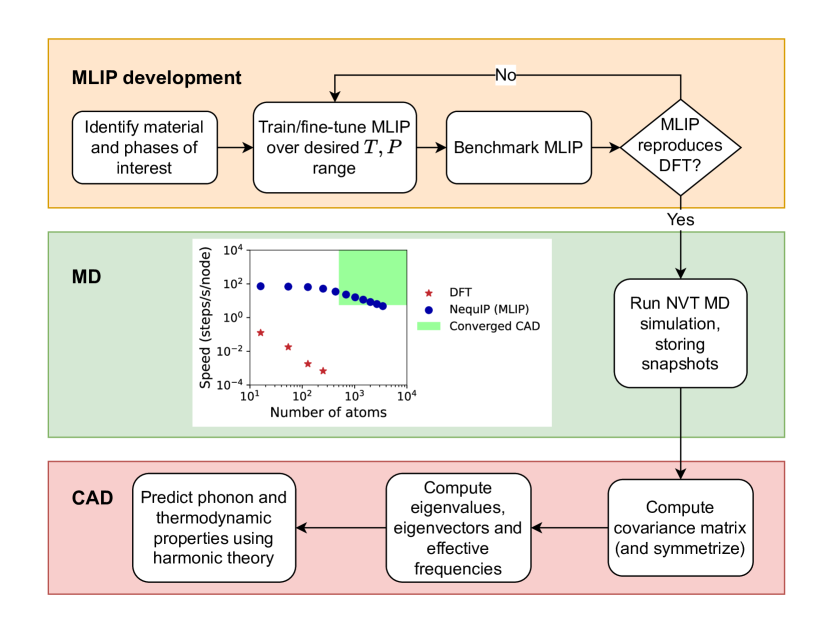
- 本研究采用基于NequIP的机器学习势(MLIP),利用从头算数据训练,以高精度和高效率模拟固态锂中的原子相互作用。
- 采用原子位移协方差(CAD)方法,通过NPT和NVT系综的分子动力学模拟中原子位移的相关性,计算振动熵与自由能。
- 模拟采用20,000个时间步,时间步长为2 fs,在LAMMPS中进行,NVT和NPT系综分别使用Nosé-Hoover热浴与压强浴。
- 该方法通过原子位移的构型积分计算亥姆霍兹自由能,振动贡献由原子位移的协方差矩阵导出。
- 吉布斯自由能计算公式为 $ G = U(V) + F_{vib}(V,T) + F_{el}(T) $,其中 $ F_{vib} $ 由CAD方法获得,最小 $ G $ 对应最稳定相。
- 该方法已通过与实验数据、DFT以及准简谐近似和热力学积分等成熟方法的对比得到验证。
实验结果
研究问题
- RQ1基于训练好的MLIP,CAD方法能否准确再现固态锂在有限温度下的振动熵与自由能?
- RQ2MLIP-CAD方法在预测声子色散关系与相稳定性方面,与准简谐近似和热力学积分等成熟方法相比表现如何?
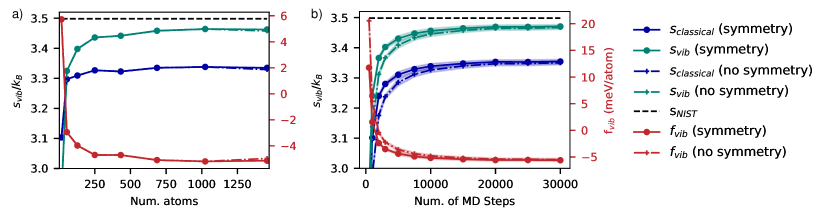
- RQ3为实现锂中基于CAD的自由能与熵的收敛,最优采样策略(如模拟长度、系综类型)是什么?
- RQ4MLIP-CAD方法是否能正确预测锂中如实验所观测到的马氏体相变?
- RQ5与从头算方法相比,CAD方法在计算元素固体有限温度性质时,其精度与效率保持程度如何?
主要发现
- MLIP-CAD方法能高精度再现固态锂的实验振动熵,验证了其预测能力。
- 该方法准确预测了锂的声子色散关系,与实验测量结果高度一致。
- MLIP-CAD方法成功捕捉了锂中的马氏体相变,这是有限温度下关键的结构转变。
- 在NPT模拟中,CAD方法在20,000个时间步后实现自由能与熵的收敛,表明MLIP具有高效的采样性能。
- MLIP-CAD结果与热力学积分和准简谐近似方法结果高度一致,证实了其可靠性。
- 本研究证明,结合CAD的MLIP为计算固体有限温度性质提供了一种可扩展、高精度且高效的替代从头算方法的途径。
更好的研究,从现在开始
从阅读论文到最终审阅,大幅缩短您的研究时间。
无需绑定信用卡
本解读由 AI 生成,并经人工编辑审核。