
[论文解读] Viewpoint-aware Progressive Clustering for Unsupervised Vehicle Re-identification
本文提出了一种新型无监督车辆重识别方法——视角感知渐进聚类(VAPC),该方法通过预测的视角对特征空间进行划分,并应用渐进聚类以减少类内差异。该方法在VeRi和VeRi-Wild基准上取得了最先进性能,在无监督设置下,VeRi-776上的Rank-1准确率达到76.2%,即使视角预测不完美也表现良好。
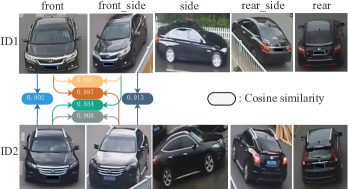
Vehicle re-identification (Re-ID) is an active task due to its importance in large-scale intelligent monitoring in smart cities. Despite the rapid progress in recent years, most existing methods handle vehicle Re-ID task in a supervised manner, which is both time and labor-consuming and limits their application to real-life scenarios. Recently, unsupervised person Re-ID methods achieve impressive performance by exploring domain adaption or clustering-based techniques. However, one cannot directly generalize these methods to vehicle Re-ID since vehicle images present huge appearance variations in different viewpoints. To handle this problem, we propose a novel viewpoint-aware clustering algorithm for unsupervised vehicle Re-ID. In particular, we first divide the entire feature space into different subspaces according to the predicted viewpoints and then perform a progressive clustering to mine the accurate relationship among samples. Comprehensive experiments against the state-of-the-art methods on two multi-viewpoint benchmark datasets VeRi and VeRi-Wild validate the promising performance of the proposed method in both with and without domain adaption scenarios while handling unsupervised vehicle Re-ID.
研究动机与目标
- 解决由于极端视角变化导致的车辆Re-ID中类内差异大和类间相似性高的挑战。
- 克服直接将行人Re-ID聚类方法应用于车辆时面临的‘相似性困境’,即在相似视角下不同车辆看起来比同一辆车在不同视角下更相似。
- 开发一种仅使用目标域数据的无监督学习框架,无需依赖带有昂贵标注的源域数据,避免对领域自适应的依赖。
- 通过引入视角感知的特征划分和跨视角的渐进聚类合并,提升无监督车辆Re-ID中的聚类准确率。
提出的方法
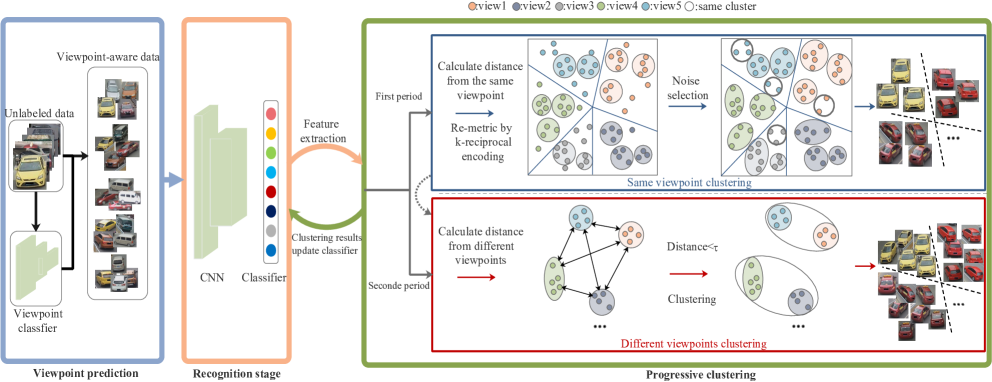
- 提出一种视角感知网络,利用预训练的视角标注预测车辆图像的视角,作为先验信息以划分特征空间。
- 基于预测的视角将特征空间划分为子空间,实现在每个视角组内进行聚类,从而减少跨视角差异并简化聚类任务。
- 实施一种渐进聚类策略,基于相似性在不同视角间迭代合并聚类,从同视角聚类开始,逐步合并具有高跨视角相似性的聚类。
- 引入一种基于阈值参数$\tilde{k}$的噪声样本选择机制,用于在聚类过程中识别并隔离噪声样本,提升对误分类的鲁棒性。
- 使用由$t_i$-th近邻对导出的距离阈值$\tau$来控制跨视角聚类的合并,平衡聚类的凝聚性与准确性。
- 通过使用伪标签聚类对Re-ID模型进行迭代微调,逐步优化特征并提升聚类质量。
实验结果
研究问题
- RQ1视角感知聚类是否能通过减少视角变化引起的类内差异,显著提升无监督车辆Re-ID的性能?
- RQ2与单阶段聚类相比,跨视角聚类的渐进合并策略如何提升聚类准确率?
- RQ3在视角预测不准确的情况下,所提方法的性能下降程度如何?其是否仍能在低精度视角分类器下保持鲁棒性?
- RQ4所提噪声选择策略在真实场景中对聚类质量的噪声样本影响有多大缓解作用?
主要发现
- 所提出的VAPC方法在无监督设置下的VeRi-776基准上实现了76.2%的Rank-1准确率,优于现有最先进无监督方法。
- 即使视角分类器准确率低至0.5,该方法仍保持70%的Rank-1准确率,表明其对噪声或不准确的视角预测具有强鲁棒性。
- 渐进聚类策略显著提升了聚类质量,以调整兰维信息(AMI)衡量,性能随迭代聚类步骤稳步提升。
- 参数分析表明,$t_i = 1200$和$\tilde{k} = 2$能取得最优性能,平衡聚类合并准确率与噪声控制,尤其在VeRi-Wild等类间差异较小的数据集上表现更优。
- 该方法在VeRi-776和VeRi-Wild上均表现出色,验证了其在无需源域标注的情况下,对多样化真实多视角场景的有效性。
- 噪声选择策略有效降低了噪声样本的负面影响,防止性能崩溃,并在迭代聚类过程中提升稳定性。
更好的研究,从现在开始
从阅读论文到最终审阅,大幅缩短您的研究时间。
无需绑定信用卡
本解读由 AI 生成,并经人工编辑审核。