
[论文解读] Visual Anomaly Detection Via Partition Memory Bank Module and Error Estimation
本文提出了一种新颖的无监督视觉异常检测方法,采用分区记忆库(PMB)模块和直方图误差估计模块。PMB通过一种独特的基于分区的查询生成方法,学习并存储语义完整的正常特征;而误差估计模块则自适应地消除累积重建误差,显著提升了标准基准上的异常检测与定位性能。
Reconstruction method based on the memory module for visual anomaly detection attempts to narrow the reconstruction error for normal samples while enlarging it for anomalous samples. Unfortunately, the existing memory module is not fully applicable to the anomaly detection task, and the reconstruction error of the anomaly samples remains small. Towards this end, this work proposes a new unsupervised visual anomaly detection method to jointly learn effective normal features and eliminate unfavorable reconstruction errors. Specifically, a novel Partition Memory Bank (PMB) module is proposed to effectively learn and store detailed features with semantic integrity of normal samples. It develops a new partition mechanism and a unique query generation method to preserve the context information and then improves the learning ability of the memory module. The proposed PMB and the skip connection are alternatively explored to make the reconstruction of abnormal samples worse. To obtain more precise anomaly localization results and solve the problem of cumulative reconstruction error, a novel Histogram Error Estimation module is proposed to adaptively eliminate the unfavorable errors by the histogram of the difference image. It improves the anomaly localization performance without increasing the cost. To evaluate the effectiveness of the proposed method for anomaly detection and localization, extensive experiments are conducted on three widely-used anomaly detection datasets. The encouraging performance of the proposed method compared to the recent approaches based on the memory module demonstrates its superiority.
研究动机与目标
- 解决现有记忆模块在视觉异常检测中的局限性,即由于逻辑查询重组导致语义完整性被破坏,异常样本仍能获得低重建误差。
- 通过PMB模块中新颖的分区机制与查询生成策略,保留空间与通道上下文,提升正常特征的学习能力。
- 减少基于自编码器模型中的累积重建误差,该误差会阻碍对细微或小区域异常的精确定位。
- 通过引入基于直方图的误差估计机制,在不增加推理成本的前提下,提升异常检测与定位性能。
- 优化PMB模块与跳跃连接的集成,以在高层语义一致性与细节特征重建之间取得平衡。
提出的方法
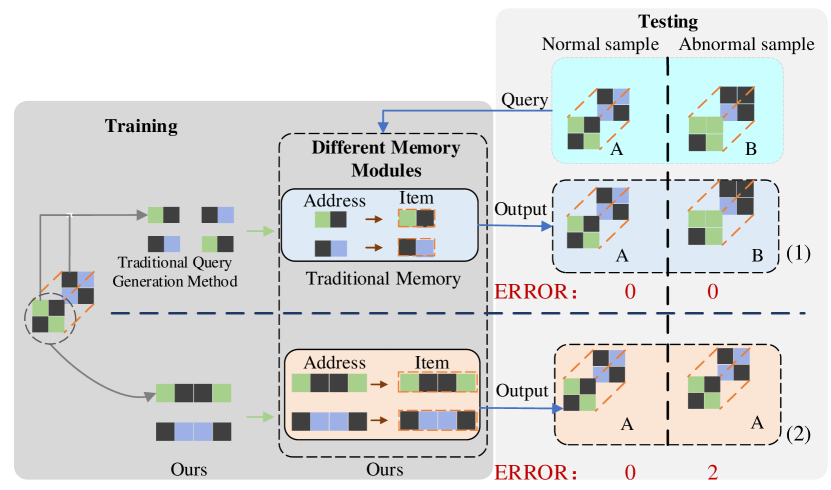
- 引入分区记忆库(PMB)模块,将特征图划分为空间分区,并生成保留原始特征图语义与上下文信息的查询。
- 设计一种独特的查询生成方法,避免跨通道的逻辑重组,确保记忆模块学习的是实际的正常特征,而非抽象化的逻辑模式。
- 在重建过程中交替使用PMB模块与跳跃连接,通过依赖存储的正常特征,迫使异常特征重建效果变差。
- 提出一种直方图误差估计模块,分析正常区域中重建误差差异的分布,实现对不利误差的自适应消除。
- 利用输入与重建特征之间差异图像的直方图,动态调整误差权重,提升定位精度,且不引入额外参数。
- 优化超参数,如分区数(k)、PMB层的数量(L)以及迭代次数(p),以平衡检测与定位性能。
![Figure 1: Illustration of the query generation methods for different memory modules. Figures (1) [ 10 ] and (2) [ 11 ] represent the logical query generated from the same position in the feature map, with different channels. Figure (3) represents the proposed query. It preserves the critical feature](https://ar5iv.labs.arxiv.org/html/2209.12441/assets/x1.png)
实验结果
研究问题
- RQ1通过空间分区保留正常特征语义完整性的记忆模块,是否能提升正常样本的重建保真度,并增加异常样本的误差?
- RQ2所提出的PMB模块在特征表示质量与异常检测能力方面,相较于传统记忆模块表现如何?
- RQ3直方图误差估计模块在基于自编码器的异常检测中,能在多大程度上减少累积重建误差并提升定位精度?
- RQ4PMB模块的最优配置(如分区数k、层数L、迭代次数p)为何种组合,才能在检测与定位性能之间实现最佳平衡?
- RQ5PMB与跳跃连接的联合使用,是否能以一种在多种数据集上均鲁棒的方式,同时提升重建质量与异常判别能力?
主要发现
- 所提方法在三个基准数据集(MVTec AD、MNIST 和 Retinal-OCT)上达到最先进性能,MNIST 上 AUC 达 98.1%,Retinal-OCT 上达 98.0%。
- 在 MVTec AD 数据集上,该方法在 k=(4,4,4) 条件下达到 97.6% AUC,展现出卓越的检测性能,尤其在纹理与细粒度异常上表现突出。
- 与无跳跃连接的基线相比,结合跳跃连接使用PMB使检测性能提升6%,尤其在纹理丰富的图像中受益显著。
- k 值较小(如 k=(2,2,2))时,定位结果更优,因误差放大更强;而更大的 k 值则通过支持更细致的特征学习,提升检测性能。
- 直方图误差估计模块有效减少了累积重建误差,使即使在存在细微异常的正常区域中,也能实现高精度定位。
- 该方法通过联合优化特征学习与误差校正,优于近期基于记忆的方法,在多种数据分布与异常类型下均表现有效。
更好的研究,从现在开始
从阅读论文到最终审阅,大幅缩短您的研究时间。
无需绑定信用卡
本解读由 AI 生成,并经人工编辑审核。