
[论文解读] ViTs for SITS: Vision Transformers for Satellite Image Time Series
该论文提出TSViT,一种基于视觉Transformer的卫星影像时序序列(SITS)处理架构,采用时空解耦的标记化方法与获取时间特定的位置编码,以建模长期时间动态。该方法在三个SITS基准数据集上实现了最先进性能,在语义分割与分类任务中均显著超越先前方法。
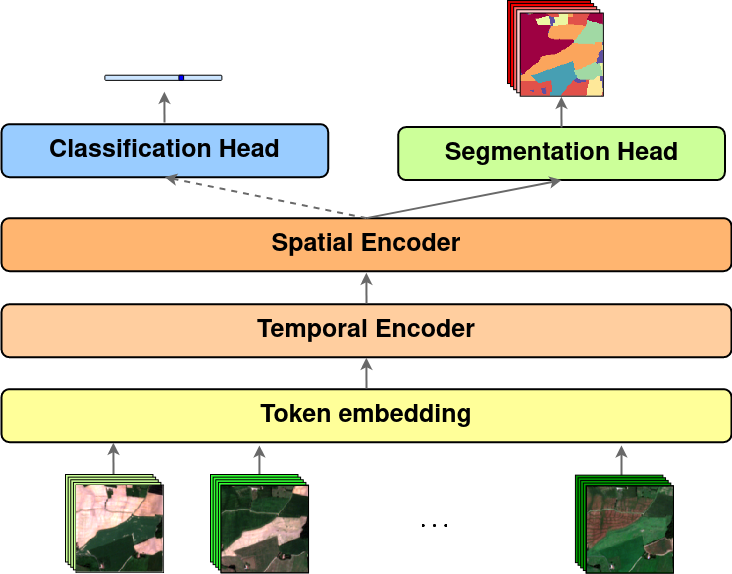
In this paper we introduce the Temporo-Spatial Vision Transformer (TSViT), a fully-attentional model for general Satellite Image Time Series (SITS) processing based on the Vision Transformer (ViT). TSViT splits a SITS record into non-overlapping patches in space and time which are tokenized and subsequently processed by a factorized temporo-spatial encoder. We argue, that in contrast to natural images, a temporal-then-spatial factorization is more intuitive for SITS processing and present experimental evidence for this claim. Additionally, we enhance the model's discriminative power by introducing two novel mechanisms for acquisition-time-specific temporal positional encodings and multiple learnable class tokens. The effect of all novel design choices is evaluated through an extensive ablation study. Our proposed architecture achieves state-of-the-art performance, surpassing previous approaches by a significant margin in three publicly available SITS semantic segmentation and classification datasets. All model, training and evaluation codes are made publicly available to facilitate further research.
研究动机与目标
- 开发一种完全基于注意力机制的深度学习模型,用于通用卫星影像时序序列(SITS)处理,且无需卷积操作。
- 解决在高计算效率与强归纳偏差下建模SITS中长时间序列的挑战。
- 通过可学习的类别标记与获取时间特定的位置编码,提升模型判别能力。
- 验证在SITS建模中,时空解耦顺序相较于时空联合解耦顺序的优越性。
- 在多个基准数据集上实现SITS语义分割与分类任务的最先进性能。
提出的方法
- TSViT将SITS数据划分为非重叠的时空块,将时间与空间视为独立维度。
- 采用解耦的时空编码器,按顺序处理时间与空间维度,注意力机制捕捉全局依赖关系。
- 引入获取时间特定的可学习位置编码,以编码不规则的卫星获取时间,提升时间特征学习能力。
- 使用多个可学习的类别标记,增强类别特定特征聚合,提升分类任务的判别能力。
- 通过自定义解码器头,支持全局(分类)与密集(语义分割)预测头。
- 消融研究评估了设计选择,包括解耦顺序、块大小与标记交互模式。
实验结果
研究问题
- RQ1在SITS建模中,时空解耦顺序是否优于时空联合解耦顺序?
- RQ2获取时间特定的位置编码在不规则采样SITS数据上如何提升性能?
- RQ3多个可学习类别标记对SITS任务中模型判别能力的影响如何?
- RQ4块大小如何影响TSViT的特征粒度与分割精度?
- RQ5Transformer的全局感受野在SITS分类与分割中相较于卷积或RNN模型的提升程度如何?
主要发现
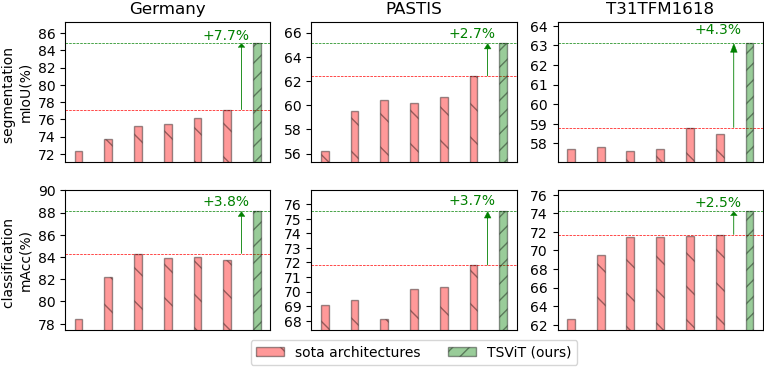
- TSViT在三个公开SITS基准数据集上实现最先进性能,使用时空解耦顺序在德国数据集上达到78.5%的mIoU,较时空联合解耦顺序提升29.7%。
- 使用多个类别标记使mIoU提升5.1个百分点(从78.5%增至83.6%),证明其在特征聚合中的有效性。
- 与固定位置编码相比,获取时间特定的位置编码导致性能下降2.8%,证实其在处理不规则获取时间中的重要性。
- 相较于3×3块,2×2小块使mIoU提升1.2%(达84.8%),表明其在保留空间粒度方面更具优势。
- TSViT在语义分割与目标分类任务中均优于所有先前方法,其中分割任务的性能差距最大。
- 尽管具有二次方复杂度,TSViT仍保持了具有竞争力的推理时间与参数量,适用于大规模SITS应用。
更好的研究,从现在开始
从阅读论文到最终审阅,大幅缩短您的研究时间。
无需绑定信用卡
本解读由 AI 生成,并经人工编辑审核。