
[论文解读] Wave function network description and Kolmogorov complexity of quantum many-body systems
论文引入波函数网络来描述量子多体快照,利用它们来估计Kolmogorov复杂性,并在Rydberg量子模拟器中展示尺度无关的网络和跨平台认证。
Programmable quantum devices are now able to probe wave functions at unprecedented levels. This is based on the ability to project the many-body state of atom and qubit arrays onto a measurement basis which produces snapshots of the system wave function. Extracting and processing information from such observations remains, however, an open quest. One often resorts to analyzing low-order correlation functions - i.e., discarding most of the available information content. Here, we introduce wave function networks - a mathematical framework to describe wave function snapshots based on network theory. For many-body systems, these networks can become scale free - a mathematical structure that has found tremendous success in a broad set of fields, ranging from biology to epidemics to internet science. We demonstrate the potential of applying these techniques to quantum science by introducing protocols to extract the Kolmogorov complexity corresponding to the output of a quantum simulator, and implementing tools for fully scalable cross-platform certification based on similarity tests between networks. We demonstrate the emergence of scale-free networks analyzing data from Rydberg quantum simulators manipulating up to 100 atoms. We illustrate how, upon crossing a phase transition, the system complexity decreases while correlation length increases - a direct signature of build up of universal behavior in data space. Comparing experiments with numerical simulations, we achieve cross-certification at the wave-function level up to timescales of 4 $μ$ s with a confidence level of 90%, and determine experimental calibration intervals with unprecedented accuracy. Our framework is generically applicable to the output of quantum computers and simulators with in situ access to the system wave function, and requires probing accuracy and repetition rates accessible to most currently available platforms.
研究动机与目标
- 推动对多体波函数快照的结构化、信息丰富的描述,超越低阶相关性。
- 为自旋、玻色子和费米子系统开发一种网络表示(波函数网络),以保留全部信息内容。
- 展示所得网络可以是尺度无关的,并利用这一结构提取Kolmogorov复杂性。
- 演示使用基于网络的相似性测试对量子模拟器进行跨平台认证。
提出的方法
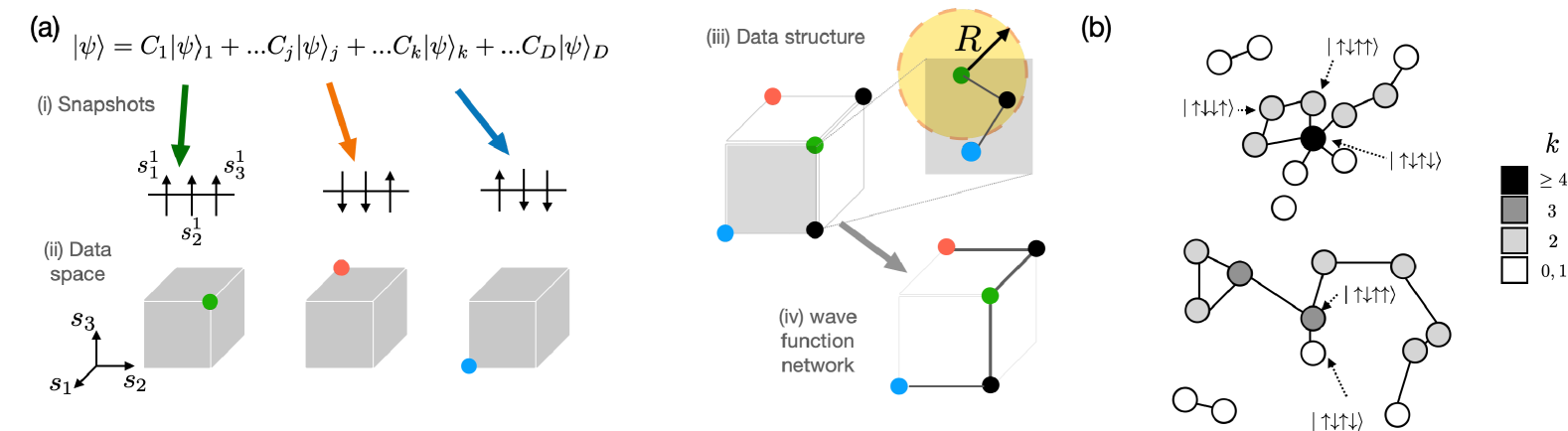
- 将波函数快照的集合映射到一个网络,其中每个快照是一个节点,当配置之间的汉明距离小于截断值 R 时绘制连边。
- 将截断值 R 定义为最近邻距离的平均值,以稳定网络稀疏性。
- 使用汉明距离来捕捉配置中的短程和长程相关性。
- 通过2-NN(两最近邻)内在维度方法估计波函数快照的Kolmogorov复杂性。
- 应用Epps-Singleton检验比较跨平台的网络并识别跨验证成立的时间尺度。
实验结果
研究问题
- RQ1波函数快照能否被忠实地表示为揭示潜在相关性和临界行为的网络?
- RQ2在量子相变附近,波函数网络是否表现出尺度无关特性?这些特性如何与实空间相关性相关?
- RQ3基于网络的Kolmogorov复杂性能否量化信息内容及其在量子模拟器中的演化?
- RQ4基于网络的跨平台认证在识别实验数据与数值数据之间的系统性差异方面有多有效?
主要发现
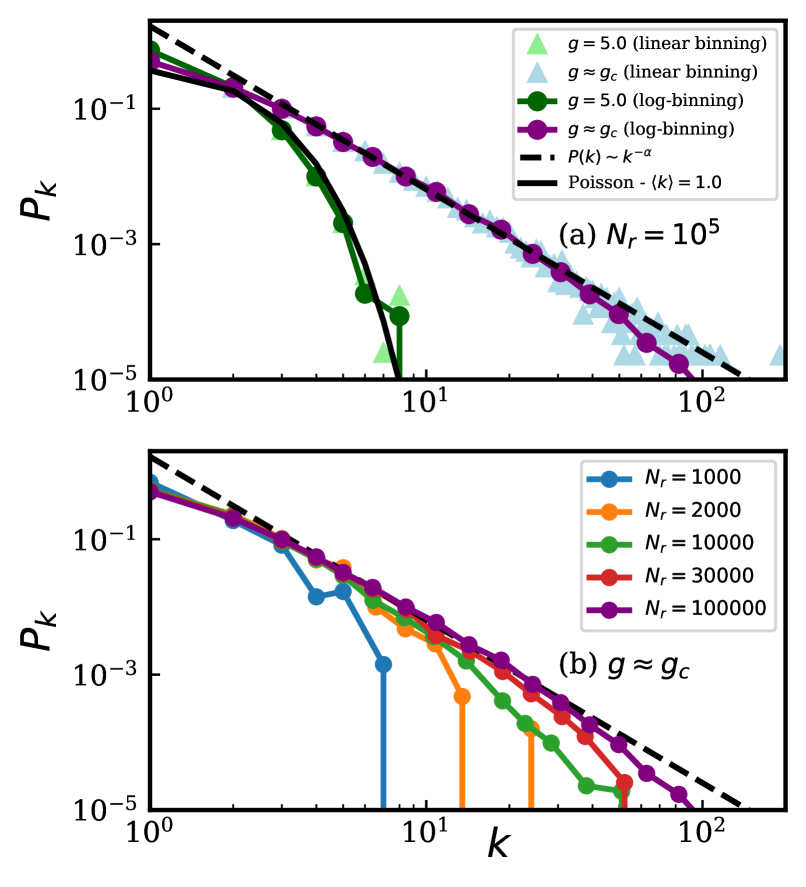
- 在相关性显著的区域,波函数网络可以变为尺度无关的,而顺磁态(ER样)区域则类似于Erdős–Rényi网络。
- 在二维量子伊辛模型中,度分布Pk在顺磁相为泊松分布,在临界点附近遵循幂律分布,指数约为 α ≈ 2.4。
- 使用Rydberg量子模拟器的实验表明Pk在短时间呈指数衰减,较晚时出现稳健的幂律尾部(α < 2)。
- 在阵列中引入约3%的缺陷并未破坏尺度无关结构,表明网络特征的鲁棒性。
- 利用基于网络的测试进行跨平台验证,可以对波函数层面的行为在大约4 μs内提供约90%的置信度的认证。
- 通过2-NN内在维度方法估计波函数快照的Kolmogorov复杂性,揭示当普适行为逐步形成时涌现出的简洁性。
更好的研究,从现在开始
从论文设计到论文写作,大幅缩短您的研究时间。
无需绑定信用卡
本解读由 AI 生成,并经人工编辑审核。