
[论文解读] Wave Mechanics, Interference, and Decoherence in Strong Gravitational Lensing
本文从曲时空标量波方程推导出用于引力透镜的波光学框架,探索本征光近似(eikonal)和衍射(diffractive)两种情形,并讨论在瞬变事件成像中观察干涉效应的前景。
Wave-mechanical effects in gravitational lensing have long been predicted, and with the discovery of populations of compact transients such as gravitational wave events and fast radio bursts, may soon be observed. We present an observer's review of the relevant theory underlying wave-mechanical effects in gravitational lensing. Starting from the curved-spacetime scalar wave equation, we derive the Fresnel-Kirchoff diffraction integral, and analyze it in the eikonal and wave optics regimes. We answer the question of what makes interference effects observable in some systems but not in others, and how interference effects allow for complementary information to be extracted from lensing systems as compared to traditional measurements. We end by discussing how diffraction effects affect optical depth forecasts and lensing near caustics, and how compact, low-frequency transients like gravitational waves and fast radio bursts provide promising paths to open up the frontier of interferometric gravitational lensing.
研究动机与目标
- 在即将到来的瞬变观测(如引力波 GWs、快速射电暴 FRBs 等)中,推动对引力透镜中波动力学效应的研究。
- 从曲时空标量波方程推导出 Fresnel-Kirchoff 衍射积分,并将其与透镜观测量联系起来。
- 表征本征光近似与波光学两种情形,并解释何时能观测到干涉效应以及这些效应为何有信息量。
- 讨论对光学深度预测、焦线(caustics)的影响,以及低频瞬变如何使干涉透镜成像成为可能。
提出的方法
- 从曲时空标量波方程出发,推导出 Fresnel-Kirchoff 衍射积分。
- 转换到平坦天空和 Fresnel 框架,得到横向波形的类薛定谔方程。
- 对 Fresnel 积分应用定常相位(本征光)和衍射(波光学)分析,得到一个对 Fresnel 积分的定常相位(eikonal)和衍射(波光学)分析的结果,即以 Morse 相相位的像点形式的和。
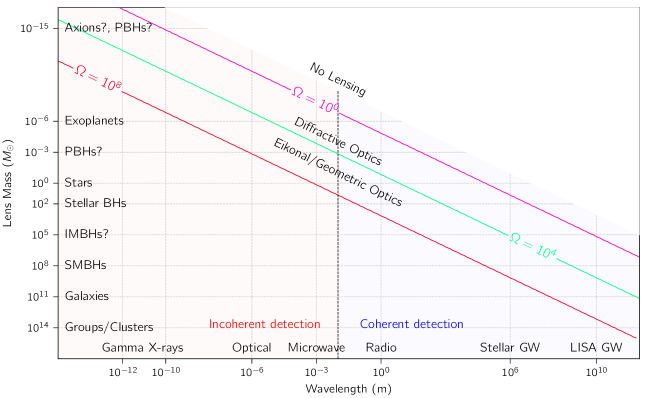
- 引入无量纲的频率 Omega 和延迟 tau,以研究衍射、本征光和几何光学之间的状态转变。
- 给出在定点附近的解析近似,并讨论放大矩阵 A 在确定相干裂区中的作用。
- 讨论色散性、有限源效应,以及衍射如何改变透镜概率和焦迹行为。
实验结果
研究问题
- RQ1在何种条件下,波干涉效应在引力透镜中变得可观测?
- RQ2本征光近似和衍射两种情形如何改变传统的透镜观测量,如放大率和时间延迟?
- RQ3波光学对透镜概率和光学深度计算有何影响,尤其在焦迹附近?
- RQ4波光学透镜中的色散性和相位信息如何提升从透镜系统中提取信息的能力?
- RQ5使用紧凑瞬变如 GWs 与 FRBs 来探测波力学透镜效应的观测前景有哪些?
主要发现
- 从第一性原理推导出 Fresnel-Kirchhoff 衍射积分,并根据频率和透镜性质,收敛到本征光(定常相位)或波光学(衍射)两种情形之一。
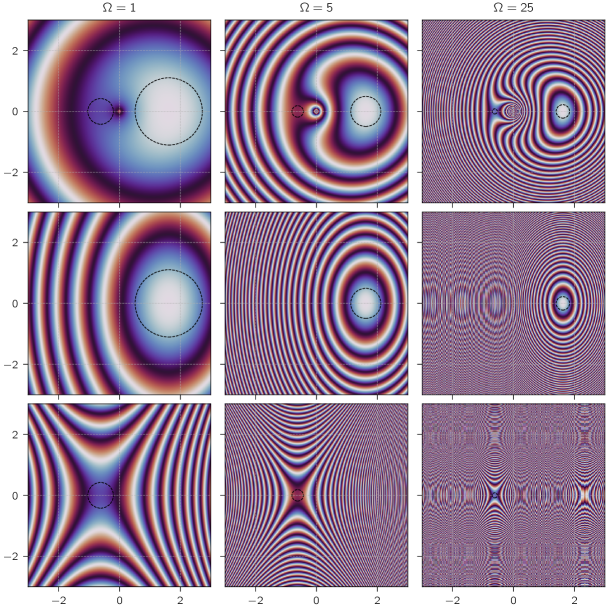
- 干涉表现为由无量纲频率 Omega 和放大矩阵 A 控制的振荡条纹,相干尺度由定点周围的相干斑决定。
- 在高频极限下,几何光学被恢复为离散像对无相干叠加,而在较低频率时衍射会使像模糊并引入色散特征。
- 该形式主义解释了波光学中色散透镜效应的产生,使得存在于传统透镜成像所没有的频率相关观测量。
- 强调有限源和焦迹区域在检测和解释衍射透镜信号方面的重要性。
- 通过如电压数据等方式进行波前相干检测可以显著提高时间延迟测量的精度,从而在低频段约束透镜性质。
更好的研究,从现在开始
从论文设计到论文写作,大幅缩短您的研究时间。
无需绑定信用卡
本解读由 AI 生成,并经人工编辑审核。