
[论文解读] Wavefield Networked Sensing: Principles, Algorithms and Applications
本文提出了一种基于物理的框架,利用衍射层析成像理论(DTT)优化网络化无线电感知的成像分辨率并抑制栅瓣。通过基于波数镶嵌原理协调多个终端,即使在带宽受限的情况下也能实现高质量成像,利用任意拓扑结构下多基地低分辨率数据的相干组合。
Networked sensing refers to the capability of properly orchestrating multiple sensing terminals to enhance specific figures of merit, e.g., positioning accuracy or imaging resolution. Regarding radio-based sensing, it is essential to understand extit{when} and extit{how} sensing terminals should be orchestrated, namely the best cooperation that trades between performance and cost (e.g., energy consumption, communication overhead, and complexity). This paper addresses networked sensing from a physics-driven perspective, aiming to provide a general theoretical benchmark to evaluate its extit{imaging} performance bounds and to guide the sensing orchestration accordingly. Diffraction tomography theory (DTT) is the method to quantify the imaging resolution of any radio sensing experiment from inspection of its spectral (or wavenumber) content. In networked sensing, the image formation is based on the back-projection integral, valid for any network topology and physical configuration of the terminals. The extit{wavefield networked sensing} is a framework in which multiple sensing terminals are orchestrated during the acquisition process to maximize the imaging quality (resolution and grating lobes suppression) by pursuing the deceptively simple extit{wavenumber tessellation principle}. We discuss all the cooperation possibilities between sensing terminals and possible killer applications. Remarkably, we show that the proposed method allows obtaining high-quality images of the environment in limited bandwidth conditions, leveraging the coherent combination of multiple multi-static low-resolution images.
研究动机与目标
- 建立用于评估网络化感知成像性能的基于物理的理论基准。
- 通过平衡性能与成本(能量、复杂度、通信开销)来指导感知终端的协同调度。
- 通过相干组合多基地低分辨率数据,在带宽受限条件下实现高分辨率成像。
- 基于谱覆盖和波数镶嵌原理,识别最优协作策略——相干与非相干、单基地与双基地。
- 提供一种适用于任意网络拓扑、终端能力及感知配置的通用框架。
提出的方法
- 本文采用衍射层析成像理论(DTT)根据感知采集的谱(波数)内容量化成像分辨率。
- 推导出适用于任意网络拓扑和终端物理配置的通用反投影积分以实现图像重建。
- 提出波数镶嵌原理作为核心协同策略,以最大化谱覆盖和成像质量。
- 通过分辨率、PSLR和ISLR等指标评估性能,这些指标源自网络化系统的空间谱。
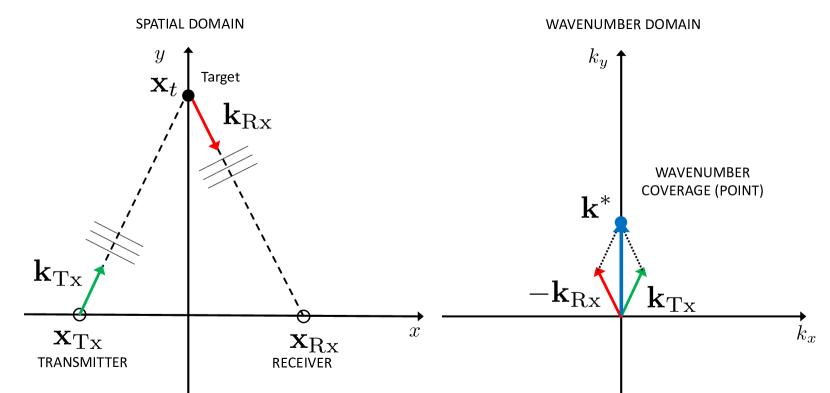
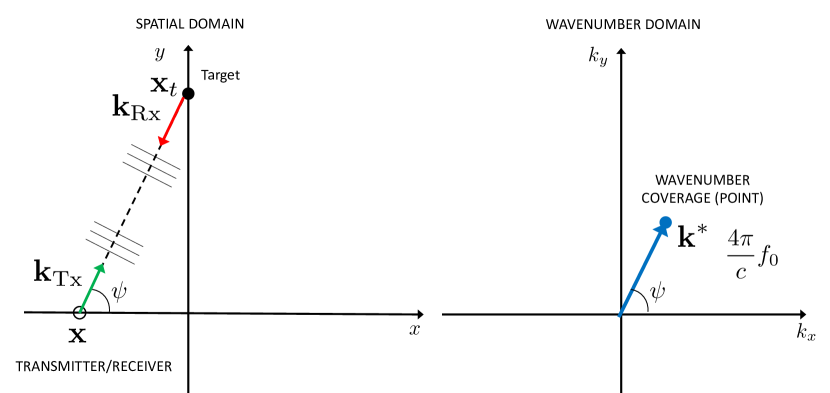
- 分析单基地和双基地配置,表明较差的谱覆盖(如发射机与接收机方向相反)会导致分辨率下降和栅瓣产生。
- 该框架仅需网络和目标的几何信息即可预测成像性能,无需特定信号或噪声模型。
实验结果
研究问题
- RQ1如何协调网络化感知终端以在最小化成本的前提下最大化成像分辨率?
- RQ2网络化感知系统的根本成像性能极限是什么?如何基于物理原理进行预测?
- RQ3波数域的谱覆盖如何影响图像质量,特别是在多基地配置中?
- RQ4在分辨率和栅瓣抑制方面,单基地与双基地感知之间的性能权衡如何?
- RQ5能否开发一种统一的理论框架,以评估任意网络拓扑和终端能力下的成像性能?
主要发现
- 波数镶嵌原理可实现最优谱覆盖,即使在带宽受限条件下也能实现高分辨率成像。
- 当双基地配置中发射机与接收机终端沿y轴方向相对时,该方向的谱覆盖为零,导致分辨率完全丧失。
- 双基地系统中的空间分辨率随双基地角一半余弦值下降,当角度大于120°时性能显著下降。
- 当空间谱稀疏时,多基地图像的相干融合无效,导致栅瓣电平过高且目标可检测性差。
- 单基地配置实现最佳分辨率,而大角度双基地对则表现出差的性能-成本权衡。
- 基于DTT的框架提供了一种无噪声、与信号无关的成像性能基准,不同于CRLB,可为感知系统定义新型KPI。
更好的研究,从现在开始
从阅读论文到最终审阅,大幅缩短您的研究时间。
无需绑定信用卡
本解读由 AI 生成,并经人工编辑审核。