
[论文解读] What is the scale of new physics behind the muon $g-2$?
本文通过规范场论有效场论(SMEFT)和简化可重整化模型中的微扰幺正性约束,研究了μ子g-2异常背后新物理的尺度。研究发现,在SMEFT中幺正性在约1 PeV处被饱和,意味着必须探测到该量级的新物理;而在可重整化模型中,新物理本征态的质量低于200 TeV。结果设定了新物理尺度的保守上限,挑战了在TeV以上能量通过直接对撞机搜索解决该异常的可行性。
We study the constraints imposed by perturbative unitarity on the new physics interpretation of the muon g−2 anomaly. Within a Standard Model effective field theory approach, we find that scattering amplitudes sourced by effective operators saturate perturbative unitarity at about 1 PeV. This corresponds to the highest energy scale that needs to be probed in order to resolve the new physics origin of the muon g−2 anomaly. On the other hand, simplified models (e.g., scalar-fermion Yukawa theories) in which renormalizable couplings are pushed to the boundary of perturbativity still imply new on-shell states below 200 TeV. We finally suggest that the highest new physics scale responsible for the anomalous effect can be reached in nonrenormalizable models at the PeV scale.
研究动机与目标
- 确定新物理在不违反微扰幺正性的情况下,能够解决μ子g-2异常的最高能量尺度。
- 比较模型无关的SMEFT中幺正性约束与包含新本征态的特定可重整化模型中的约束。
- 评估未来高能对撞机直接探测g-2异常起源的可行性。
提出的方法
- 将部分波幺正性应用于由SMEFT算符贡献于μ子反常磁矩的散射振幅。
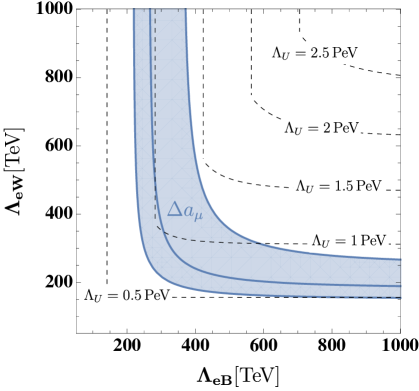
- 计算SMEFT中威尔逊系数的幺正性约束,并将其转化为新物理尺度$\Lambda_{U}$的上限。
- 分析简化可重整化模型(如标量-费米子Yukawa理论)以推导耦合的微扰性约束,并推断新本征态质量的上限。
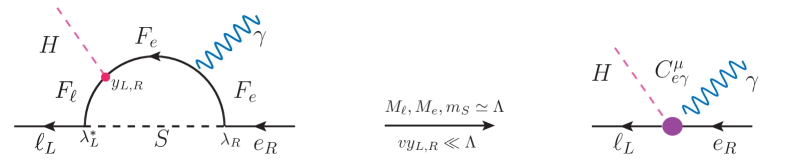
- 将可重整化模型匹配到SMEFT,以在不同框架间比较结果。
- 利用高能散射过程识别导致幺正性饱和的最严格约束通道。
- 通过在不同量子数通道(特别是$J=0$和$J=1/2$部分波)中对$\mathcal{T}$-矩阵进行对角化,推导约束条件。
实验结果
研究问题
- RQ1在SMEFT描述μ子g-2异常时,与微扰幺正性一致的最高新物理尺度是多少?
- RQ2对于相同的异常,可重整化模型中的幺正性约束与SMEFT中的约束相比如何?
- RQ3考虑到幺正性约束,未来多TeV能量的直接对撞机搜索能否解决g-2异常的起源?
- RQ4圈因子和耦合结构在决定新物理尺度中起什么作用?
- RQ5非可重整化模型能否实现SMEFT中推导出的幺正性上限?
主要发现
- 在SMEFT框架中,微扰幺正性在约1 PeV处被饱和,这设定了必须探测以解决μ子g-2异常的最高尺度。
- 在如标量-费米子Yukawa理论等可重整化模型中,幺正性约束表明存在质量低于200 TeV的新本征态。
- SMEFT方法对新物理尺度给出了最保守的上限,因其为模型无关,并考虑了所有可能的算符贡献。
- SMEFT中的幺正性约束来源于涉及$\mu^+\mu^-\to Z(\gamma)h$和$\mu^+\mu^-\to t\bar{t}$的散射振幅,这些过程与μ子对撞机搜索密切相关。
- 非可重整化模型可以实现SMEFT中推导出的1 PeV幺正性上限,表明该量级在理论上可作为解释该异常的可行尺度。
- 最强约束来自SMEFT中的$J=1/2$部分波和可重整化模型中的$J=0$通道,特别是涉及$\ell_R$、$t_R$和$q_L$态的散射。
更好的研究,从现在开始
从阅读论文到最终审阅,大幅缩短您的研究时间。
无需绑定信用卡
本解读由 AI 生成,并经人工编辑审核。