
[论文解读] What to do when things get crowded? Scalable joint analysis of overlapping gravitational wave signals
该论文表明使用 TMNRE(通过 peregrine 与 swyft)进行序贯基于仿真的推断,能够联合推断两个重叠、自旋导致前进的双黑洞信号的30个参数,具有高精度,仅需约 7×10^6 次波形评估,显著少于传统方法。
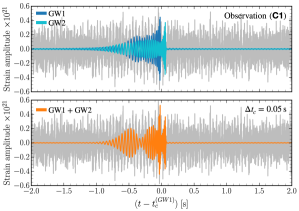
The gravitational wave sky is starting to become very crowded, with the fourth science run (O4) at LIGO expected to detect $\mathcal{O}(100)$ compact object coalescence signals. Data analysis issues start to arise as we look further forwards, however. In particular, as the event rate increases in e.g. next generation detectors, it will become increasingly likely that signals arrive in the detector coincidentally, eventually becoming the dominant source class. It is known that current analysis pipelines will struggle to deal with this scenario, predominantly due to the scaling of traditional methods such as Monte Carlo Markov Chains and nested sampling, where the time difference between analysing a single signal and multiple can be as significant as days to months. In this work, we argue that sequential simulation-based inference methods can solve this problem by breaking the scaling behaviour. Specifically, we apply an algorithm known as (truncated marginal) neural ratio estimation (TMNRE), implemented in the code peregrine and based on swyft. To demonstrate its applicability, we consider three case studies comprising two overlapping, spinning, and precessing binary black hole systems with merger times separated by 0.05 s, 0.2 s, and 0.5 s. We show for the first time that we can recover, with full precision (as quantified by a comparison to the analysis of each signal independently), the posterior distributions of all 30 model parameters in a full joint analysis. Crucially, we achieve this with only $\sim 15\%$ of the waveform evaluations that would be needed to analyse even a single signal with traditional methods.
研究动机与目标
- 在当前及未来探测器中,说明对重叠引力波信号进行联合分析的必要性。
- 开发并应用一种序贯仿真基推断方法,以提取多个重叠信号的完整后验分布。
- 证明 TMNRE 能在显著少于传统方法的波形评估次数下恢复完整的 30 参数后验。
- 与独立的单信号分析进行准确性验证并评估校准/覆盖率。
- 讨论可扩展性以及对下一代探测器和更复杂重叠的前景。
提出的方法
- 对重叠 GW 信号应用截断边际神经比率估计(TMNRE),使用 peregrine 实现(基于 swyft 构建)。
- 在三探测器 O4 网络(Hanford、Livingston、Virgo)中,使用两重叠自旋、前进的 BBH 波形(IMRPhenomXPHM)进行前向建模数据。
- 通过先验截断执行序贯推断 rounds,以聚焦于低维边际后验,从而实现对参数的高效边际化。
- 实现联合 30 参数后验恢复(每个信号 15 个),并与独立的单信号分析进行比较以进行验证。
- 量化计算成本:≈7×10^6 次波形评估,18 核节点每轮约 2–3 小时,每轮训练约 8–12 小时,总计约 48 小时。
- 讨论潜在改进以及对 3G 探测器和多于两个重叠信号的可扩展性。
实验结果
研究问题
- RQ1TMNRE 基于 SBI 是否能够以高精度和良好校准恢复两个重叠 BBH 信号的完整 30 维后验?
- RQ2联合重叠分析与对每个信号分别分析相比,表现如何?
- RQ3TMNRE 在联合分析重叠 GW 信号中的计算需求与可扩展性的潜在优势?
- RQ4重叠程度和合并时间分离对参数约束和简并性有何影响?
- RQ5对未来探测器和更多重叠信号的意义为何?
主要发现
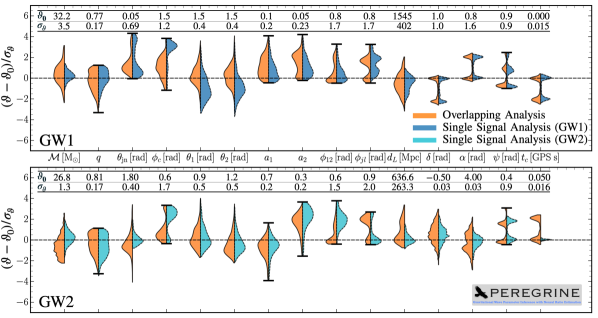
- TMNRE 能以高精度恢复两个重叠自旋、前进 BBH 的完整 30 参数后验,接近单信号分析的精度。
- 重叠分析仅表现出适度的后验宽化,在所有参数上接近于注入值的覆盖度。
- 一维与二维边际后验显示,伴随信号分离, chirp mass 有略微改善,而大多数参数在两个信号之间基本不相关。
- 方法产生的后验极其良好地校准(覆盖在覆盖图对角线附近)。
- 计算效率显著提高:≈7×10^6 次波形评估(比传统的联合分析少一个数量级量级),在可用硬件上运行 rounds 的总墙钟时间约为 2–3 天。
- 展示了下一代探测器的可扩展性潜力,其中重叠信号将更为普遍。
更好的研究,从现在开始
从论文设计到论文写作,大幅缩短您的研究时间。
无需绑定信用卡
本解读由 AI 生成,并经人工编辑审核。