
[论文解读] When Services Computing Meets Blockchain: Challenges and Opportunities
本文研究了区块链技术与服务计算的融合,以应对隐私风险、信息孤岛和激励机制等关键挑战。通过利用区块链的去中心化、智能合约和密码学安全特性,该研究提出了一种统一框架,增强了服务生命周期各阶段(如创建、发现、编排和仲裁)的可信度、互操作性和自动化水平,其中区块链即服务(BaaS)成为可扩展部署的关键推动者。
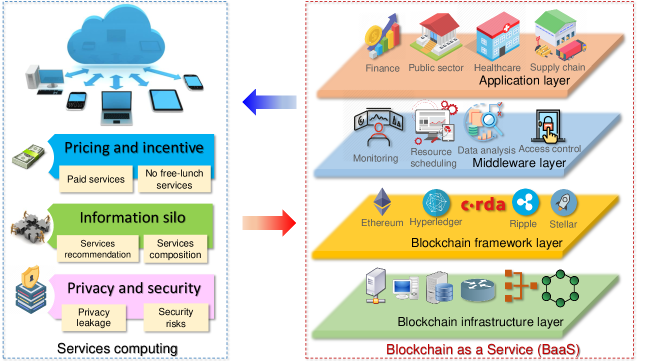
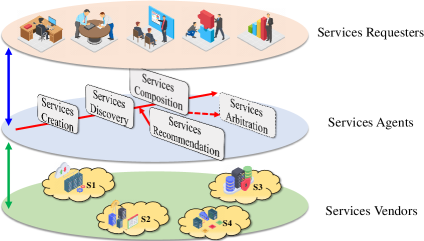
Services computing can offer a high-level abstraction to support diverse applications via encapsulating various computing infrastructures. Though services computing has greatly boosted the productivity of developers, it is faced with three main challenges: privacy and security risks, information silo, and pricing mechanisms and incentives. The recent advances of blockchain bring opportunities to address the challenges of services computing due to its build-in encryption as well as digital signature schemes, decentralization feature, and intrinsic incentive mechanisms. In this paper, we present a survey to investigate the integration of blockchain with services computing. The integration of blockchain with services computing mainly exhibits merits in two aspects: i) blockchain can potentially address key challenges of services computing and ii) services computing can also promote blockchain development. In particular, we categorize the current literature of services computing based on blockchain into five types: services creation, services discovery, services recommendation, services composition, and services arbitration. Moreover, we generalize Blockchain as a Service (BaaS) architecture and summarize the representative BaaS platforms. In addition, we also outline open issues of blockchain-based services computing and BaaS.
研究动机与目标
- 分析服务计算中的核心挑战:隐私与安全风险、信息孤岛以及定价/激励机制。
- 研究区块链技术如何通过去中心化、加密技术和智能合约解决这些挑战。
- 将基于区块链的服务计算划分为五个关键领域:创建、发现、推荐、编排和仲裁。
- 调查并比较现有的区块链即服务(BaaS)平台及其架构设计。
- 识别基于区块链的服务计算及BaaS在技术与非技术层面的开放性挑战,以指导未来研究。
提出的方法
- 将现有区块链集成服务计算的文献按五个服务生命周期阶段(创建、发现、推荐、编排和仲裁)进行分类。
- 分析区块链的核心特性——密码学、去中心化、智能合约和内在激励机制——作为解决服务计算挑战的使能因素。
- 提出一种分层BaaS架构,以抽象区块链基础设施并支持多样化的应用工作负载。
- 基于其技术栈、可扩展性和集成能力,调查代表性BaaS平台(如Amazon QLDB、Azure Blockchain、IBM Blockchain)的实现。
- 识别技术与非技术障碍,如系统复杂性、高成本、监管风险以及缺乏标准化。
- 采用对比分析方法,从可扩展性、安全性及开发者友好性等维度评估BaaS平台。
实验结果
研究问题
- RQ1区块链技术如何减轻服务计算中的隐私与安全风险?
- RQ2区块链在何种方式下有助于克服分布式服务生态系统中的信息孤岛问题?
- RQ3智能合约与去中心化激励机制如何改善服务计算中的定价与激励机制?
- RQ4区块链即服务(BaaS)平台的关键架构模式与功能组件是什么?
- RQ5在大规模部署基于区块链的服务计算时,存在哪些主要的开放性挑战——包括技术与非技术方面?
主要发现
- 区块链内置的加密技术和数字签名显著降低了服务计算中数据滥用与隐私泄露的风险。
- 去中心化有效缓解了来自中心化攻击(如DDoS和系统故障)的风险,提升了系统的韧性。
- 智能合约实现了自动化、无需信任的激励机制,例如奖励开发者贡献或报告漏洞,从而提升生态系统参与度。
- BaaS平台如Amazon QLDB和IBM Blockchain提供了抽象层,简化了服务开发者对区块链的部署与管理。
- 尽管已有进展,BaaS平台在支持无服务器和微服务架构方面仍缺乏灵活性。
- 即使在公有区块链中,安全漏洞(如DAO攻击)和交易去匿名化等问题仍是开放挑战。
更好的研究,从现在开始
从阅读论文到最终审阅,大幅缩短您的研究时间。
无需绑定信用卡
本解读由 AI 生成,并经人工编辑审核。