
[论文解读] Where are NANOGrav's big black holes?
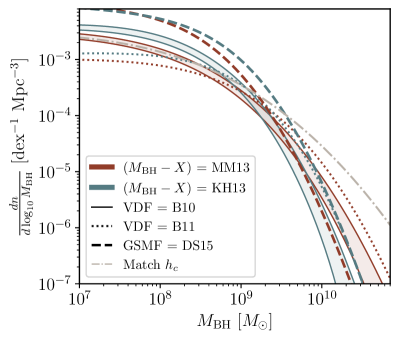
本文研究了脉冲星时标阵列(PTA)测量的引力波背景(GWb)振幅与基于本地超大质量黑洞(SMBH)质量函数的理论预测之间的差异。利用Phinney(2001)的形式体系,表明观测到的GWb振幅无法通过增加并合率或质量依赖演化来解释,而应归因于质量约为3×10¹⁰ M☉的SMBH——其质量比以往从本地观测推断的高出约十倍——这要求在100 Mpc范围内存在此前未被探测到的此类大质量黑洞群体。
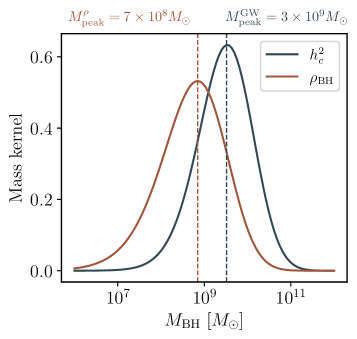
Multiple pulsar timing array (PTA) collaborations have recently reported the first detection of gravitational waves (GWs) of nanohertz frequencies. The signal is expected to be primarily sourced by inspiralling supermassive black hole binaries (SMBHBs) and these first results are broadly consistent with the expected GW spectrum from such a population. Curiously, the measured amplitude of the GW background in all announced results is a bit larger than theoretical predictions. In this work, we show that the amplitude of the stochastic gravitational wave background (SGWB) predicted from the present-day abundance of SMBHs derived from local scaling relations is significantly smaller than that measured by the PTAs. We demonstrate that this difference cannot be accounted for through changes in the merger history of SMBHs and that there is an upper limit to the boost to the characteristic strain from multiple merger events, due to the fact that they involve black holes of decreasing masses. If we require the current estimate of the black hole mass density -- equal to the integrated quasar luminosity function through the classic Soltan argument -- to be preserved, then the currently measured PTA result would imply that the typical total mass of SMBHs contributing to the background should be at least $\sim 3 imes 10^{10} M_\odot$, a factor of $\sim 10$ larger than previously predicted. The required space density of such massive black holes corresponds to order $10$ $3 imes 10^{10} M_\odot$ SMBHs within the volume accessible by stellar and gas dynamical SMBH measurements. By virtue of the GW signal being dominated by the massive end of the SMBH distribution, PTA measurements offer a unique window into such rare objects and complement existing electromagnetic observations.
研究动机与目标
- 解决PTA测得的纳赫兹引力波背景(GWb)振幅与基于本地SMBH质量函数的理论预测之间的矛盾。
- 确定SMBH的增强并合率或质量演化是否能解释GWb振幅的过剩。
- 在保持总黑洞质量密度(通过Sołtan论证)的同时,匹配PTA测量结果,评估其影响。
- 确定能够调和GW与电磁观测的SMBH质量函数峰值。
- 检验对M–σ关系或速度弥散函数的修改是否能解释缺失的高质量群体。
提出的方法
- 将Phinney(2001)的形式体系适配,通过双星并合历史将现今SMBH群体与随机引力波背景(SGWB)联系起来。
- 利用Sołtan论证保持总黑洞质量密度,从而约束SMBH质量函数所需的大质量尾部。
- 应用Hénon–Hertzsprung关系,将SGWB的特征应变建模为SMBH质量函数的函数。
- 量化由多次并合事件引起的GW应变最大可能增强,表明其受黑洞质量递减限制,最大仅为∼1.64。
- 评估在M–σ关系和速度弥散函数(VDF)中改变固有离散度(ε₀)和转折尺度(σ*)的影响。
- 检验在高红移速度弥散区域M–σ关系是否更陡,能否解释所需的大质量群体,同时与残差拟合的观测结果保持一致。
实验结果
研究问题
- RQ1PTA测量的引力波背景过剩振幅能否通过SMBH并合率增加来解释?
- RQ2由涉及质量逐次减轻的黑洞的多次并合事件引起的特征应变最大可能增强是多少?
- RQ3在保持总黑洞质量密度(通过Sołtan论证)的同时,为匹配PTA GWb振幅,所需SMBH质量函数峰值是多少?
- RQ4对M–σ关系或VDF的修改是否与当前SMBH质量与速度弥散的观测约束一致?
- RQ5为解释观测到的GWb,预测的本地空间密度(M ∼ 3×10¹⁰ M☉)的超大质量SMBH数量是多少?
主要发现
- 即使考虑并合历史,PTA测量的GWb振幅仍显著超过基于本地SMBH质量函数的理论预测。
- 由多次并合引起的特征应变最大理论增强仅为∼1.64,不足以解释观测到的过剩。
- 为在保持总黑洞质量密度(通过Sołtan论证)的同时调和PTA测量结果,贡献GWb的峰值质量必须为∼3×10¹⁰ M☉——比从本地观测推断的高出约十倍。
- 所需本地空间密度对应于在100 Mpc范围内约有10个质量为∼3×10¹⁰ M☉的SMBH,或一个质量为∼10¹¹ M☉的SMBH,该群体尚未通过恒星或气体动力学测量探测到。
- 对M–σ关系的固有离散度或转折尺度的修改无法在不违反残差拟合观测约束的前提下解释所需的大质量群体。
- 在高红移速度弥散区域采用更陡的M–σ关系可能解释缺失的大质量尾部,但即使如此仍不足以完全调和差异,暗示存在更大规模的高质量SMBH群体。
更好的研究,从现在开始
从阅读论文到最终审阅,大幅缩短您的研究时间。
无需绑定信用卡
本解读由 AI 生成,并经人工编辑审核。