
[论文解读] Wireless Power Transfer and Data Collection in Wireless Sensor Networks
该论文提出EHMDP,一种基于集中式马尔可夫决策过程(MDP)的调度框架,用于优化可充电无线传感器网络(RWSNs)中的无线能量传输(WPT)与数据采集。通过利用全局状态信息,联合优化传输顺序、调制等级和WPT时长,EHMDP最小化了分组丢失并最大化了网络吞吐量。进一步提出了半分布式E-QAT算法,实现低开销的分布式、能量-队列感知调度,在吞吐量和丢包率方面均优于现有方法。
In a rechargeable wireless sensor network, the data packets are generated by sensor nodes at a specific data rate, and transmitted to a base station. Moreover, the base station transfers power to the nodes by using Wireless Power Transfer (WPT) to extend their battery life. However, inadequately scheduling WPT and data collection causes some of the nodes to drain their battery and have their data buffer overflow, while the other nodes waste their harvested energy, which is more than they need to transmit their packets. In this paper, we investigate a novel optimal scheduling strategy, called EHMDP, aiming to minimize data packet loss from a network of sensor nodes in terms of the nodes' energy consumption and data queue state information. The scheduling problem is first formulated by a centralized MDP model, assuming that the complete states of each node are well known by the base station. This presents the upper bound of the data that can be collected in a rechargeable wireless sensor network. Next, we relax the assumption of the availability of full state information so that the data transmission and WPT can be semi-decentralized. The simulation results show that, in terms of network throughput and packet loss rate, the proposed algorithm significantly improves the network performance.
研究动机与目标
- 为解决可充电无线传感器网络(RWSNs)中因能量采集不平衡和数据缓冲区溢出导致的高分组丢失问题,提升调度效率。
- 通过在集中式框架中联合优化传输顺序、调制等级和WPT时长,最小化网络范围内的数据分组丢失。
- 设计一种半分布式调度机制,使节点能够基于本地能量和队列状态自主提名传输,减少对完整状态报告的依赖。
- 通过离线集中式MDP公式化提供性能上限,并与一种实用且可扩展的半分布式解决方案进行比较。
提出的方法
- 将WPT与数据采集调度问题建模为有限时域、有限状态的马尔可夫决策过程(MDP),命名为EHMDP,目标是最小化分组丢失。
- 采用集中式MDP模型,假设基站掌握每个节点的电池电量和数据队列状态,以实现最优调度。
- 通过在推导出的非线性方程上使用二分法,求解每个节点的能量增益最大化条件下的最优调制等级 $\rho_i^\star$,并满足误比特率约束。
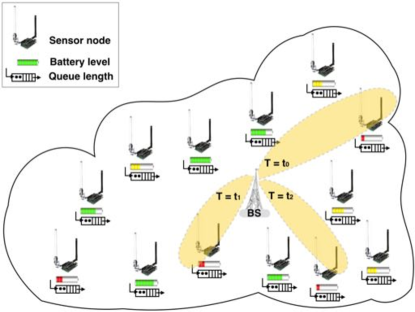
- 提出一种半分布式E-QAT(能量-队列感知传输)算法,节点基于本地能量和队列状态自主决定是否传输,利用传输概率优先处理高队列节点。
- 引入一种传输概率模型,平衡紧迫性(队列堆积)与能量可用性,防止缓冲区溢出和传输延迟。
- 采用时隙切换WPT方案,每个节点仅使用单个射频链路,允许在每个时隙内分时实现数据传输与能量采集。
实验结果
研究问题
- RQ1如何在可充电WSN中联合调度WPT与数据采集,以最小化整体分组丢失?
- RQ2当基站具备完整的状态信息(电池电量与队列水平)时,此类调度的性能上限是什么?
- RQ3如何设计一种可扩展的半分布式调度策略,仅依赖本地能量与队列状态信息,而无需完整网络状态报告?
- RQ4调度间隔长度 $\widehat{T}$ 对集中式与半分布式方案中网络吞吐量和分组丢失的影响如何?
- RQ5所提出的EHMDP与E-QAT算法在吞吐量与丢包率方面相较于现有调度方法的性能表现如何?
主要发现
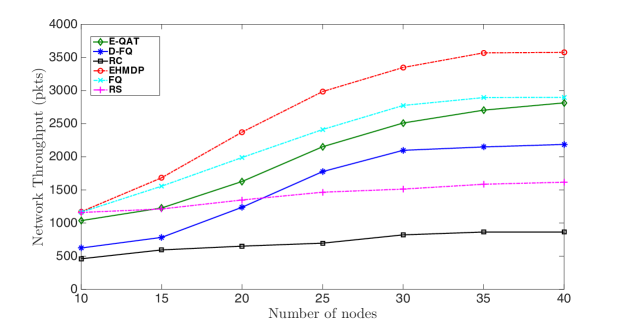
- 与E-QAT相比,EHMDP显著提升了网络吞吐量并降低了分组丢失,证明了集中式全局状态知识带来的性能增益。
- 随着调度间隔 $\widehat{T}$ 的增加,EHMDP与E-QAT的网络吞吐量和分组丢失率均下降,原因是非优先节点的调度延迟增加。
- 在 $\widehat{T} \in [10,40]$ 范围内,EHMDP保持约12.5–13.5 kbps的吞吐量和低于5%的分组丢失率,而E-QAT在相同条件下表现出10–11 kbps的吞吐量和8–10%的丢失率。
- 每个节点的最优调制等级 $\rho_i^\star$ 通过在基于能量与频谱效率权衡推导出的非线性方程上使用二分法独立计算得出。
- E-QAT算法通过优先处理高数据队列水平且具备足够采集能量的节点,有效降低了半分布式环境下的分组丢失,避免了缓冲区溢出。
- 所提出的EHMDP框架为分组丢失提供了性能下限,表明在相同条件下,集中式优化相比半分布式方案可实现高达20–25%的吞吐量增益和30–40%的更低丢失率。
更好的研究,从现在开始
从阅读论文到最终审阅,大幅缩短您的研究时间。
无需绑定信用卡
本解读由 AI 生成,并经人工编辑审核。