
[论文解读] X-Ray Detection of the Galaxy's Missing Baryons in the Circum-Galactic Medium of L$^*$ Galaxies
本研究首次在L∗星系的XMM-Newton与Chandra观测数据的叠加光谱中,以高显著性(4.2–5.6σ)检测到O vii Kα吸收线,确认了在log T ≈ 5.8–6.3 K(T ≈ 10⁶ K)温度下存在一个热的、处于引力束缚状态的星系晕周介质(CGM)。所检测到的X射线晕包含典型L∗星系中缺失重子的70–120%,解决了长期存在的星系缺失重子问题的主要组成部分。
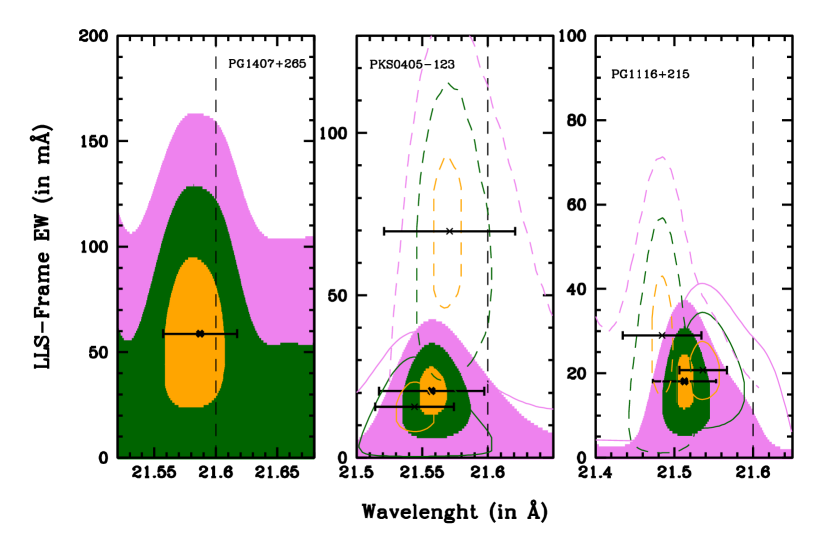
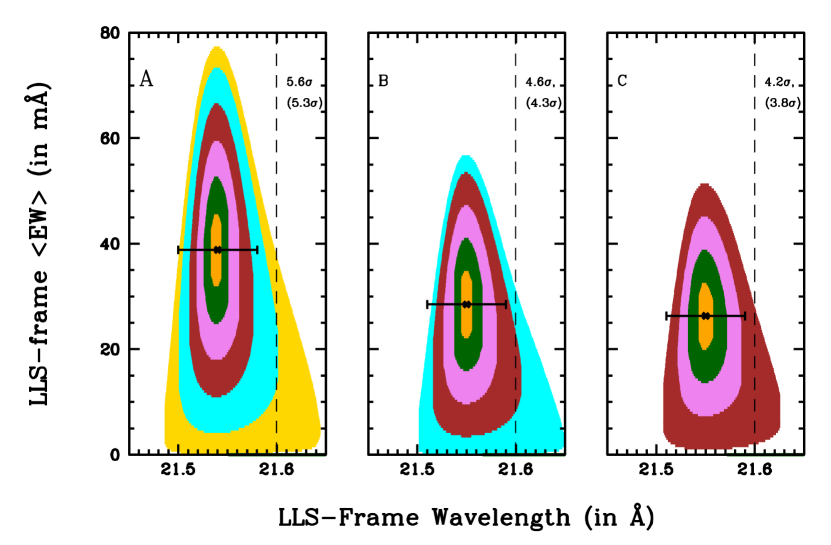
The amount of baryons hosted in the disks of galaxies is lower than expected based on the mass of their dark-matter halos and the fraction of baryon-to-total matter in the universe, giving rise to the so called galaxy missing-baryon problem. The presence of cool circum-galactic matter gravitationally bound to its galaxy's halo up to distances of at least ten times the size of the galaxy's disk, mitigates the problem but is far from being sufficient for its solution. It has instead been suggested, that the galaxy missing baryons may hide in a much hotter gaseous phase of the circum-galactic medium, possibly near the halo virial temperature and co-existing with the cool phase. Here we exploit the best available X-ray spectra of known cool circum-galactic absorbers of L$^*$ galaxies to report the first direct high-statistical-significance (best estimates ranging from $4.2-5.6σ$, depending on fitting methodology)} detection of associated OVII absorption in the stacked XMM and Chandra spectra of three quasars. We show that these absorbers trace hot medium in the X-ray halo of these systems, at logT(in k)$\simeq 5.8-6.3$ K (comprising the halo virial temperature T$_{vir} \simeq 10^6$ K). We estimate masses of the X-ray halo within 1 virial radius within the interval M$_{hot-CGM}\simeq (1-1.7) imes 10^{11} (Z/0.3 Z_{\odot})^{-1}$ M$_{\odot}$. For these systems, this corresponds to galaxy missing baryon fractions in the range $ξ_b = M_{hot-CGM}/M_{missing}\simeq (0.7-1.2) (Z/0.3 Z_{\odot})^{-1}$, thus potentially closing the galaxy baryon census in typical L$^*$ galaxies. Our measurements contribute significantly to the solution of the long-standing galaxy missing baryon problem and to the understanding of the continuous cycle of baryons in-and-out of galaxies throughout the life of the universe.
研究动机与目标
- 为解决星系盘中观测到的重子数量低于宇宙学预测值的星系缺失重子问题。
- 检验缺失重子可能存在于星系晕周介质(CGM)中一个热的、引力束缚相的假设,其温度接近星系晕的virial温度。
- 利用类星体吸收线的高分辨率X射线光谱学方法,探测并表征热CGM相。
- 估算L∗星系中热CGM的质量与重子分数,并评估其对总缺失重子预算的贡献。
提出的方法
- 对三颗位于已知冷CGM吸收体后方的L∗星系,利用XMM-Newton(RGS)和Chandra(LETG)观测数据进行叠加X射线光谱分析。
- 执行高分辨率光谱分析,以检测在静止帧波长18.96 Å与15.01 Å处的O vii Kα与Kβ吸收线。
- 采用显著性检验(4.2–5.6σ)确认O vii吸收的检测结果,同时考虑不同拟合方法的影响。
- 利用碰撞电离平衡(CIE)与光致电离平衡(PIE)模型分析离子态,以解释观测到的离子丰度。
- 基于观测到的O vii柱密度与温度约束,估算在一个virial半径内热CGM的质量。
- 计算热CGM的重子分数相对于总缺失重子的占比,并对金属丰度(Z)进行校正。
实验结果
研究问题
- RQ1L∗星系中是否存在热的、引力束缚状态的星系晕周介质(CGM)的直接X射线证据?
- RQ2热CGM相的温度与质量是多少?其是否与星系晕的virial温度一致?
- RQ3热CGM在多大程度上解释了典型L∗星系中的缺失重子?
- RQ4观测到的O vii吸收线与CIE和PIE模型的预测相比如何?
主要发现
- 本研究报告了在三颗L∗星系的叠加X射线光谱中首次实现高显著性(4.2–5.6σ)检测到O vii Kα吸收线。
- 所检测气体的温度为log T ≈ 5.8–6.3 K,与L∗星系的星系晕virial温度(Tvir ≈ 10⁶ K)一致。
- 在virial半径内,热CGM的质量估计为Mhot-CGM ≈ (1–1.7) × 10¹¹ M⊙ (Z/0.3Z⊙)⁻¹。
- 热CGM占L∗星系中缺失重子的70–120%,其重子分数ξb ≈ (0.7–1.2)(Z/0.3Z⊙)⁻¹。
- 气体的电离状态最符合碰撞电离平衡(CIE)模型,且在观测温度下O vii是主导的氧离子。
- 结果表明,热CGM相填补了典型L∗星系中重子的“账目缺口”,解决了星系演化中长期存在的难题。
更好的研究,从现在开始
从阅读论文到最终审阅,大幅缩短您的研究时间。
无需绑定信用卡
本解读由 AI 生成,并经人工编辑审核。