
[论文解读] YbV$_3$Sb$_4$ and EuV$_3$Sb$_4$, vanadium-based kagome metals with Yb$^{2+}$ and Eu$^{2+}$ zig-zag chains
本研究报道了YbV₃Sb₄和EuV₃Sb₄的合成与表征,这两种新型钒基kagome金属具有二价Yb²⁺和Eu²⁺离子的之字形链结构。尽管YbV₃Sb₄在60 mK至300 K范围内保持非磁性金属特性且无相变,EuV₃Sb₄在T_C = 32 K处表现出类铁磁转变,具有易面各向异性和调制磁基态的迹象,为调控kagome晶格中的磁序提供了新平台。
Here we present YbV$_3$Sb$_4$ and EuV$_3$Sb$_4$, two new compounds exhibiting slightly distorted vanadium-based kagome nets interleaved with zig-zag chains of divalent Yb$^{2+}$ and Eu$^{2+}$ ions. Single crystal growth methods are reported alongside magnetic, electronic, and thermodynamic measurements. YbV$_3$Sb$_4$ is a nonmagnetic metal with no collective phase transitions observed between 60mK and 300K. Conversely, EuV$_3$Sb$_4$ is a magnetic kagome metal exhibiting easy-plane ferromagnetic-like order below $T_ ext{C}$=32K with signatures of noncollinearity under low field. Our discovery of YbV$_3$Sb$_4$ and EuV$_3$Sb$_4$ demonstrate another direction for the discovery and development of vanadium-based kagome metals while incorporating the chemical and magnetic degrees of freedom offered by a rare-earth sublattice.
研究动机与目标
- 通过引入具有可调磁矩的稀土离子,扩展钒基kagome金属家族。
- 探索巡游kagome能带结构与稀土子晶格中局域磁矩之间的相互作用。
- 研究稀土之字形链中的磁序如何影响kagome金属的电子与磁性性质。
- 建立一类新型kagome材料(AV₃Sb₄),通过A位阳离子实现化学与磁性的可调性。
提出的方法
- 采用助熔法生长YbV₃Sb₄和EuV₃Sb₄单晶,以获得高质量样品。
- 利用SQUID磁强计进行磁性表征,测量温度与磁场依赖的磁化率与磁化强度。
- 采用弛豫法测量比热,探测热力学相变并提取磁熵。
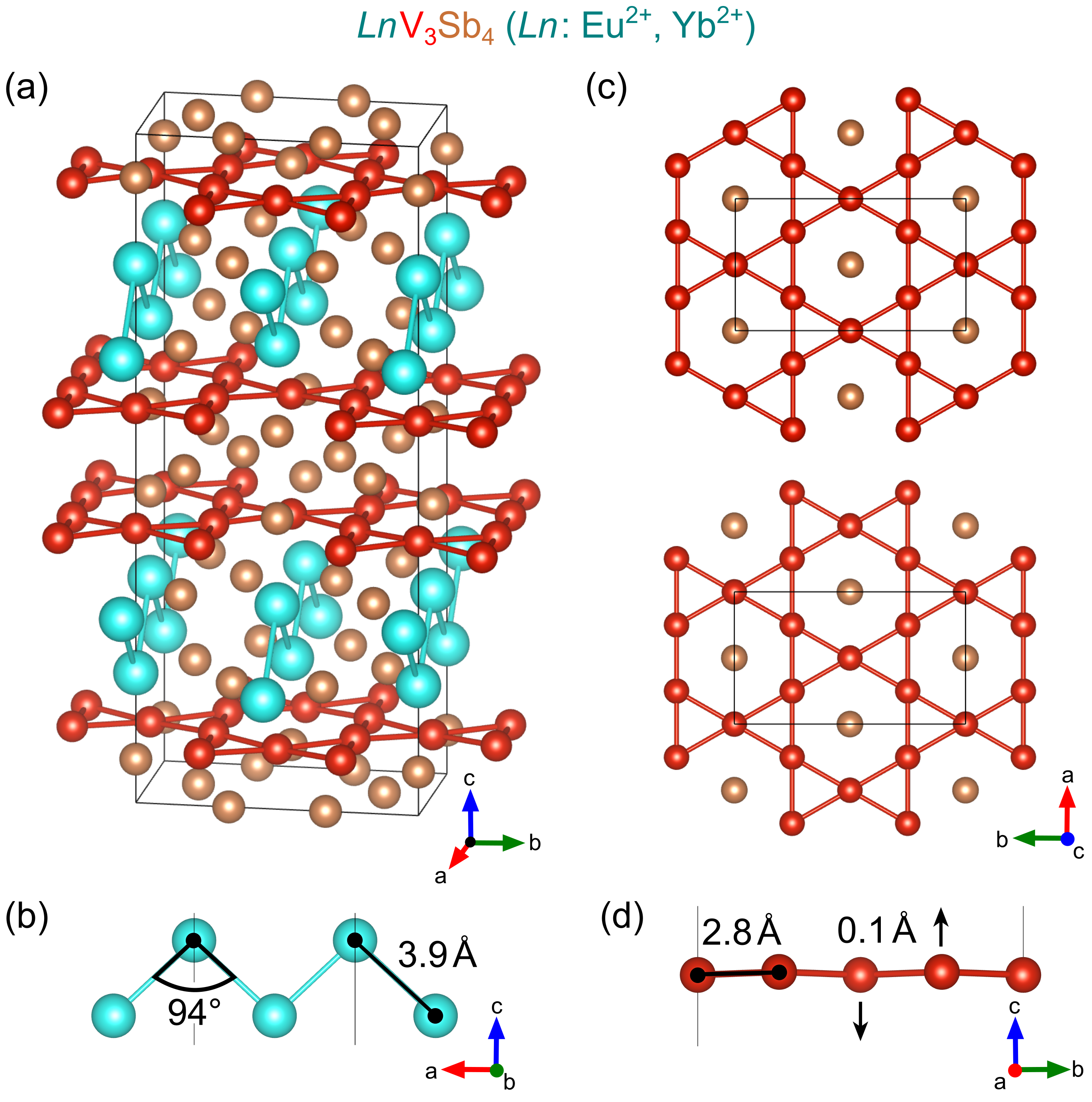
- 通过X射线衍射与晶体结构精修,确认AM₃X₄结构,其kagome网略有畸变,且A位呈现之字形链结构。
- 利用Curie-Weiss定律分析磁性数据,并与非磁性YbV₃Sb₄比较,以分离磁性贡献。
- 将YbV₃Sb₄用作非磁性声子参考,以提取EuV₃Sb₄中的磁比热与磁熵。
实验结果
研究问题
- RQ1能否将二价稀土离子(Yb²⁺、Eu²⁺)引入AV₃Sb₄结构中,形成具有可调磁性的稳定kagome金属?
- RQ2Eu²⁺的存在是否在钒kagome晶格中诱导出长程磁序?若存在,其性质与转变温度为何?
- RQ3EuV₃Sb₄的磁基态与简单铁磁性有何不同?其存在调制或自旋倾斜序的证据是什么?
- RQ4EuV₃Sb₄的磁性性质与S = 7/2体系的预期值相比偏离程度如何?可能的原因是什么?
- RQ5EuV₃Sb₄中的磁熵能否被定量解释?其是否趋近于S = 7/2离子完全有序时的预期值R ln 8?
主要发现
- YbV₃Sb₄为非磁性金属,在60 mK至300 K范围内未观察到体相变,其行为与Pauli顺磁性一致。
- EuV₃Sb₄在T_C = 32 K处表现出类铁磁转变,具有易面各向异性,且在T_C以下磁化强度出现驼峰,暗示存在复杂磁序。
- 磁比热分析显示,EuV₃Sb₄中的磁熵达到16.8 J mol⁻¹ K⁻¹,相当于S = 7/2 Eu²⁺离子预期值R ln 8的97%。
- H ∥ c方向的磁化率数据表明,其基态比简单铁磁性更复杂,可能涉及自旋倾斜或螺旋序。
- 等温磁化数据表明,即使经过质量校正,仍存在1 μB的磁矩亏损,提示可能存在未计入的钒贡献或动力学效应。
- 在磁场作用下,T_C处的比热异常峰展宽并发生向低温偏移,表明磁涨落具有磁场依赖性。
更好的研究,从现在开始
从阅读论文到最终审阅,大幅缩短您的研究时间。
无需绑定信用卡
本解读由 AI 生成,并经人工编辑审核。