
[论文解读] You Truly Understand What I Need: Intellectual and Friendly Dialogue Agents grounding Knowledge and Persona
本文提出INFO,一种对话智能体,通过基于多编码器的检索系统与检索增强生成技术,同时实现外部知识与用户人格的对齐。通过在输入查询中注入检索到的知识与人格信息,模型生成的回复更具信息量、更富吸引力且更少幻觉化,在人格-知识对话基准测试中,于对齐与生成任务上均达到最先进性能。
To build a conversational agent that interacts fluently with humans, previous studies blend knowledge or personal profile into the pre-trained language model. However, the model that considers knowledge and persona at the same time is still limited, leading to hallucination and a passive way of using personas. We propose an effective dialogue agent that grounds external knowledge and persona simultaneously. The agent selects the proper knowledge and persona to use for generating the answers with our candidate scoring implemented with a poly-encoder. Then, our model generates the utterance with lesser hallucination and more engagingness utilizing retrieval augmented generation with knowledge-persona enhanced query. We conduct experiments on the persona-knowledge chat and achieve state-of-the-art performance in grounding and generation tasks on the automatic metrics. Moreover, we validate the answers from the models regarding hallucination and engagingness through human evaluation and qualitative results. We show our retriever's effectiveness in extracting relevant documents compared to the other previous retrievers, along with the comparison of multiple candidate scoring methods. Code is available at https://github.com/dlawjddn803/INFO
研究动机与目标
- 为解决现有对话智能体在幻觉生成或被动使用人格方面存在的局限,提出同时对齐外部知识与用户人格的方法。
- 通过减少幻觉并提升互动性,改善开放域个性化对话系统中的回复质量。
- 开发一种检索增强生成框架,通过标记级边缘化方法,保持对齐与生成之间的一致性。
- 评估不同候选评分方法(双编码器、交叉编码器、多编码器)在联合知识与人格检索中的效果。
- 通过检索到的知识与人格来源,实现回复的可解释性与来源可追溯性。
提出的方法
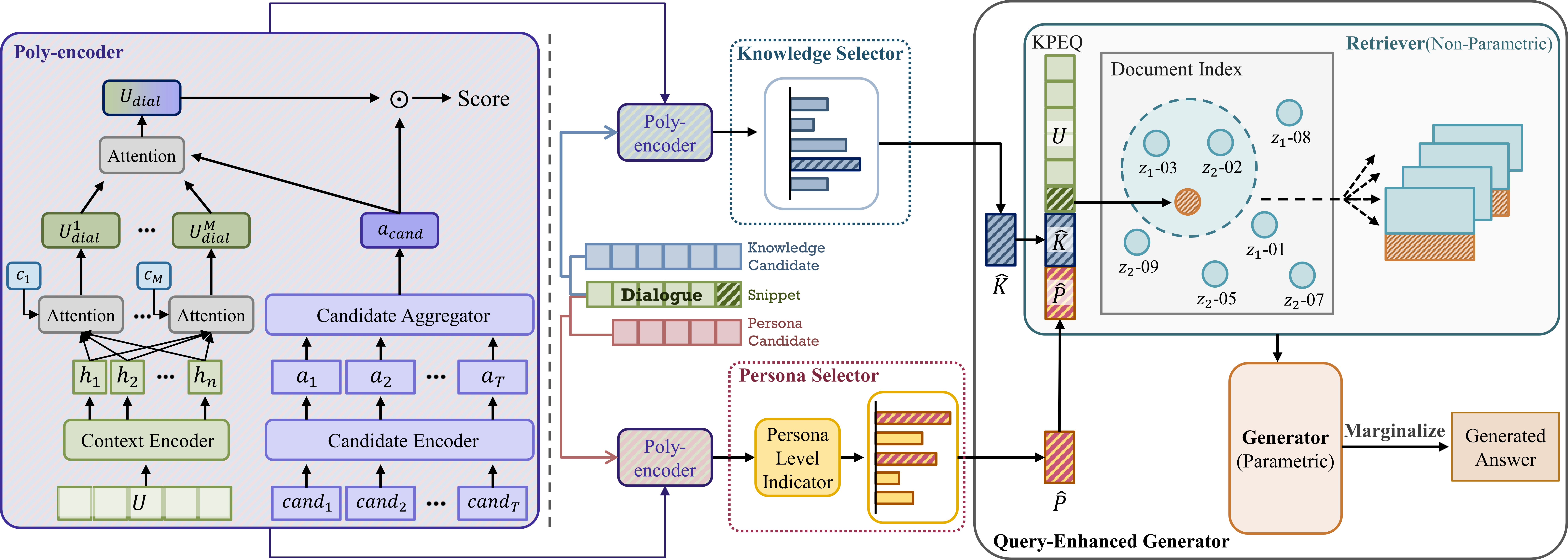
- 采用多编码器架构,对候选知识与人格片段与对话上下文的相关性进行评分。
- 通过将检索到的知识与人格信息注入生成器的输入提示,构建知识-人格增强型查询。
- 采用检索增强生成(RAG)方法,结合非参数记忆(检索到的文档)与参数化生成器(大语言模型),提升回复的一致性。
- 在训练过程中应用标记级边缘化损失,使生成回复与检索到的知识及人格保持对齐。
- 引入人格级别指示符,支持多个人格选择,实现对个人特质的精细化对齐。
- 对比多种检索组件(双编码器、交叉编码器、多编码器),评估其对对齐准确率与回复质量的影响。
实验结果
研究问题
- RQ1对话智能体能否有效平衡在外部知识与用户人格两方面的对齐,以减少幻觉?
- RQ2在输入查询中整合知识与人格信息,如何影响回复的互动性与事实一致性?
- RQ3在联合知识与人格检索中,哪种候选评分方法(双编码器、交叉编码器、多编码器)表现最佳?
- RQ4与标准微调模型相比,所提出的检索增强生成框架在多大程度上提升了生成质量?
- RQ5模型能否生成既事实准确又社交互动性强的回复,经由人工评估验证?
主要发现
- INFO在人格-知识对话基准测试中,于对齐与生成任务上均达到最先进性能,自动指标优于现有模型。
- 人工评估确认,与BART和GPT-2等基线模型相比,INFO生成的回复幻觉更少,互动性更高。
- 多编码器在候选评分中表现优于双编码器与交叉编码器,展现出更强的捕捉上下文与候选知识/人格相关性的能力。
- 定性分析表明,INFO能正确检索并整合真实知识与人格信息,而基线模型则或产生幻觉,或完全忽略人格。
- 模型通过使用检索来源增强了可解释性与来源可追溯性,使用户能够追踪回复中事实性陈述的来源。
- INFO通过主动整合人格信息,减少重复与通用化回复,避免生成如'我有四个孩子'这类被动陈述。
更好的研究,从现在开始
从阅读论文到最终审阅,大幅缩短您的研究时间。
无需绑定信用卡
本解读由 AI 生成,并经人工编辑审核。