
[论文解读] Zeeman tomography of magnetic white dwarfs III. The 70-80 Megagauss magnetic field of PG 1015+014
本研究利用甚大望远镜(VLT)获取的高分辨率光谱偏振数据,采用Zeeman断层成像技术重建了白矮星PG 1015+014的复杂磁场几何结构。结果揭示其主导磁场强度为70 MG,在约三分之一的自转周期内存在80 MG的次级峰值,表明该星体具有非偶极型、多极场结构,无法用简单的倾斜偶极模型描述,磁场贡献范围在50–90 MG之间,显著偏差表明存在未被建模的小尺度磁场结构。
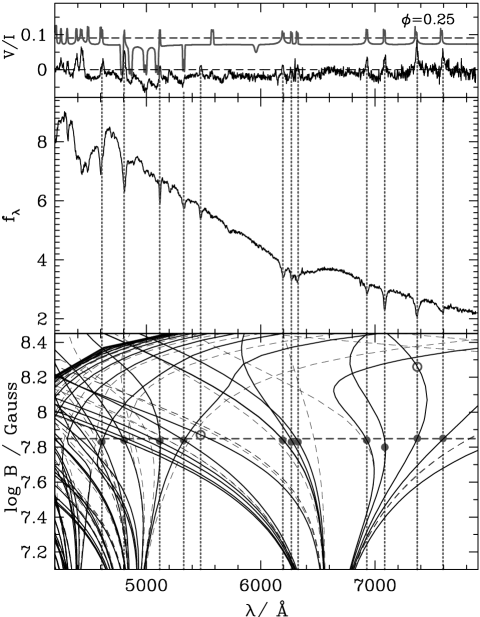
<b>Aims:</b> We analyse the magnetic field geometry of the magnetic DA white dwarf PG 1015+014 with our Zeeman tomography method.<br> <b>Methods:</b> This study is based on rotation-phase resolved optical flux and circular polarization spectra of PG 1015+014 obtained with FORS1 at the ESO VLT. Our tomographic code makes use of an extensive database of pre-computed Zeeman spectra. The general approach has been described in Papers I and II of this series.<br> <b>Results:</b> The surface field strength distributions for all rotational phases of PG 1015+014 are characterised by a strong peak at 70 MG. A separate peak at 80 MG is seen for about one third of the rotation cycle. Significant contributions to the Zeeman features arise from regions with field strengths between 50 and 90 MG. We obtain equally good simultaneous fits to the observations, collected in five phase bins, for two different field parametrizations: (i) a superposition of individually tilted and off-centred zonal multipole components; and (ii) a truncated multipole expansion up to degree l = 4 including all zonal and tesseral components. The magnetic fields generated by both parametrizations exhibit a similar global structure of the absolute surface field values, but differ considerably in the topology of the field lines. An effective photospheric temperature of T<sub>eff</sub> = 10000 ± 1000 K was found.<br> <b>Conclusions:</b> Remaining discrepancies between the observations and our best-fit models suggest that additional small-scale structure of the magnetic field exists which our field models are unable to cover due to the restricted number of free parameters.<br>
研究动机与目标
- 利用高分辨率光谱偏振数据,确定磁性白矮星PG 1015+014的详细磁场几何结构。
- 检验标准倾斜偶极或偶极矩模型是否能够再现观测到的Zeeman特征。
- 评估当前磁场建模技术在捕捉白矮星表面真实磁场分布复杂性方面的局限性。
- 研究观测光谱与合成光谱之间残差差异的含义,以评估模型精度与磁场结构。
- 探索未来通过更高分辨率模型和更多自由参数改进磁场几何结构重建的潜力。
提出的方法
- 将Zeeman断层成像应用于欧洲南方天文台(ESO)甚大望远镜(VLT)FORS1仪器获取的旋转相位分辨通量与圆偏振光谱。
- 该方法利用预先计算的合成Zeeman光谱数据库,匹配多个旋转相位下的观测光谱特征。
- 测试了两种磁场参数化方式:(i) 倾斜、非中心的环带多极分量叠加,以及 (ii) 截断至l=4阶的球谐多极展开,包含轴对称与非轴对称分量。
- 对五个相位区间同时进行拟合,以约束磁场强度与方向的空间分布。
- 利用原子参数与Zeeman分裂理论合成模型光谱,并迭代调整有效温度与磁场强度分布。
- 分析观测光谱与合成光谱之间的残差,以评估模型质量并识别系统性偏差。

实验结果
研究问题
- RQ1简单的倾斜偶极模型是否足以描述PG 1015+014中观测到的Zeeman特征?
- RQ2PG 1015+014表面的磁场强度空间分布如何?其随自转相位如何变化?
- RQ3与截断的球谐展开相比,多极分量参数化在拟合观测光谱方面表现如何?
- RQ4观测光谱与最佳拟合模型之间的残差差异,对当前建模技术的局限性有何启示?
- RQ5合成光谱中的系统性误差或磁场模型空间分辨率不足,是否在很大程度上导致了观测与模型之间的不匹配?
主要发现
- PG 1015+014的表面磁场强度分布以70 MG的强峰值为主导,同时在约三分之一自转周期内存在80 MG的次级峰值。
- Zeeman特征的显著贡献来自磁场强度在50至90 MG之间的区域,表明恒星表面存在广泛的磁场强度分布。
- 两种不同的磁场参数化方式——非中心环带多极分量与l=4阶截断多极展开——对五相位数据集的拟合效果相当。
- 尽管整体拟合效果良好,但残差仍持续存在,表明存在当前模型复杂度无法涵盖的小尺度磁场结构。
- 有效光球温度测定为10,000 ± 1,000 K,与该天体的光谱分类和演化状态一致。
- 简单倾斜偶极模型无法再现观测数据,证实PG 1015+014具有复杂且非偶极型的磁场几何结构。
更好的研究,从现在开始
从论文设计到论文写作,大幅缩短您的研究时间。
无需绑定信用卡
本解读由 AI 生成,并经人工编辑审核。