
[Paper Review] Adaptive Trotterization for time-dependent Hamiltonian quantum dynamics using piecewise conservation laws
This paper introduces tADA-Trotter, an adaptive Trotterization algorithm for time-dependent quantum Hamiltonians that uses instantaneous conservation laws of effective time-independent Hamiltonians to bound local and global errors. By dynamically adjusting the time step based on measured deviations in energy and energy variance, the method suppresses Trotter-induced heating and achieves higher simulation accuracy than fixed-step Trotterization with reduced circuit depth.
Digital quantum simulation relies on Trotterization to discretize time evolution into elementary quantum gates. On current quantum processors with notable gate imperfections, there is a critical tradeoff between improved accuracy for finer timesteps, and increased error rate on account of the larger circuit depth. We present an adaptive Trotterization algorithm to cope with time-dependent Hamiltonians, where we propose a concept of piecewise "conserved" quantities to estimate errors in the time evolution between two (nearby) points in time; these allow us to bound the errors accumulated over the full simulation period. They reduce to standard conservation laws in the case of time-independent Hamiltonians, for which we first developed an adaptive Trotterization scheme [PRX Quantum 4, 030319]. We validate the algorithm for a time-dependent quantum spin chain, demonstrating that it can outperform the conventional Trotter algorithm with a fixed step size at a controlled error.
Motivation & Objective
- To address the challenge of balancing simulation accuracy and circuit depth in noisy intermediate-scale quantum (NISQ) devices during digital quantum simulation of time-dependent Hamiltonians.
- To extend adaptive Trotterization—previously limited to time-independent systems—by introducing a criterion for step-size adaptation in time-dependent settings.
- To suppress Trotter-induced heating effects through global error control, enabling reliable long-time simulations.
- To provide a feedback-based algorithm that uses measurable quantities (energy and energy variance) to guide step-size adaptation in real time.
- To validate the method on a driven quantum spin chain, demonstrating superior performance over fixed-step Trotterization.
Proposed method
- The method discretizes time evolution into intervals [t, t+δt], within which an effective time-independent Hamiltonian H_{[∞]}^{t,δt} is defined via a perturbative Magnus expansion in δt.
- Within each interval, the algorithm enforces instantaneous conservation laws: the expectation values of H_{[∞]}^{t,δt} and its variance should remain unchanged after evolution.
- The adaptive step size δt is determined by measuring the deviation of these expectation values before and after Trotterized evolution, with δt maximized as long as errors remain bounded.
- A global error is defined as the cumulative sum of local errors in the instantaneous conservation laws, which is constrained via feedback to prevent error accumulation.
- The algorithm uses a truncated Magnus expansion H_{[k]}^{t,δt} to approximate H_{[∞]}^{t,δt} and applies a Trotter decomposition U_{[λ]}(t+δt,t) for time evolution.
- The feedback loop adjusts δt dynamically, reducing it when local errors exceed thresholds and increasing it when errors are small, especially in regions of slow dynamics.
![Figure 1: Schematics of tADA-Trotter for a time-dependent Hamiltonian. (a) The expectation values of the instantaneous conserved Hamiltonian $H_{[\infty]}^{t,\delta t}$ coincide at times $t$ and $t+\delta t$ . We maximize $\delta t$ as long as errors in this conservation law are bounded, i.e., devia](https://ar5iv.labs.arxiv.org/html/2307.10327/assets/x1.png)
Experimental results
Research questions
- RQ1Can instantaneous conservation laws of effective time-independent Hamiltonians be used to define a reliable error metric for adaptive Trotterization in time-dependent systems?
- RQ2How can global error accumulation from local Trotter errors be controlled to suppress Trotter-induced heating in long-time simulations?
- RQ3Can adaptive step sizing based on measured energy and energy variance outperform fixed-step Trotterization in terms of accuracy and circuit depth?
- RQ4Does the algorithm maintain accuracy under strong time-dependent driving and complex many-body dynamics?
- RQ5Can the framework be generalized to open quantum systems or higher-order Trotter schemes?
Key findings
- tADA-Trotter successfully suppresses Trotter-induced heating by constraining the accumulation of errors in instantaneous conservation laws, enabling reliable long-time simulations.
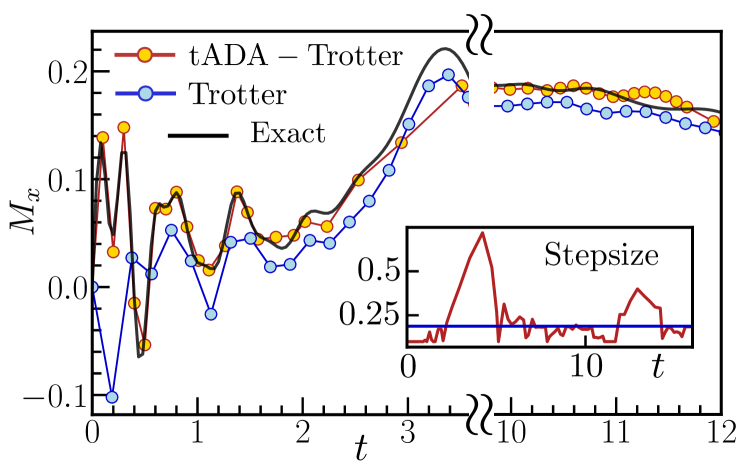
- The algorithm achieves significantly better accuracy than fixed-step Trotterization, with simulation errors only becoming visible at t > 11, while fixed-step errors appear much earlier (t > 5).
- The adaptive step size varies dynamically over a range of [0.1, 0.7], decreasing to 0.1 during rapidly changing dynamics and increasing to 0.7 in quiescent regions, demonstrating flexibility.
- Accumulated errors in the expectation value of H_{[k]} and its variance remain bounded below specified thresholds for most of the simulation, with occasional overruns due to tight early-time tolerances.
- The method reduces circuit depth while maintaining accuracy, as evidenced by the red (globally bounded) data closely following the exact solution, unlike the blue (fixed-step) data which diverges early.
- For a driven spin chain with ω = 0.8 and τ = 30, tADA-Trotter achieves a total simulation time of t ~ 20 with N = 100 Trotter steps, demonstrating practical feasibility.
Better researchstarts right now
From reading papers to final review, dramatically reduce your research time.
No credit card · Free plan available
This review was created by AI and reviewed by human editors.