
[Paper Review] Adjacent-category models for ordinal time series and their application to climate-dependent spruce budworm defoliation dynamics
This paper proposes an adjacent-category autoregressive (ACAR) model for ordinal time series to analyze climate-driven spruce budworm defoliation in eastern Canada using dendrochronological data. The model reveals that summer temperature ranges below 22.7–21.8°C reduce defoliation, while spring temperature ranges above 32.5°C increase it, with significant autoregressive dynamics differing between sites.
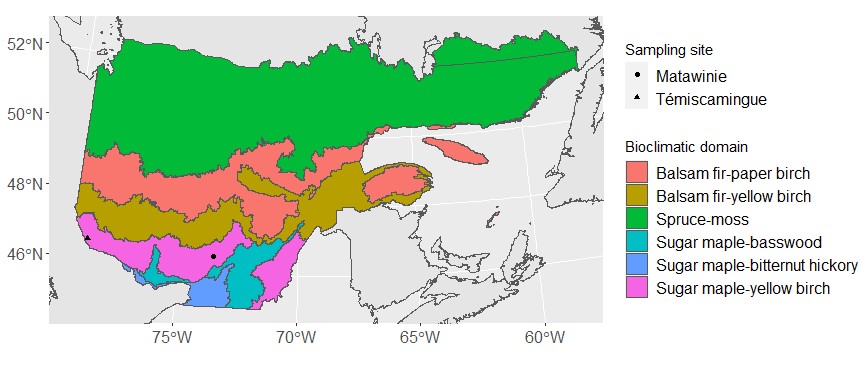
This work proposes an adjacent-category autoregressive model for time series of ordinal variables. We apply this model to dendrochronological records to study the effect of climate on the intensity of spruce budworm defoliation during outbreaks in two sites in eastern Canada. The model's parameters are estimated using the maximum likelihood approach. We show that this estimator is consistent and asymptotically Gaussian distributed. We also propose a Portemanteau test for goodness-of-fit. Our study shows that the seasonal ranges of maximum daily temperatures in the spring and summer have a significant quadratic effect on defoliation. The study reveals that for both regions, a greater range of summer daily maximum temperatures is associated with lower levels of defoliation up to a threshold estimated at 22.7C (CI of 0-39.7C at 95%) in Témiscamingue and 21.8C (CI of 0-54.2C at 95%) for Matawinie. For Matawinie, a greater range in spring daily maximum temperatures increased defoliation, up to a threshold of 32.5C (CI of 0-80.0C). We also present a statistical test to compare the autoregressive parameter values between different fits of the model, which allows us to detect changes in the defoliation dynamics between the study sites in terms of their respective autoregression structures.
Motivation & Objective
- To develop a novel observation-driven autoregressive model for ordinal categorical time series, addressing a gap in statistical methods for such data.
- To analyze the impact of climate variables—specifically seasonal temperature ranges—on spruce budworm defoliation intensity using tree-ring records.
- To compare defoliation dynamics between two boreal forest sites in eastern Canada using statistical tests on autoregressive parameters.
- To provide a goodness-of-fit test and a test for equality of ACAR model parameters across different sites.
- To enable inference on climate thresholds influencing defoliation levels through quadratic effects in the model.
Proposed method
- Proposes an adjacent-category autoregressive (ACAR) model that links cumulative odds of ordinal outcomes to linear predictors involving past responses and covariates.
- Uses log-odds ratios between adjacent categories as the link function, with parameters estimated via conditional maximum likelihood.
- Applies the perturbation and coupling methods from Truquet (2020) to establish asymptotic properties: consistency and asymptotic normality of the estimator.
- Develops a Portemanteau-type test for model adequacy based on residuals' autocorrelations, with a scaled chi-square asymptotic distribution under the null.
- Introduces a statistical test to compare autoregressive parameter structures between two fitted ACAR models, enabling site-wise dynamic comparison.
- Incorporates exogenous climate variables (e.g., seasonal max temperature ranges) as covariates in the linear predictor with quadratic terms to detect threshold effects.
Experimental results
Research questions
- RQ1How do seasonal ranges of maximum daily temperatures in spring and summer affect the intensity of spruce budworm defoliation?
- RQ2What are the threshold levels of temperature range beyond which defoliation levels change significantly?
- RQ3How do the autoregressive dynamics of defoliation differ between two boreal forest sites in eastern Canada?
- RQ4Is the ACAR model a valid and adequate representation of ordinal defoliation time series with climate covariates?
- RQ5Can statistical tests detect significant differences in autoregressive structure between sites, indicating divergent outbreak dynamics?
Key findings
- A greater range of summer daily maximum temperatures is associated with lower defoliation levels up to a threshold of 22.7 °C (95% CI: 0–39.7 °C) in Témiscamingue.
- In Matawinie, a greater range of summer daily maximum temperatures is also linked to reduced defoliation, with a threshold of 21.8 °C (95% CI: 0–54.2 °C).
- For Matawinie, a higher range of spring daily maximum temperatures increases defoliation up to a threshold of 32.5 °C (95% CI: 0–80.0 °C).
- The negative effect of spring temperatures on defoliation may stem from temperature-induced suppression of parasitoids, which are less effective above 20 °C.
- The ACAR model shows significant differences in autoregressive parameter structures between the two sites, indicating distinct defoliation dynamics.
- The model’s goodness-of-fit test and parameter comparison test are effective in detecting structural differences and model adequacy in real-world ecological data.
Better researchstarts right now
From reading papers to final review, dramatically reduce your research time.
No credit card · Free plan available
This review was created by AI and reviewed by human editors.