
[论文解读] Anomalies in Particle Physics
本文综述了粒子物理学中的近期异常现象——从μ子g-2到稀有B介子衰变及Higgs粒子对产生,这些现象均偏离了标准模型的预测。文章评估了实验的一致性、理论预测的可靠性以及新物理解释的潜力,特别强调了轻子球子和扩展的Higgs场等新粒子的存在,同时指出了未来对撞机与精密实验在确认或排除这些异常迹象方面的前景。
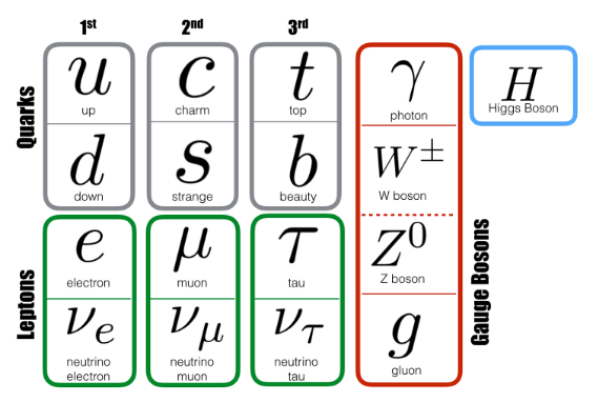
The currently accepted mathematical description of the fundamental constituents and interactions of matter is the Standard Model of particle physics. Its last missing particle, the famous Higgs boson, was observed at the Large Hadron Collider at CERN in 2012. However, it is clear that the Standard Model cannot be the ultimate theory of Nature, and e.g. cannot account for Dark Matter or non-vanishing neutrino masses (and does not include gravity). In fact, searches for physics beyond the SM have been intensified since the Higgs boson discovery. In this article, we review the hints for new physics, called ``anomalies'', obtained in particle physics experiments within the last years. We consider both direct high-energy searches for new resonances at the LHC and indirect low-energy precision experiments. These anomalies range from the nuclear scale (approximately the mass of the proton) to the electroweak scale (i.e. the mass of the Higgs boson) to the TeV scale (the highest scale directly accessible at the LHC), therefore spanning over four orders of magnitude. After discussing the experimental and theoretical status of the anomalies, we summarize possible explanations in terms of new particles and new interactions. In particular, new Higgs bosons and leptoquarks are promising candidates. Discovery prospects and implications for future colliders are discussed.
研究动机与目标
- 系统评估并综合近期偏离标准模型预测的粒子物理实验异常现象。
- 评估这些异常在不同实验之间的一致性及其与理论计算的兼容性。
- 识别可解释观测偏差的可行新物理模型,特别是轻子球子、扩展的Higgs场以及新费米子。
- 概述正在进行和未来的实验(包括LHC、FCC-ee、ILC和CEPC)在确认或排除新物理方面的发现潜力。
- 为在标准模型之外物理的背景下,评估多个异常现象的可信度及其相互关联性,提供一个全面的框架。
提出的方法
- 采用多准则框架系统评估异常现象:实验一致性、标准模型预测的可靠性、统计显著性、新物理解释的可行性,以及异常现象之间的稳定关联。
- 分析来自高能对撞机(LHC、Belle-II、LHCb)和低能精密实验(μ子g-2、β衰变、K→μν、Z→bb̄)的实验数据。
- 利用格点QCD和色散关系改进稀有衰变及强子真空极化贡献的理论预测。
- 通过模拟和未来实验(如Belle-II、NA62、PIONEER,以及未来的e+e−对撞机ILC、FCC-ee、CEPC)的预期灵敏度,评估未来发现潜力。
- 聚焦于轻子球子、扩展的Higgs场以及新强相互作用粒子的模型构建分析,作为解释多个异常现象的自然候选。
- 使用标准化评分系统对异常现象进行交叉比较,以评估其可信度和相互依赖性。
实验结果
研究问题
- RQ1μ子g-2、稀有B介子衰变及W玻色子质量测量中的观测异常在多大程度上表明了标准模型之外的新物理?
- RQ2独立测量结果在实验上的一致性如何?相应的标准模型预测的可靠性如何?
- RQ3是否存在一个单一的新物理模型(如轻子球子或扩展的Higgs场)能够同时解释多个异常现象,包括R(D*)和R(K)异常?
- RQ4改进的理论计算(如格点QCD、色散关系)在调和实验与标准模型之间张力方面起到什么作用?
- RQ5哪些未来的实验和对撞机(如FCC-ee、ILC、CEPC,或高亮度LHC)最具潜力确认或排除观测到的异常?
主要发现
- μ子的异常磁矩(a_μ)与标准模型存在4.2σ的偏差,尽管改进的HVP计算以及未来的Belle-II和MUonE数据可能缓解部分张力。
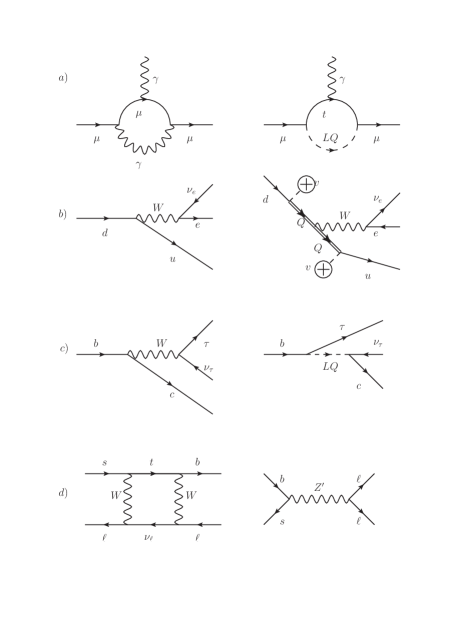
- B介子衰变中的R(D*)和R(K)异常(暗示轻子味 universality 可能被破坏)具有2.5–3σ的显著性,与轻子球子或Z′玻色子的解释一致。
- CDF II实验对W玻色子质量的测量结果与标准模型预测相差7σ,尽管该结果仍具争议,未来e+e−对撞机可能予以澄清。
- LHC中二胶子和二光子末态的过量信号(如750 GeV二光子共振)在Run 3数据中已不再受青睐,但Higgs粒子对产生(yy)中的类似信号仍具可行性,未来高亮度LHC运行可加以检验。
- τ子到μ子的衰变异常(τ→μνν)显示2.5σ的偏离,未来Belle-II或FCC-ee的测量可能证实或排除该现象。
- R(D*)和R(K)异常、W玻色子质量异常以及eμ过量之间存在一致的关联,暗示可能存在一个共同的新物理模型,可能涉及具有特定耦合的轻子球子或Z′玻色子。
更好的研究,从现在开始
从阅读论文到最终审阅,大幅缩短您的研究时间。
无需绑定信用卡
本解读由 AI 生成,并经人工编辑审核。