
[Paper Review] Anomalous Hall Crystals in Rhombohedral Multilayer Graphene I: Interaction-Driven Chern Bands and Fractional Quantum Hall States at Zero Magnetic Field
This paper proposes that interaction-driven topological order in rhombohedral pentalayer graphene leads to a robust, isolated Chern band with Chern number |C|=1 at zero magnetic field, enabling fractional quantum anomalous Hall states. Using self-consistent Hartree-Fock and exact diagonalization, the authors identify a spontaneously broken translation-symmetry state—termed the 'anomalous Hall crystal'—that stabilizes topological order even without a moiré potential.
Recent experiments on rhombohedral pentalayer graphene flakes with a substrate induced moiré potential have identified both Chern insulators and fractional Quantum Hall states in the absence of an applied magnetic field. Surprisingly, these states are observed in strong displacement fields where the effects of the moiré lattice are weak, and seem to be readily accessed without fine-tuning. To address these experimental puzzles we study an interacting model of electrons in this geometry, first within the self-consistent Hartree-Fock (SCHF) approximation. We find an isolated Chern band with Chern number $|C|=1$, that moreover is relatively flat and shows good quantum geometry. Exact diagonalization and density matrix renormalization group methods at fractional filling establish the presence of fractional quantum anomalous Hall (FQAH) states. The $|C|=1$ band in SCHF is remarkably robust to varying microscopic parameters, and is also found in the $N_L=4$ and $N_L=6$ layer systems. Remarkably, it appears stable even to switching off the moiré potential, pointing to spontaneous breaking of translation symmetry. We term this topological crystalline state the ``anomalous Hall crystal" (AHC), and argue that it constitutes a general mechanism for creating stable Chern bands in rhombohedral graphene. Our work elucidates the physics behind the recent rhombohedral pentalayer graphene observations, predicts the appearance of the same phase in other systems, and opens the door to studying the interplay between electronic topology and spontaneous translation symmetry breaking.
Motivation & Objective
- To resolve the experimental observation of Chern insulators and fractional quantum Hall states in rhombohedral pentalayer graphene without an external magnetic field.
- To determine the origin of the robust |C|=1 Chern band observed in experiments under strong displacement fields.
- To investigate whether the topological state arises from interactions rather than single-particle band structure.
- To explore the stability of the Chern band across different layer counts (NL = 4, 5, 6) and in the absence of a moiré potential.
- To identify a new topological crystalline phase—'anomalous Hall crystal'—where spontaneous translation symmetry breaking stabilizes topological order.
Proposed method
- Employed self-consistent Hartree-Fock (SCHF) calculations to solve the interacting many-body problem in rhombohedral multilayer graphene with and without a moiré potential.
- Used exact diagonalization (ED) and density matrix renormalization group (DMRG) on a cylinder geometry to probe fractional quantum anomalous Hall (FQAH) states at fractional filling.
- Mapped the system to a one-band effective Hamiltonian using form factors derived from the lowest Hartree-Fock band, enabling simulation of topological correlations.
- Applied MPO compression to efficiently represent the long-range Coulomb interaction in DMRG simulations with errors below 10⁻² meV.
- Diagnosed topological order via entanglement spectrum analysis, confirming characteristic degeneracy counting matching partition numbers 1,1,2,3,5,7,…
- Performed flux insertion via subsampling to demonstrate spectral flow between quasidegenerate ground states, confirming topological order.
Experimental results
Research questions
- RQ1What is the microscopic origin of the robust |C|=1 Chern band observed in rhombohedral pentalayer graphene at zero magnetic field?
- RQ2Can interaction-driven topological order stabilize fractional quantum anomalous Hall states without an external magnetic field?
- RQ3Is the Chern band stable when the moiré potential is turned off, and what mechanism stabilizes it?
- RQ4Does the same topological phase emerge in multilayer systems with NL = 4 and NL = 6?
- RQ5What is the nature of the spontaneously broken symmetry state that stabilizes the Chern band?
Key findings
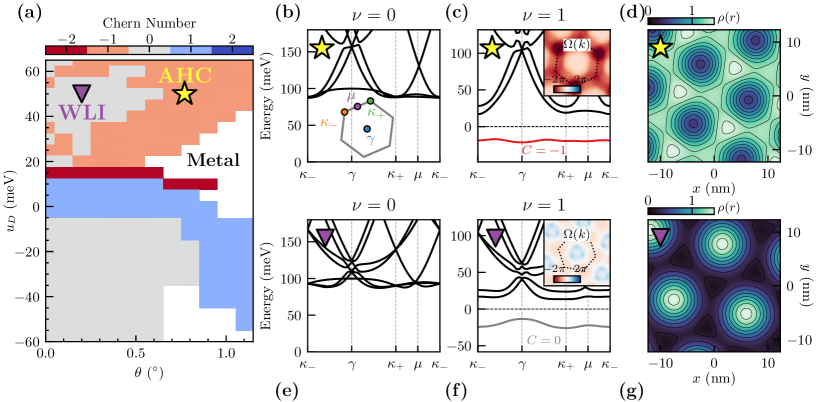
- A stable |C|=1 Chern band with high quantum geometry and flatness emerges in the self-consistent Hartree-Fock solution, even without a moiré potential.
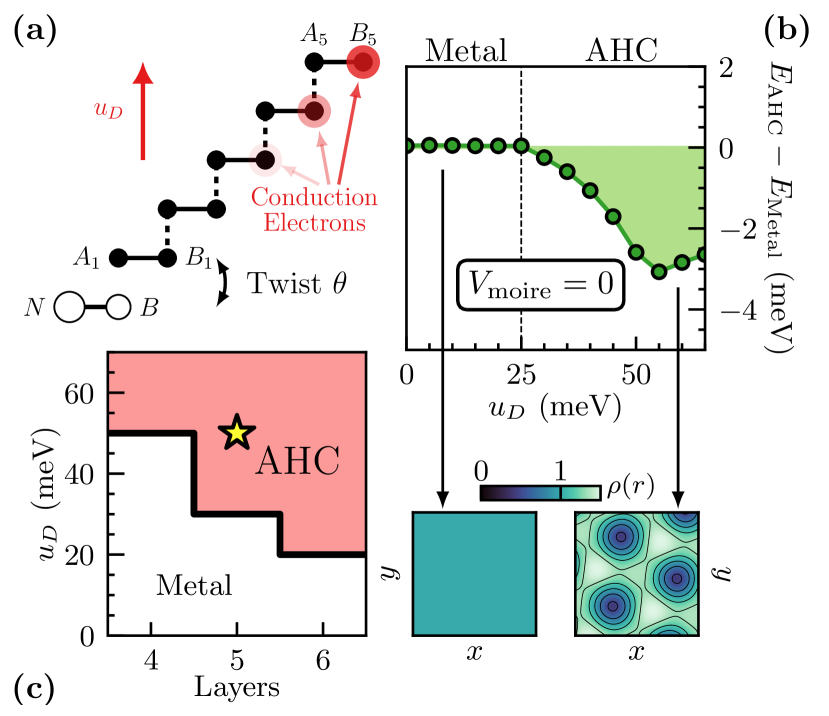
- The anomalous Hall crystal (AHC) phase—characterized by spontaneous breaking of translation symmetry—becomes the ground state at displacement fields uD > 25 meV in the absence of moiré potential.
- Fractional quantum anomalous Hall states are confirmed via exact diagonalization and DMRG, showing a characteristic entanglement spectrum with degeneracy counting 1,1,2,3,5,7,…
- The |C|=1 Chern band is robust across different moiré potentials, hopping parameters, and layer counts (NL = 4, 5, 6), indicating a general mechanism.
- The phase transition to the AHC state occurs at a critical displacement field uD* that decreases with increasing layer count NL.
- The AHC phase is stable even when the moiré potential is switched off, indicating that electron-electron interactions alone can stabilize topological order via spontaneous symmetry breaking.
Read this paper
Open the full text in the Nubint reader and ask about any passage as you read.
Read this paper on NubintThis review was generated by AI from the original paper. Please check the paper before citing it.