
[Paper Review] Cramér-Rao Bound Optimized Subspace Reconstruction in Quantitative MRI
This paper proposes a novel subspace reconstruction method for quantitative MRI that optimizes the basis vectors not only for signal energy preservation but also for Cramér-Rao bound (CRB) preservation. By approximating the compressed-domain CRB using orthogonalized signal derivatives, the method enables singular value decomposition (SVD)-based optimization that improves parameter estimation accuracy and precision, especially at smaller subspace sizes, with significant computational savings in both simulations and in vivo applications.
We extend the traditional framework for estimating subspace bases that maximize the preserved signal energy to additionally preserve the Cramér-Rao bound (CRB) of the biophysical parameters and, ultimately, improve accuracy and precision in the quantitative maps. To this end, we introduce an <i>approximate</i> compressed CRB based on orthogonalized versions of the signal's derivatives with respect to the model parameters. This approximation permits singular value decomposition (SVD)-based minimization of both the CRB and signal losses during compression. Compared to the traditional SVD approach, the proposed method better preserves the CRB across all biophysical parameters with negligible cost to the preserved signal energy, leading to reduced bias and variance of the parameter estimates in simulation. In vivo, improved accuracy and precision are observed in two quantitative neuroimaging applications, permitting the use of smaller basis sizes in subspace reconstruction and offering significant computational savings.
Motivation & Objective
- To address the limitation of traditional SVD-based subspace reconstruction in quantitative MRI, which prioritizes signal energy preservation but neglects the Cramér-Rao bound (CRB) of biophysical parameters.
- To improve the conditioning of parameter estimation by optimizing the subspace basis to preserve the CRB of tissue parameters, thereby enhancing both accuracy and precision.
- To develop a computationally efficient approximation of the compressed-domain CRB using orthogonalized signal derivatives, enabling practical integration into SVD-based basis optimization.
- To demonstrate that CRB-optimized bases enable smaller subspace sizes without sacrificing estimation quality, leading to computational savings in reconstruction.
- To validate the method in two in vivo qMRI applications: two-pool quantitative magnetization transfer (qMT) and T₁/T₂ mapping using MRF-FISP.
Proposed method
- The method introduces an approximate compressed CRB using orthogonalized versions of the signal’s derivatives with respect to biophysical parameters, enabling efficient computation during basis optimization.
- This CRB approximation is incorporated into a joint objective function that minimizes both signal loss (via standard SVD) and CRB increase during subspace projection.
- The optimization is performed via SVD on a modified data matrix constructed from the orthogonalized signal derivatives and simulated fingerprints across the expected parameter range.
- The resulting CRB-SVD basis is a drop-in replacement for the traditional SVD basis in existing subspace reconstruction pipelines.
- The method leverages the geometric interpretation of the CRB as a measure of local curvature in parameter space, favoring bases that maintain high statistical efficiency.
- The approach is validated through simulations and in vivo experiments on two qMRI applications: qMT and T₁/T₂ mapping using MRF-FISP.
![Figure 1: (a) Distinguishing one model parameter from another depends on the components of its signal derivative, $\mathbf{j}_{i}$ , that are orthogonal to the span of all other signal derivatives, $\mathbf{J}_{i}$ [ 44 ] . (b) Depiction of a representative signal $\mathbf{s}$ for the inversion reco](https://ar5iv.labs.arxiv.org/html/2305.00326/assets/figures/fig1.png)
Experimental results
Research questions
- RQ1Can subspace basis optimization that preserves the Cramér-Rao bound (CRB) of biophysical parameters lead to improved accuracy and precision in quantitative MRI parameter maps?
- RQ2How can the compressed-domain CRB be efficiently approximated to enable practical integration into SVD-based basis optimization?
- RQ3Does CRB-optimized basis selection allow for smaller subspace sizes without degrading parameter estimation performance?
- RQ4To what extent does CRB preservation reduce bias and variance in parameter estimates when the number of measurements is near the number of parameters (Nc ≈ Np)?
- RQ5Can CRB-SVD improve computational efficiency in subspace reconstruction while maintaining or improving estimation quality in real-world neuroimaging applications?
Key findings
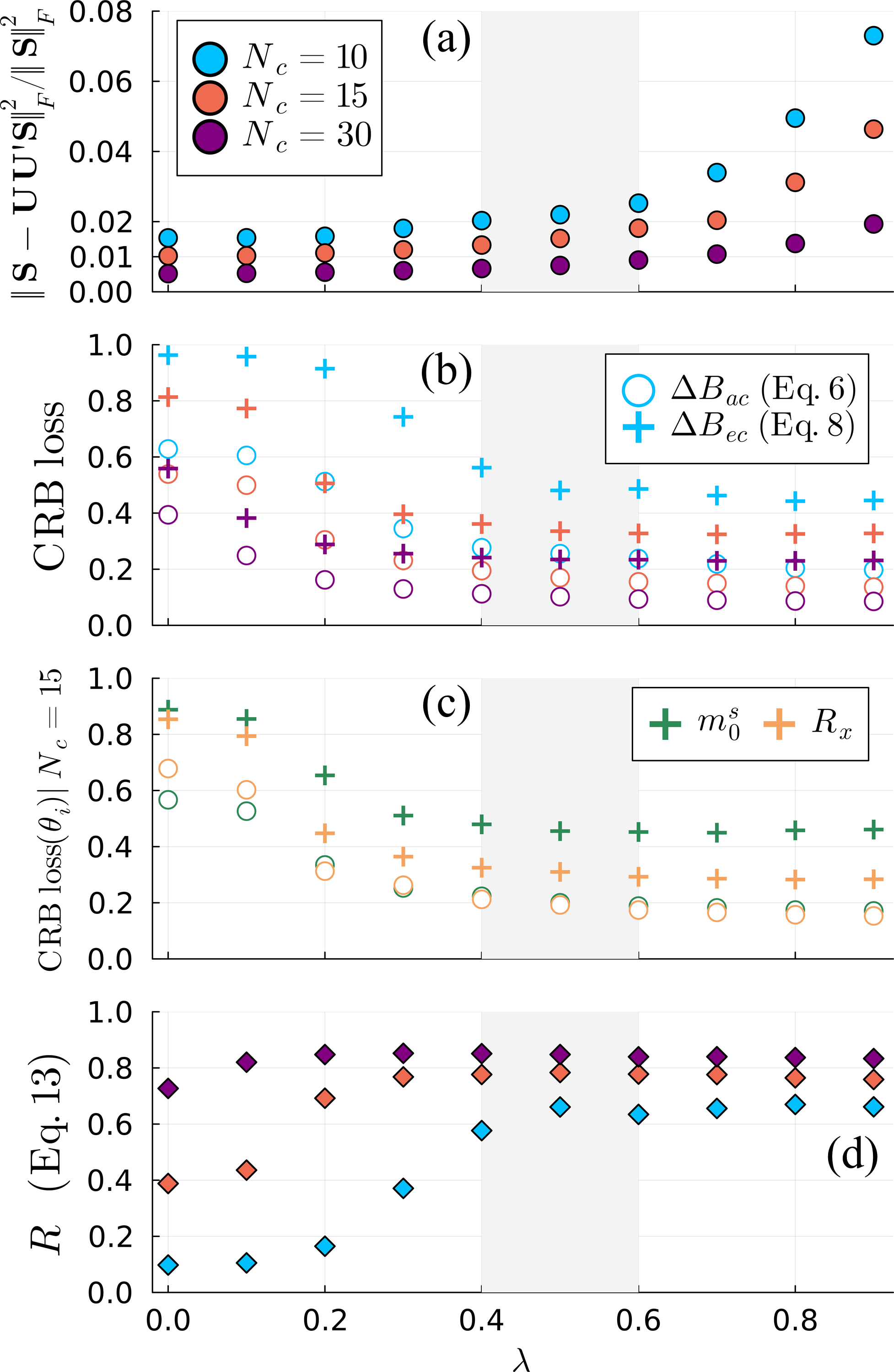
- The CRB-SVD basis significantly improves the preservation of the Cramér-Rao bound across all biophysical parameters compared to traditional SVD, with negligible loss in preserved signal energy.
- In simulations, the proposed method reduces both bias and variance in parameter estimates, particularly under low signal-to-noise ratio (SNR) and limited measurement conditions.
- In vivo results for the two-pool qMT model showed improved accuracy and precision in magnetization transfer parameters when using the CRB-optimized basis.
- For T₁/T₂ mapping with MRF-FISP, the CRB-SVD basis enabled reliable parameter estimation at smaller subspace sizes, reducing computational load and memory usage.
- The method achieved computational savings and memory efficiency by allowing the use of smaller basis sizes without sacrificing estimation quality.
- The approximation of the compressed CRB using orthogonalized derivatives was shown to be sufficiently accurate and effective for practical basis optimization, with no significant performance difference when increasing sample size beyond a certain threshold.
Better researchstarts right now
From reading papers to final review, dramatically reduce your research time.
No credit card · Free plan available
This review was created by AI and reviewed by human editors.