
[Paper Review] Crystal Structure Generation Based on Polyhedra using Dual Periodic Graphs
This paper proposes a novel method for crystal structure generation using dual periodic graphs derived from polyhedral motifs, leveraging closed-path bases in periodic graphs to model atomic connectivity. The approach enables systematic enumeration of stable crystal structures by encoding topological constraints via algebraic relations in edge and cycle spaces, with successful application to FCC, HCP, and BCC structures through computational realization using graph theory and linear algebra.
Crystal structure design is important for the discovery of new highly functional materials because crystal structure strongly influences material properties. Crystal structures are composed of space-filling polyhedra, which affect material properties such as ionic conductivity and dielectric constant. However, most conventional methods of crystal structure prediction use random structure generation methods that do not take space-filling polyhedra into account, contributing to the inefficiency of materials development. In this work, we propose a crystal structure generation method based on discrete geometric analysis of polyhedra information. In our method, the shape and connectivity of a space-filling polyhedron are represented as a dual periodic graph, and the crystal structure is generated by the standard realization of this graph. We demonstrate that this method can correctly generate face-centered cubic, hexagonal close-packed, and body-centered cubic structures from dual periodic graphs. This work is a first step toward generating undiscovered crystal structures based on the target polyhedra, leading to major advances in materials design in areas including electronics and energy storage.
Motivation & Objective
- To develop a systematic method for generating crystal structures from polyhedral motifs using periodic graph theory.
- To model atomic connectivity in crystals through closed-path bases in multi-directed periodic graphs.
- To formalize the topological constraints of crystal structures using cycle space and edge space algebra.
- To enable automated generation of dual periodic structures from graph-based representations.
- To demonstrate the method on common close-packed and body-centered structures (FCC, HCP, BCC).
Proposed method
- Construct a multi-directed periodic graph representing atomic connectivity in a crystal motif, with nodes as atoms and edges as bonds.
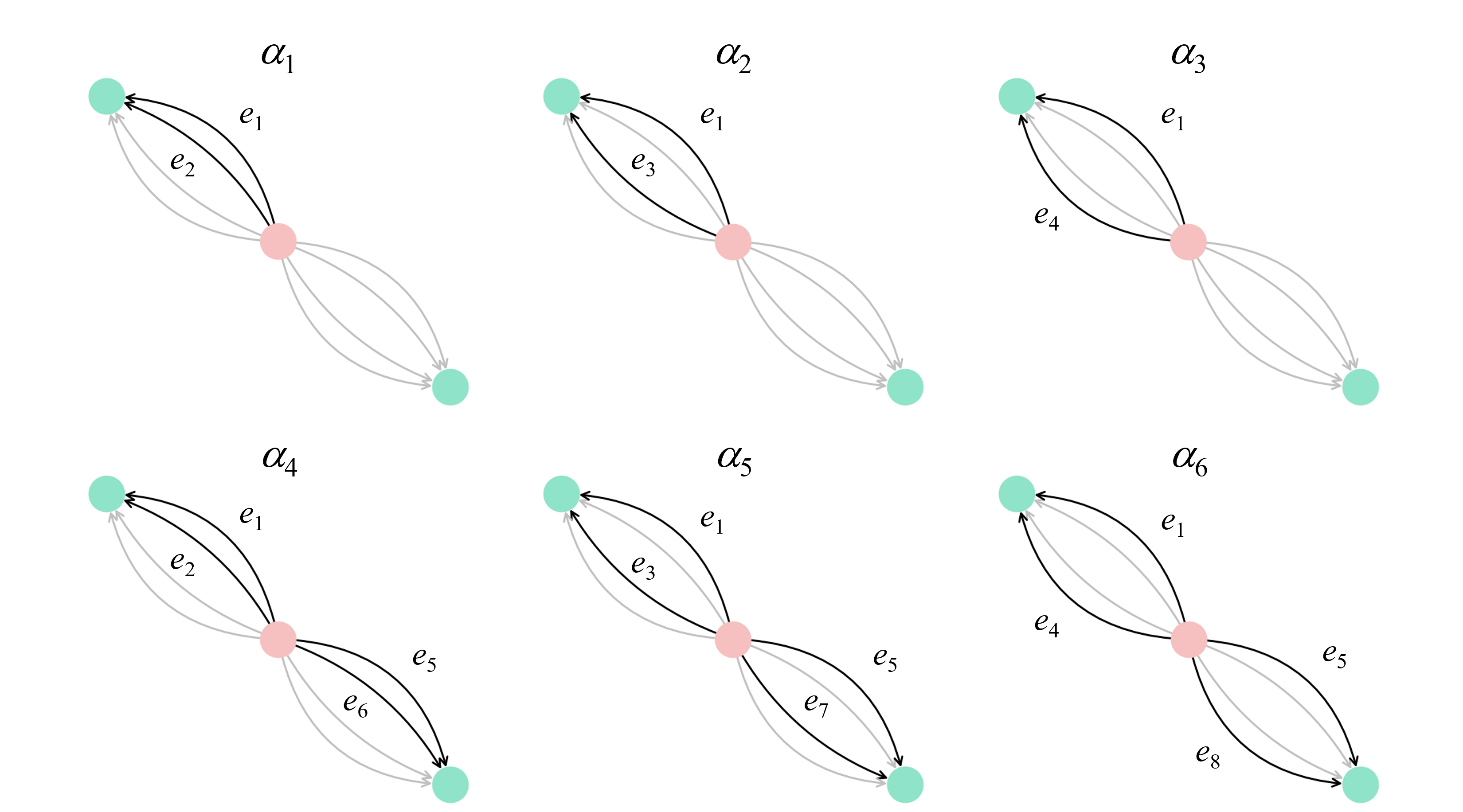
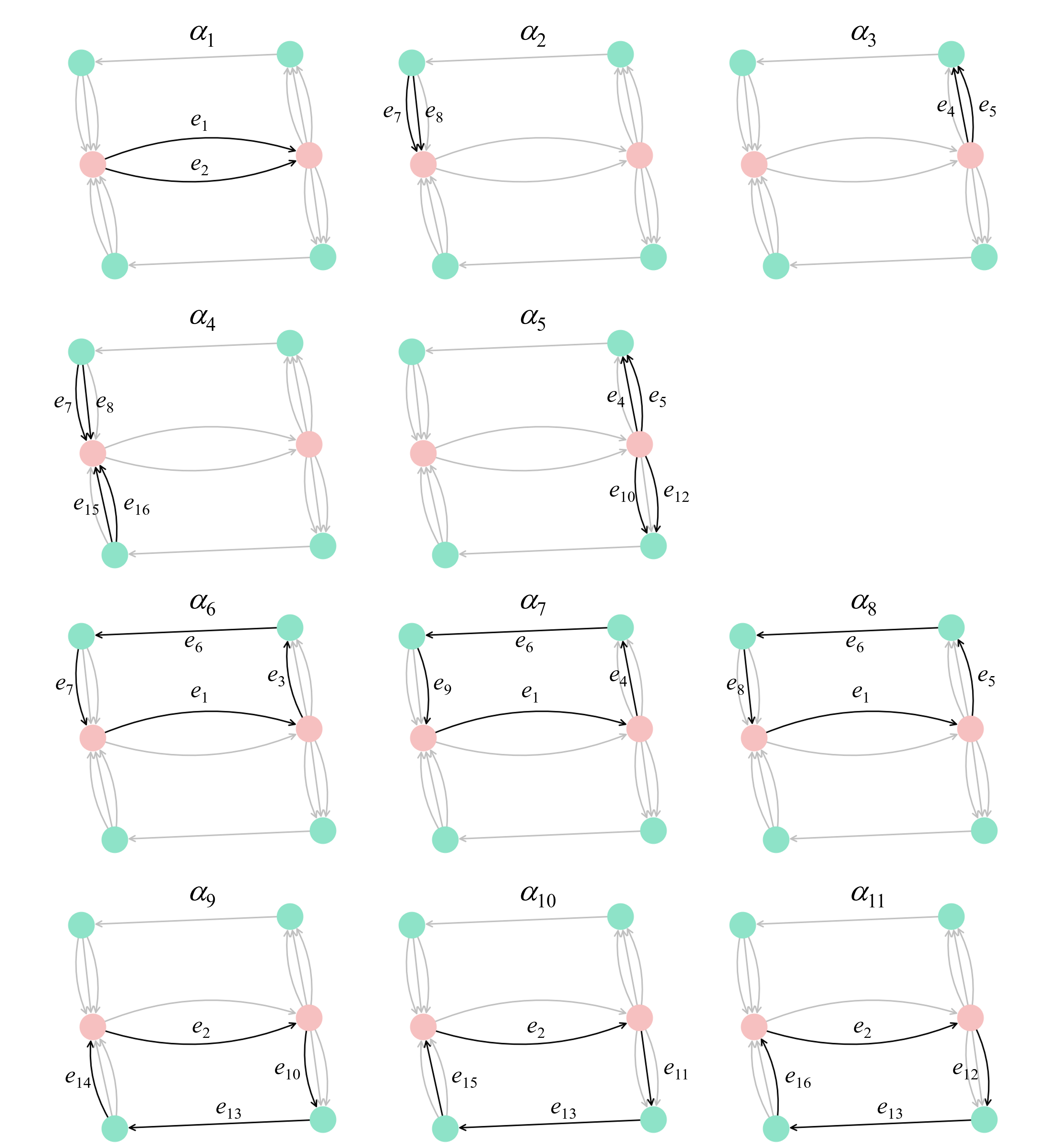
- Define a cycle basis using closed paths in the graph, represented as integer combinations of edge vectors.
- Formulate algebraic relations (alpha vectors) that encode topological consistency conditions for the graph's cycles.
- Apply linear algebra to compute the standard realization of the graph via matrix inversion and Cholesky decomposition on the Gram matrix.
- Generate atomic coordinates by summing edge displacements along shortest paths from a reference node.
- Construct the final crystal structure using pymatgen, with lattice scaling to desired volume and site merging for consistency.
Experimental results
Research questions
- RQ1How can polyhedral motifs in crystals be systematically encoded as periodic graphs with topological constraints?
- RQ2What algebraic framework can represent the cycle space of a periodic graph to ensure structural consistency?
- RQ3Can a dual periodic graph representation generate physically plausible crystal structures for common close-packed and body-centered lattices?
- RQ4How do edge and cycle basis vectors relate to the geometric realization of crystal structures?
- RQ5What is the role of the Gram matrix and edge displacement vectors in reconstructing atomic coordinates from graph topology?
Key findings
- The method successfully generates dual periodic structures for FCC, HCP, and BCC lattices using a unified graph-theoretic framework.
- Closed-path bases in the graph's cycle space are encoded as integer vectors (alpha) that enforce topological consistency.
- The standard realization is computed via matrix inversion and Cholesky decomposition on the Gram matrix derived from the alpha vectors.
- Atomic coordinates are reconstructed by path-wise summation of edge displacement vectors from a reference origin.
- The resulting structures are validated through pymatgen’s structure generation and lattice scaling, with site merging to ensure chemical consistency.
- The approach enables automated, topology-driven crystal structure generation without prior knowledge of atomic positions.
Read this paper
Open the full text in the Nubint reader and ask about any passage as you read.
Read this paper on NubintThis review was generated by AI from the original paper. Please check the paper before citing it.