
[Paper Review] Cutting multi-control quantum gates with ZX calculus
This paper introduces a method to decompose multi-controlled Z (MCZ) gates using ZX calculus for circuit cutting in NISQ-era quantum computing. It achieves a sampling overhead of 𝒪(6²ᴷ) for general MCZ gates and 𝒪(4.5²ᴷ) for CCZ gates, enabling noise-resilient execution on current hardware by reducing CNOT gate counts, as validated experimentally on IBM hardware.
Circuit cutting, the decomposition of a quantum circuit into independent partitions, has become a promising avenue towards experiments with larger quantum circuits in the noisy-intermediate scale quantum (NISQ) era. While previous work focused on cutting qubit wires or two-qubit gates, in this work we introduce a method for cutting multi-controlled Z gates. We construct a decomposition and prove the upper bound $\mathcal{O}(6^{2K})$ on the associated sampling overhead, where $K$ is the number of cuts in the circuit. This bound is independent of the number of control qubits but can be further reduced to $\mathcal{O}(4.5^{2K})$ for the special case of CCZ gates. Furthermore, we evaluate our proposal on IBM hardware and experimentally show noise resilience due to the strong reduction of CNOT gates in the cut circuits.
Motivation & Objective
- To address the challenge of executing large-scale quantum circuits on NISQ devices with limited qubits and high noise.
- To extend circuit-cutting techniques beyond qubit wires and two-qubit gates to multi-controlled Z (MCZ) gates.
- To develop a decomposition method for MCZ gates using ZX calculus that minimizes sampling overhead.
- To demonstrate experimental noise resilience through reduced CNOT gate counts in cut circuits on IBM hardware.
Proposed method
- The authors use ZX calculus to derive explicit decompositions of multi-controlled Z gates into tensor networks with controlled-Z and Pauli-Z operations.
- They decompose the unitary channel of an MCZ gate into a weighted sum of independent circuit pairs, enabling circuit cutting.
- The method introduces a superoperator decomposition that allows probabilistic estimation of the original circuit's output via intermediate measurements and post-selection.
- A sampling overhead bound of 𝒪(6²ᴷ) is proven for general MCZ gates, with a tighter bound of 𝒪(4.5²ᴷ) for CCZ gates, independent of the number of control qubits.
- The approach leverages gate teleportation and Bell-state decompositions to reduce variance in estimation, similar to prior work on joint cutting.
- The method is evaluated on IBM Q hardware, where reduced CNOT counts lead to improved noise resilience in cut circuits.
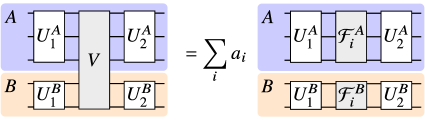
Experimental results
Research questions
- RQ1Can multi-controlled Z gates be effectively cut using a diagrammatic calculus like ZX calculus to enable execution on smaller quantum devices?
- RQ2What is the sampling overhead associated with cutting MCZ gates, and how does it scale with the number of cuts?
- RQ3Can the decomposition of MCZ gates be optimized to reduce the sampling overhead, especially for special cases like CCZ gates?
- RQ4How does the reduced CNOT count in cut circuits affect noise resilience in real hardware experiments?
- RQ5Can the proposed method be applied to near-term quantum algorithms such as QAOA or constrained optimization?
Key findings
- The sampling overhead for cutting general MCZ gates is bounded by 𝒪(6²ᴷ), independent of the number of control qubits.
- For the special case of CCZ gates, the sampling overhead is reduced to 𝒪(4.5²ᴷ), representing a significant improvement.
- The decomposition method is implemented and experimentally validated on IBM Q hardware, showing reduced CNOT gate counts in cut circuits.
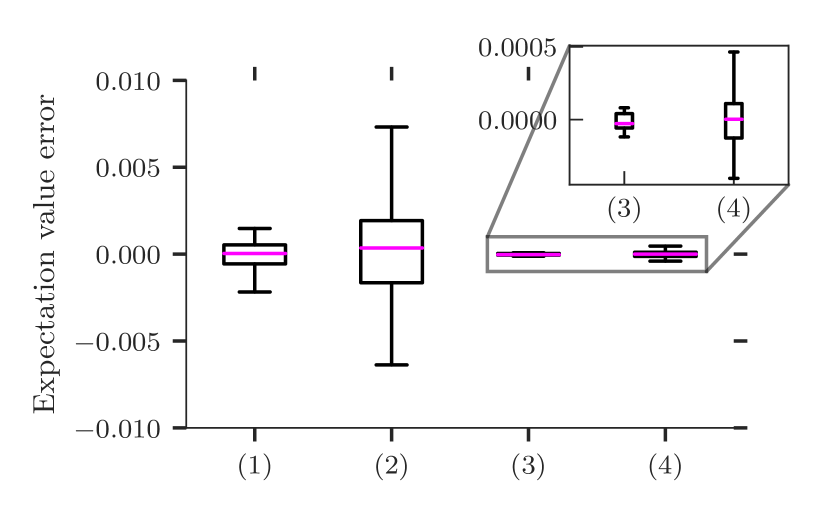
- The reduction in CNOT gates leads to observable noise resilience in real hardware, confirming the practical benefit of the method.
- The method enables the use of circuit cutting in algorithms like the alternating operator ansatz for constrained optimization, where MCZ gates are common.
- The approach maintains unbiased estimation through post-selection and probabilistic sampling, with variance bounded by Hoeffding's inequality.
Better researchstarts right now
From reading papers to final review, dramatically reduce your research time.
No credit card · Free plan available
This review was created by AI and reviewed by human editors.