
[Paper Review] Distribution Grid Line Outage Identification with Unknown Pattern and Performance Guarantee
This paper proposes a robust, data-driven method for distribution grid line outage identification using only voltage magnitudes, eliminating the need for phase angles or power flow data. By employing projected gradient descent with a Bregman divergence constraint, the approach learns unknown post-outage distribution parameters with convergence guarantees, achieving timely detection and localization in real-world grids without prior outage pattern knowledge.
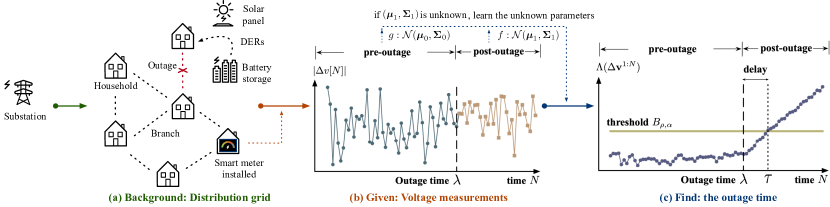
Line outage identification in distribution grids is essential for sustainable grid operation. In this work, we propose a practical yet robust detection approach that utilizes only readily available voltage magnitudes, eliminating the need for costly phase angles or power flow data. Given the sensor data, many existing detection methods based on change-point detection require prior knowledge of outage patterns, which are unknown for real-world outage scenarios. To remove this impractical requirement, we propose a data-driven method to learn the parameters of the post-outage distribution through gradient descent. However, directly using gradient descent presents feasibility issues. To address this, we modify our approach by adding a Bregman divergence constraint to control the trajectory of the parameter updates, which eliminates the feasibility problems. As timely operation is the key nowadays, we prove that the optimal parameters can be learned with convergence guarantees via leveraging the statistical and physical properties of voltage data. We evaluate our approach using many representative distribution grids and real load profiles with 17 outage configurations. The results show that we can detect and localize the outage in a timely manner with only voltage magnitudes and without assuming a prior knowledge of outage patterns.
Motivation & Objective
- To address the challenge of line outage identification in distribution grids when post-outage patterns are unknown and prior knowledge is unavailable.
- To develop a method that relies solely on readily available voltage magnitude measurements, avoiding reliance on expensive phasor or power flow data.
- To ensure timely operation by providing theoretical convergence guarantees for parameter learning under physical and statistical constraints.
- To eliminate feasibility issues in gradient descent-based parameter estimation through a Bregman divergence constraint.
- To enable accurate and fast outage detection and localization in real-world distribution grids with minimal assumptions.
Proposed method
- A projected gradient descent framework is proposed to learn unknown post-outage distribution parameters from voltage magnitude data.
- A Bregman divergence constraint is introduced to maintain feasibility during parameter updates, preventing divergence in gradient descent.
- The method leverages statistical and physical properties of voltage data to ensure convergence and stability.
- The algorithm is accelerated via optimization techniques, reducing execution time by over 75% with minimal accuracy loss.
- The approach uses a change-point detection framework with learned post-outage distributions, avoiding the need for prior knowledge of outage patterns.
- Theoretical convergence is proven using restricted convexity and bounded gradient norms, ensuring sub-optimality bounds over iterations.
Experimental results
Research questions
- RQ1Can line outages be accurately detected and localized using only voltage magnitude measurements without prior knowledge of outage patterns?
- RQ2How can gradient descent be made feasible and stable when learning unknown post-outage distributions in distribution grids?
- RQ3What theoretical guarantees can be provided for the convergence and performance of the parameter learning process in outage detection?
- RQ4Can the proposed method achieve timely operation while maintaining high detection accuracy in real-world distribution grid scenarios?
- RQ5How does the Bregman divergence constraint improve the feasibility and robustness of the parameter estimation process?
Key findings
- The proposed method detects and localizes line outages using only voltage magnitudes, eliminating the need for phase angles or power flow data.
- The Bregman divergence constraint successfully prevents feasibility issues in gradient descent, enabling stable parameter learning.
- Theoretical convergence is guaranteed, with sub-optimality decreasing as O(1/√E) over E iterations.
- The algorithm achieves over 75% reduction in execution time through acceleration, enabling timely operation.
- Empirical evaluation on representative distribution grids with 17 outage configurations confirms high accuracy and robustness across diverse scenarios.
- The method maintains high performance even in mesh networks and with distributed energy resources, where traditional 'last gasp' signals fail.
Better researchstarts right now
From reading papers to final review, dramatically reduce your research time.
No credit card · Free plan available
This review was created by AI and reviewed by human editors.