
[Paper Review] Evolution from quantum anomalous Hall insulator to heavy-fermion semimetal in magic-angle twisted bilayer graphene
The paper uses momentum-space determinant QMC to show a transition in magic-angle TBG at ν = -3 from a quantum anomalous Hall insulator (chiral limit) to a heavy-fermion semimetal as AA hopping u0 increases, with signatures of localized and itinerant electrons and a possible quadratic band touching semimetal.
The ground states of twisted bilayer graphene (TBG) at chiral and flat-band limit with integer fillings are known from exact solutions, while their dynamical and thermodynamical properties are revealed by unbiased quantum Monte Carlo (QMC) simulations. However, to elucidate experimental observations of correlated metallic, insulating and superconducting states and their transitions, investigations on realistic, or non-chiral cases are vital. Here we employ momentum-space QMC method to investigate the evolution of correlated states in magic-angle TBG away from chiral limit at charge neutrality with polarized spin/valley, which approximates to an experimental case with filling factor $ν=-3$. We find that the ground state evolves from quantum anomalous Hall insulator into an intriguing correlated semimetallic state possessing heavy-fermion features as AA hopping strength reaches experimental values. Such a state resembles the recently proposed heavy-fermion representations with localized electrons residing at AA stacking regions and delocalized electrons itinerating via AB/BA stacking regions. The spectral signatures of the localized and itinerant electrons in the heavy-fermion semimetal phase are revealed, with the connection to experimental results being discussed.
Motivation & Objective
- Explore how correlated states in magic-angle TBG evolve away from the chiral limit at charge neutrality (ν = -3).
- Determine how increasing AA hopping u0 affects the QAH ground state and potential emergence of a heavy-fermion semimetal.
- Identify spectral and real-space signatures distinguishing localized and itinerant electrons in the non-chiral regime.
- Connect theoretical findings with experimental observations of metallic, insulating, and superconducting states in TBG.
Proposed method
- Use momentum-space determinant Quantum Monte Carlo to study the projected flat-band Hamiltonian with long-range Coulomb interactions.
- Project the full Hamiltonian onto two low-energy flat bands at ν = -3 and simulate spin/valley polarized sector.
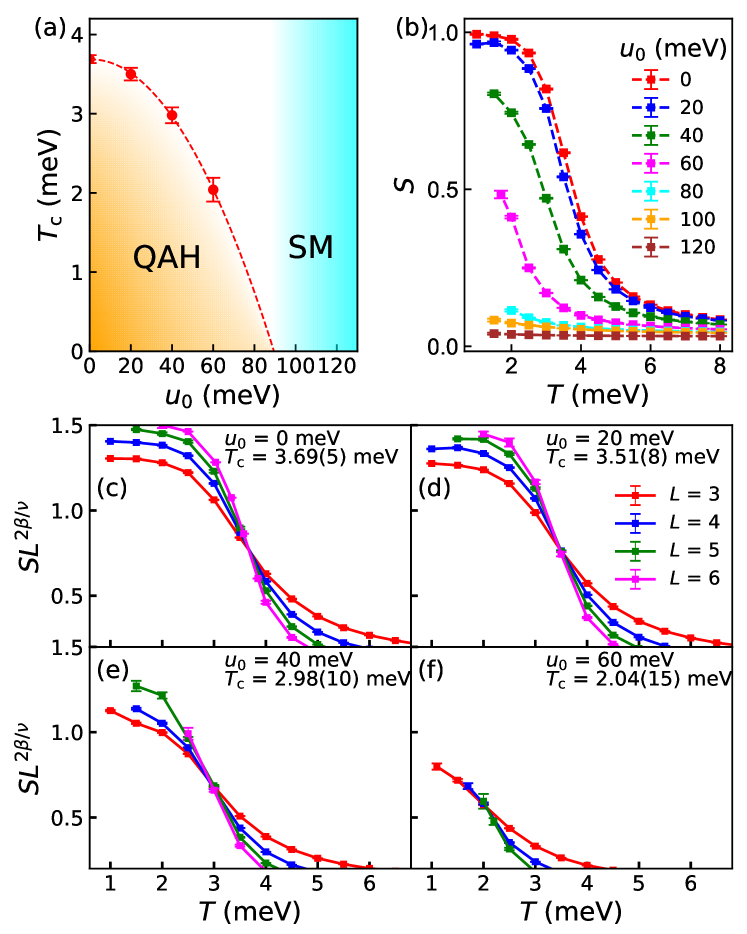
- Compute Chern-number polarization S from finite-size scaling to extract Tc and identify QAH order.
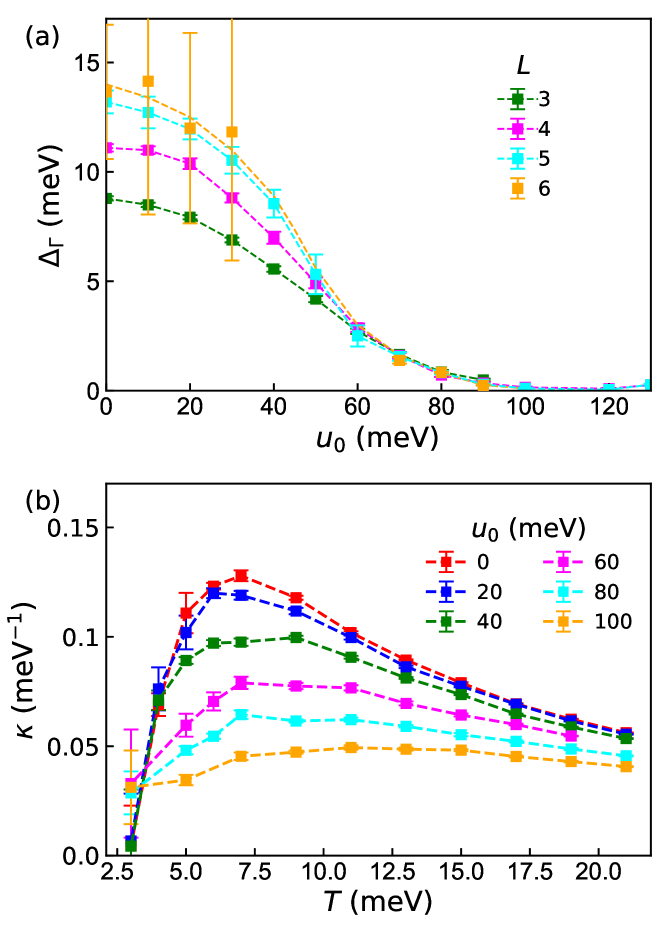
- Extract quasiparticle gaps ΔΓ from imaginary-time Green's functions via fits and stochastic analytic continuation.
- Compute spectral functions A(k,ω) and LDOS to analyze gap closing and metallicity.
- Analyze real-space spectral weight A(r,ω) to distinguish localized AA vs itinerant AB/BA contributions.
Experimental results
Research questions
- RQ1Does the QAH ground state persist away from the chiral limit as u0 increases?
- RQ2At what u0 does the system transition to a semimetal, and what are its topological and spectral characteristics?
- RQ3Do localized AA-stacking states coexist with itinerant AB/BA states in the high-u0 regime, consistent with a heavy-fermion picture?
- RQ4Is the resulting semimetal preserving C3 symmetry and showing quadratic band touching at Γ?
- RQ5How do theoretical findings align with experimental observations of ν = -3 TBG in non-chiral regimes?
Key findings
- Tc for spontaneous time-reversal symmetry breaking decreases with increasing u0 and vanishes near u0 ≈ 90 meV.
- The ground state evolution is from a QAH insulator to a semimetal as u0 crosses ≈ 0.8 u1, with Γ-point quasiparticle gap closing.
- Quasiparticle spectra show a gap for all k below Tc and gapless Γ vicinity above Tc, indicating a SM phase.
- LDOS shows a peak at the Fermi level emerging as the gap closes, signaling metallicity.
- Real-space spectra reveal enhanced low-energy weight at AB/BA regions and localized states concentrating at AA centers, consistent with a heavy-fermion picture.
- The SM phase likely preserves C3 symmetry and resembles a quadratic band touching semimetal.
Better researchstarts right now
From reading papers to final review, dramatically reduce your research time.
No credit card · Free plan available
This review was created by AI and reviewed by human editors.