
[Paper Review] Symmetric Kondo Lattice States in Doped Strained Twisted Bilayer Graphene
The paper studies symmetric Kondo lattice states in doped twisted bilayer graphene using a topological heavy fermion model and its Kondo lattice limit, revealing suppression of symmetric Kondo phases at integer fillings and possible stabilization via doping or strain.
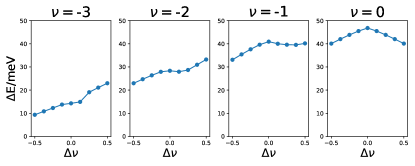
We use the topological heavy fermion (THF) model and its Kondo Lattice (KL) formulation to study the symmetric Kondo state in twisted bilayer graphene. Via a large-N approximation, we find a symmetric Kondo (SK) state in KL mode at fillings $ν=0,\pm 1,\pm 2$. In the SK state, all symmetries are preserved and the local moments are Kondo screened by the conduction electrons. At the mean-field level of the THF model at $ν=0,\pm 1, \pm 2, \pm 3$, we also find a similar symmetric state. We study the stability of the symmetric state by comparing its energy with the ordered states and find the ordered states to have lower energy. However, moving away from integer fillings by doping holes to the light bands, we find the energy difference is reduced, which suggests the loss of ordering and a tendency towards Kondo screening. In order to include many-body effects beyond the mean-field approximation, we perform dynamical mean-field theory (DMFT) calculations on the THF model. We find the spin susceptibility follows a Curie behavior at $ν=0, \pm 1,\pm 2$ down to $\sim 2 ext{K}$ where the onset of screening of the local moment becomes visible. This hints to very low Kondo temperatures at these fillings, in agreement with the outcome of our mean-field calculations. At non-integer filling $ν=\pm 0.5,\pm 0.8,\pm 1.2$ DMFT shows deviations from a $1/T$-susceptibility at much higher temperatures, suggesting a more effective screening of local moments with doping. Finally, we study the effect of a $C_{3z}$-rotational-symmetry-breaking strain via mean-field approaches and find that a symmetric phase (that only breaks $C_{3z}$ symmetry) can be stabilized at sufficiently large strain at $ν=0,\pm 1, \pm 2$. Our results suggest that a symmetric Kondo phase is strongly suppressed at integer fillings, but could be stabilized either at non-integer fillings or by applying strain.
Motivation & Objective
- Motivate understanding of how local moments in MATBLG can be screened by conduction electrons via a Kondo mechanism.
- Investigate whether a symmetric Kondo phase can exist at integer fillings within the THF and KL frameworks.
- Compare mean-field and dynamical mean-field theory (DMFT) results to assess stability of symmetric vs. ordered states.
- Examine how doping and strain affect the competition between Kondo screening and symmetry-breaking orders.
Proposed method
- Utilize the topological heavy fermion (THF) model and its Kondo lattice (KL) formulation to describe c-electrons and localized f-electrons in MATBLG.
- Perform a large-N mean-field analysis of the KL model to identify a symmetric Kondo (SK) state at integer fillings ν=0, ±1, ±2.
- Derive a mean-field Hamiltonian that renormalizes f–c hybridization via self-consistent fields V1*, V2*, V3*, V4* and incorporate a Lagrange multiplier to fix f-electron filling.
- Map the KL model onto a mean-field periodic Anderson-like framework, including Hartree contributions and a k-dependent c-electron scattering term H_cc.
- Employ dynamical mean-field theory (DMFT) to study beyond-mean-field effects on the THF model, focusing on spin susceptibility and Kondo screening tendencies.
- Explore the impact of C3z-breaking strain by adding a strain term and assessing stability of symmetric vs. ordered states.

Experimental results
Research questions
- RQ1Can a symmetric Kondo phase exist in the KL model at integer fillings ν=0, ±1, ±2?
- RQ2Is the symmetric phase adiabatically connected to any symmetric state in the THF model?
- RQ3How does doping (non-integer fillings) influence the competition between Kondo screening and symmetry-breaking order?
- RQ4What is the effect of strain that breaks C3z symmetry on the stability of symmetric vs. ordered states?
- RQ5Do DMFT results support or challenge the mean-field prediction regarding Kondo screening temperatures and local moment behavior?
Key findings
- In the KL model, a symmetric Kondo state is found at ν=0, −1, −2 where all symmetries are preserved and local moments are Kondo screened.
- Mean-field THF calculations show the symmetric state has higher energy than the ordered, symmetry-breaking states at integer fillings, suggesting ordering is energetically favored.
- DMFT reveals Curie-like spin susceptibility at integer fillings down to ~2 K, indicating very low Kondo temperatures and supporting suppression of Kondo screening at these fillings.
- Doping (hole doping near integer fillings) reduces the energy gap between symmetric and ordered states, signaling enhanced tendency toward Kondo screening away from integer fillings.
- Strain breaking C3z symmetry can stabilize a symmetric phase at sufficient strain, with ΔE strain indicating possible stabilization near ν=0, −1, −2 under strong strain.
- Overall, a fully symmetric Kondo phase is unlikely at integer fillings, but could emerge at non-integer fillings or under strong strain.
Read this paper
Open the full text in the Nubint reader and ask about any passage as you read.
Read this paper on NubintThis review was generated by AI from the original paper. Please check the paper before citing it.