
[Paper Review] Flavor mixing and CP violation from the interplay of $S_4$ modular group and gCP
This paper proposes a unified flavor model based on $S_4$ modular symmetry combined with generalized CP (gCP) symmetry to explain lepton and quark masses and mixing patterns. By assigning matter fields to irreducible representations of $S_4$ and using modular forms of the modulus $ au$, the framework generates hierarchical masses and mixing angles with minimal free parameters. The key result is the identification of nine viable lepton models with seven real parameters (including $ ext{Re} au$, $ ext{Im} au$) and ten quark models with seven couplings that successfully fit experimental data, including CP violation and baryogenesis.
We have performed a systematical analysis of lepton and quark masses models based on $Γ_4\cong S_4$ modular symmetry with gCP symmetry. We have considered both cases that neutrinos are Majorana particles and Dirac particles. All possible nontrivial representation assignments of matter fields are considered, and the most general form of fermion mass matrices are given. The phenomenologically viable models with the lowest number of free parameters together with the results of fit are presented. We find out nine lepton models with seven real free parameters including the real and imaginary parts of modulus for Majorana neutrinos, which can accommodate the lepton masses and neutrino oscillation data. The prediction for leptogenesis is studied in an example lepton model. The observed baryon asymmetry as well as lepton masses and mixing angles can be explained. For Dirac neutrinos, four lepton models with five real free couplings are compatible with experimental data. Ten quark models containing seven couplings are found to be able to accommodate the hierarchical quark masses and mixing angles and CP violation phase. Furthermore, the $S_4$ modular symmetry can provide a unified description of lepton and quark flavor structure, and a benchmark model is presented.
Motivation & Objective
- To construct a minimal and predictive flavor model for lepton and quark masses and mixing using $S_4$ modular symmetry and gCP symmetry.
- To systematically classify all possible nontrivial representation assignments of matter fields under $S_4$ and derive the most general fermion mass matrices.
- To identify phenomenologically viable models with the lowest number of free parameters that reproduce experimental data on neutrino oscillations, quark masses, and mixing angles.
- To study the implications for leptogenesis and CP violation in the context of the $S_4$-modular framework.
- To demonstrate that $S_4$ modular symmetry with gCP provides a unified description of both lepton and quark flavor structures.
Proposed method
- Employing $S_4$ modular symmetry with the modulus $ au$ as a free parameter to generate modular forms that serve as Yukawa couplings in the superpotential.
- Imposing generalized CP (gCP) symmetry to constrain complex phases and reduce the number of free parameters, ensuring all couplings are real when Clebsch-Gordan coefficients are real.
- Systematically analyzing all irreducible representations of $S_4$ (1, 1', 2, 3, 3') for left-handed leptons, right-handed neutrinos, and quark fields to derive the most general mass matrices.
- Using the modular weight $k$ and transformation properties of modular forms to construct Dirac and Majorana mass matrices for neutrinos and charged fermions.
- Performing numerical fits of the resulting models to experimental data, including neutrino masses, mixing angles, quark masses, and CKM mixing parameters.
- Studying leptogenesis in a benchmark lepton model to assess the model’s ability to generate the observed baryon asymmetry.
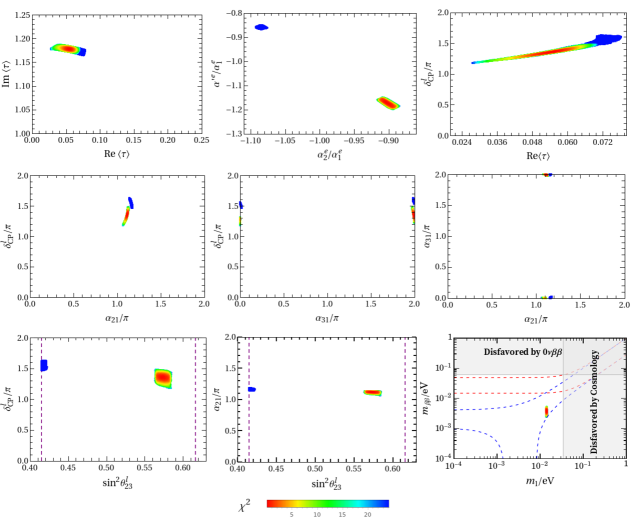
![Figure 1: The correlations among the input parameters, lepton mixing angles, CP violation phases and neutrino masses in the model L1. The lepton masses and mixing angles are required to lie in the experimentally preferred $3\sigma$ regions [ 76 ] . Notice that the transformation $\tau\rightarrow-\ta](https://ar5iv.labs.arxiv.org/html/2106.11659/assets/x1.png)
Experimental results
Research questions
- RQ1Can $S_4$ modular symmetry combined with gCP symmetry produce a minimal and predictive model for lepton masses and mixing with only a few free parameters?
- RQ2How many viable lepton models exist with Majorana neutrinos that can simultaneously fit neutrino oscillation data, CP violation, and leptogenesis?
- RQ3What is the minimal number of free parameters required to describe quark masses and mixing angles in a $S_4$-modular framework with gCP?
- RQ4Can the same $S_4$-modular and gCP framework consistently describe both lepton and quark flavor structures?
- RQ5What is the role of the modulus $ au$ in generating hierarchical masses and CP violation in this framework?
Key findings
- Nine phenomenologically viable lepton models with Majorana neutrinos were identified, each containing seven real free parameters (including $ ext{Re} au$ and $ ext{Im} au$), successfully fitting neutrino masses, mixing angles, and CP violation.
- Four lepton models with Dirac neutrinos and five real free couplings were found to be compatible with experimental data, including neutrino oscillation parameters.
- Ten quark models with seven real couplings were constructed that reproduce the hierarchical quark masses, mixing angles, and the observed CP violation phase in the CKM matrix.
- The model successfully explains the observed baryon asymmetry via leptogenesis in a benchmark lepton model, with the correct order of magnitude for the baryon-to-entropy ratio.
- The inclusion of gCP symmetry significantly reduces the number of free parameters by enforcing reality of couplings when Clebsch-Gordan coefficients are real, enhancing model predictivity.
- The $S_4$ modular symmetry with gCP provides a unified framework that simultaneously describes both lepton and quark flavor structures within a single group-theoretic and modular form-based construction.
Better researchstarts right now
From reading papers to final review, dramatically reduce your research time.
No credit card · Free plan available
This review was created by AI and reviewed by human editors.