
[Paper Review] GA-NIFS: Early-stage feedback in a heavily obscured AGN at $z=4.76$
Using JWST/NIRSpec integral field spectroscopy, this study detects a broad Hα line in the heavily obscured AGN ALESS073.1 at z=4.76, confirming a supermassive black hole (log M_BH/M☉ > 8.7) accreting at <15% Eddington rate. Despite high dust extinction (N_H ~ 10^24 cm⁻²), the presence of a broad line region classifies it as a Type 1 AGN, and a marginally resolved ionized outflow with a mass loading factor of ~0.01 increases turbulence in the central region without quenching star formation.
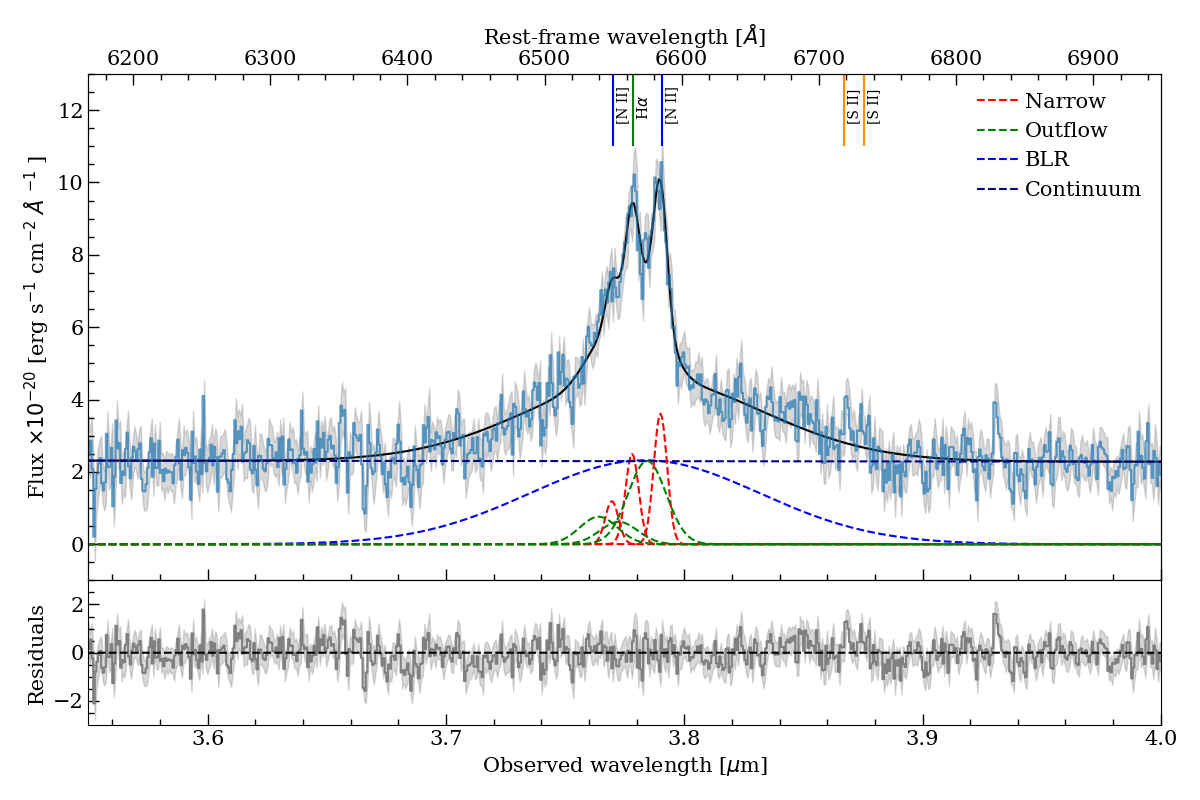
Dust-obscured galaxies are thought to represent an early evolutionary phase of massive galaxies in which the active galactic nucleus (AGN) is still deeply buried in significant amounts of dusty material and its emission is strongly suppressed. The unprecedented sensitivity of the James Webb Space Telescope enables us for the first time to detect the rest-frame optical emission of heavily obscured AGN and unveil the properties of the hidden accreting super-massive black holes (BHs). In this work, we present the JWST/NIRSpec IFS data of ALESS073.1, a massive, dusty, star-forming galaxy at $z = 4.76$ hosting an AGN at its center. The detection of a very broad $H_α$ emission associated with the Broad Line Region (BLR) confirms the presence of a BH ($\log(M_{BH}/M_\odot)>8.7$) accreting at less than 15\% of its Eddington limit and classifies the target as a Type 1 AGN. The rest-frame optical emission lines also reveal a fast ionized gas outflow marginally resolved in the galaxy center. The high sensitivity of NIRSpec allows us to perform the kinematic analysis of the narrow H$α$ component which indicates that the warm ionized gas velocity field is consistent with disk rotation. We also find that, in the innermost nuclear regions ($< 1.5$ kpc), the intrinsic velocity dispersion of the disk reaches $\sim 150$ km/s, $\sim 2-3$ times higher than the velocity dispersion inferred from the [CII] 158$μ$m line tracing mostly cold gas. Since, at large radii, the velocity dispersion of the warm and cold gas are comparable, we conclude that the outflows are injecting turbulence in the warm ionized gas in the central region, but they are not sufficiently powerful to disrupt the dense gas and quench star formation. These findings support the scenario that dust-obscured galaxies represent the evolutionary stage preceding the unobscured quasar when all gas and dust are removed from the host.
Motivation & Objective
- To investigate the early-phase feedback mechanisms in a heavily obscured AGN at high redshift (z=4.76), where AGN feedback is expected to be in its initial stages.
- To determine the accretion state and black hole mass of the AGN in ALESS073.1 using rest-frame optical emission lines.
- To assess the impact of AGN-driven outflows on the host galaxy's interstellar medium, particularly on star formation and gas kinematics.
- To compare the observed M_BH/M_star ratio with local and high-redshift quiescent systems to evaluate black hole-host co-evolution.
- To determine the ionization source of the ISM by analyzing the [N ii]/Hα line ratio across spatial scales.
Proposed method
- Acquired high-sensitivity, spatially resolved NIRSpec integral field spectroscopy (IFS) of ALESS073.1 with JWST to probe rest-frame optical emission lines.
- Performed kinematic decomposition of the Hα emission line to separate broad (BLR) and narrow components, measuring velocity widths and outflow properties.
- Measured the [N ii] λ6585/Hα ratio across the galaxy to distinguish between ionization sources: AGN vs. young stars.
- Calculated the mass loading factor (ξ) of the ionized outflow using the outflow mass flux and star formation rate.
- Compared the Hα velocity dispersion with [C ii] 158 μm line kinematics to assess energy deposition in different gas phases.
- Used stellar mass (log M_*/M☉ = 10.7) and black hole mass estimates (log M_BH/M☉ > 8.7) to evaluate the M_BH/M_star ratio relative to local and high-redshift benchmarks.
Experimental results
Research questions
- RQ1What is the accretion state of the AGN in ALESS073.1, and does it confirm the presence of a supermassive black hole?
- RQ2How does the ionized gas kinematics reveal the presence and properties of an AGN-driven outflow in a heavily obscured system?
- RQ3What is the role of the AGN in ionizing the host galaxy's interstellar medium, and how does it compare to ionization by young stars?
- RQ4To what extent is the outflow injecting energy into the ISM, and is it capable of quenching star formation?
- RQ5How does the M_BH/M_star ratio in this high-redshift obscured AGN compare to local and high-redshift quiescent systems?
Key findings
- The detection of a broad Hα component with FWHM > 9000 km s⁻¹ confirms the presence of a broad line region, indicating a supermassive black hole with log M_BH/M☉ > 8.7, despite high dust extinction (N_H ~ 10^24 cm⁻²).
- The AGN is classified as Type 1 due to the BLR, even though it is heavily obscured, demonstrating that rest-frame optical emission can be detected with JWST's sensitivity.
- A marginally resolved ionized outflow with a mass loading factor of ~0.01 is detected, indicating low efficiency in removing gas from the galaxy.
- The Hα velocity dispersion in the central region is 2–3 times higher than in the rest of the galaxy, indicating increased turbulence due to the outflow.
- The [N ii]/Hα ratio shows that the AGN dominates the ionization in the central region and outflow component, while younger stars dominate at larger radii.
- The M_BH/M_star ratio is more than one order of magnitude higher than in local AGN of similar stellar mass, suggesting early-stage black hole growth relative to the host.
![Figure 2: Spectrum of the central region from the G235H/F170LP cube. In the upper panel, we report in blue the spectrum around the [O iii ] $\lambda$ 5007Å emission, extracted from a circular aperture with a radius of 0.15″ in the central region with the associated error (gray-shaded region). In bla](https://ar5iv.labs.arxiv.org/html/2309.05713/assets/OIIIspectrum.png)
Better researchstarts right now
From reading papers to final review, dramatically reduce your research time.
No credit card · Free plan available
This review was created by AI and reviewed by human editors.