
[Paper Review] Holographic $T\bar{T}$ deformed entanglement entropy in dS$_3$/CFT$_2$
This paper proposes a holographic $T\bar{T}$-deformed $\text{dS}_3/\text{CFT}_2$ correspondence, where the entanglement entropy of two antipodal points on a 2-sphere is computed via the replica method in a $T\bar{T}$-deformed 2D CFT. The result exactly matches the complex geodesic length in the bulk $\text{dS}_3$, with the real part corresponding to the spacelike geodesic and the imaginary part to the timelike geodesics, confirming a precise duality for pseudoentropy in non-unitary de Sitter holography.
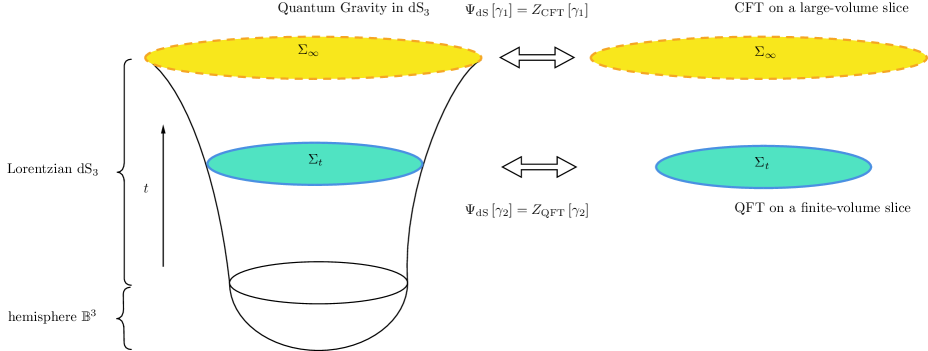
In this paper, based on the $T\bar{T}$ deformed version of $ ext{dS}_3/ ext{CFT}_2$ correspondence, we calculate the pseudoentropy for an entangling surface consisting of two antipodal points on a sphere and find it is exactly dual to the complex geodesic in the bulk.
Motivation & Objective
- To extend the $\text{dS}_3/\text{CFT}_2$ correspondence to include $T\bar{T}$ deformations, enabling a finite-time slice description of quantum gravity in de Sitter space.
- To compute the entanglement entropy for a two-point entangling surface in a $T\bar{T}$-deformed 2D CFT on a finite-volume spatial slice.
- To test whether the resulting pseudoentropy matches the length of a complex geodesic in the $\text{dS}_3$ bulk, as predicted by the Ryu-Takayanagi formula in de Sitter spacetime.
- To establish a holographic duality between $T\bar{T}$-deformed CFTs and finite-time bulk geometries, generalizing the $\text{AdS}/T\bar{T}$-CFT correspondence to de Sitter space.
Proposed method
- The $T\bar{T}$ deformation is implemented perturbatively via the flow equation $\partial_\lambda \log Z = -2\pi \int_{\Sigma} d^2x \sqrt{\gamma} \langle T\bar{T} \rangle_\lambda$, with the deformation parameter $\lambda \sim \mathcal{O}(1/c)$.
- The partition function of the $T\bar{T}$-deformed QFT on a 2-sphere is computed using the Wheeler-DeWitt equation and the $T\bar{T}$ flow, yielding a complex logarithmic partition function with both real and imaginary parts.
- The entanglement pseudoentropy is calculated using the replica method on an $n$-sheeted cover with metric $ds^2 = r^2(d\theta^2 + n^2 \sin^2\theta \, d\phi^2)$, leading to $S_A = (1 - n\partial_n)\log Z_n \big|_{n=1}$.
- The variation of $\log Z_n$ with respect to $n$ is related to the trace of the stress tensor via $n\partial_n \log Z_n = -\frac{1}{2} \int d^2x \sqrt{\gamma} \, T_a^a = \frac{r}{2} \frac{d}{dr} \log Z_{\text{QFT}}$.
- The bulk geodesic distance between antipodal points is computed in $\text{dS}_3$ using the metric $ds^2 = -\cosh^2 t \, dt^2 + \ell_{\text{dS}}^2 (d\theta^2 + \sin^2\theta \, d\phi^2)$, yielding $D = \ell_{\text{dS}} \pi - 2i \ell_{\text{dS}} t$.
- The Ryu-Takayanagi formula is applied with $S_A = D / (4G_N)$, and the Newton constant is identified via $G_N \sim 1/c_{\text{dS}}$, leading to a match with the field theory result.
Experimental results
Research questions
- RQ1Does the $T\bar{T}$-deformed $\text{dS}_3/\text{CFT}_2$ correspondence reproduce the correct entanglement entropy for a two-point entangling surface?
- RQ2Can the pseudoentropy in a non-unitary $T\bar{T}$-deformed CFT be holographically matched to a complex geodesic in $\text{dS}_3$?
- RQ3Is the real part of the entanglement entropy proportional to the length of the spacelike geodesic, and the imaginary part to the timelike geodesics, as in the Ryu-Takayanagi prescription?
- RQ4How does the $T\bar{T}$ deformation affect the holographic entanglement entropy in de Sitter space, particularly in the finite-time slice regime?
Key findings
- The pseudoentropy for two antipodal points on a $\mathbb{S}^2$ in the $T\bar{T}$-deformed CFT is $S_A = \frac{c_{\text{dS}}}{6}\pi - i\frac{c_{\text{dS}}}{3}t$, with the real part matching the spacelike geodesic and the imaginary part the timelike geodesics.
- The bulk geodesic distance between antipodal points at equal time is $D = \ell_{\text{dS}} \pi - 2i \ell_{\text{dS}} t$, which matches the field theory result when $S_A = D / (4G_N)$.
- The identification $G_N \sim 1/c_{\text{dS}}$ leads to $S_A = \frac{c_{\text{dS}}}{6}\pi - i\frac{c_{\text{dS}}}{3}t$, confirming the duality between the field theory pseudoentropy and the complex geodesic length.
- The $T\bar{T}$ deformation introduces an imaginary shift in the partition function, which is responsible for the complex structure of the entanglement entropy, consistent with non-unitary CFTs in de Sitter space.
- The result confirms that the $T\bar{T}$-deformed $\text{dS}_3/\text{CFT}_2$ correspondence is consistent with Cauchy slice holography, where time emerges as a radial direction.
- The complex geodesic structure—comprising one spacelike and two timelike geodesics—matches the extremal surface in the Ryu-Takayanagi formula, validating the holographic entanglement entropy in de Sitter space.
Better researchstarts right now
From reading papers to final review, dramatically reduce your research time.
No credit card · Free plan available
This review was created by AI and reviewed by human editors.