
[Paper Review] Impact of dimension-eight SMEFT operators in the EWPO and Triple Gauge Couplings analysis in Universal SMEFT
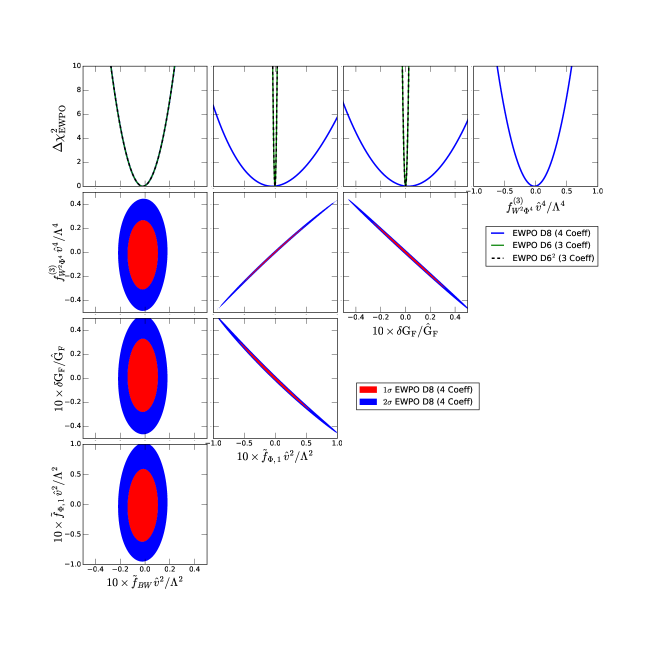
This paper performs a comprehensive analysis of electroweak precision observables (EWPO) and diboson production in the Universal SMEFT up to dimension-eight operators, assuming universal, C- and P-conserving new physics. It demonstrates that LHC data can independently constrain Wilson coefficients of both dimension-six and dimension-eight operators contributing to triple gauge couplings, and finds that dimension-eight effects on triple gauge couplings are negligible within this framework.
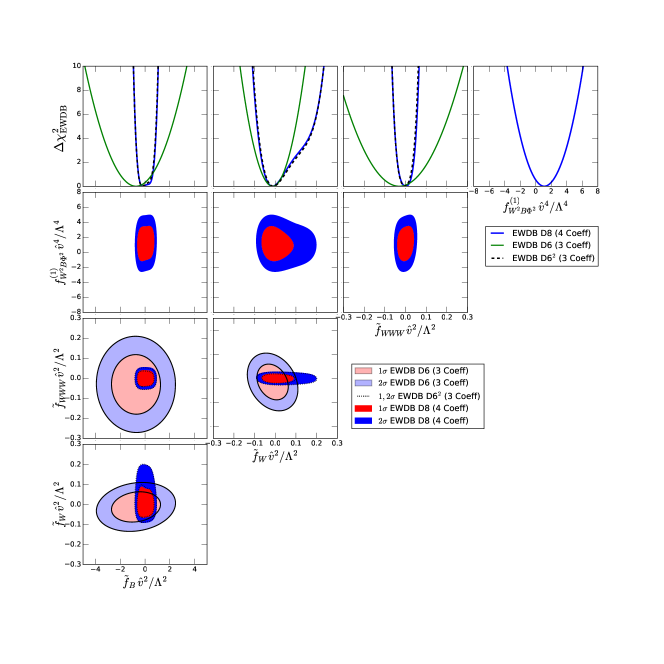
We perform a complete study of the electroweak precision observables and electroweak gauge boson pair production in terms of the SMEFT up to ${\cal O}(1/Λ^4)$ under the assumption of universal, C and P conserving new physics. We show that the analysis of data from those two sectors allows us to obtain closed constraints in the relevant parameter space in this scenario. In particular we find that the Large Hadron Collider data can independently constrain the Wilson coefficients of the dimension-six and -eight operators directly contributing to the triple gauge boson vertices. Our results show that the impact of dimension-eight operators in the study of triple gauge couplings is small.
Motivation & Objective
- To perform a complete analysis of electroweak precision observables (EWPO) and electroweak diboson (EWDB) production in the Universal SMEFT up to $\mathcal{O}(1/\Lambda^4)$.
- To constrain Wilson coefficients of dimension-six and dimension-eight operators using LHC data under the assumption of universal, C- and P-conserving new physics.
- To assess the impact of dimension-eight operators on triple gauge coupling (TGC) measurements in the context of current experimental constraints.
- To demonstrate the feasibility of sequential analysis: first constraining effective combinations of coefficients via EWPO, then applying bounds to diboson processes.
- To close the parameter space of relevant Wilson coefficients using data from both EWPO and EWDB sectors.
Proposed method
- Uses the Hagiwara-Ishihara-Szalapski-Zeppenfeld (HISZ) basis for dimension-six operators in the universal SMEFT framework.
- Applies field redefinitions to eliminate fermionic operators, retaining only bosonic operators under C and P conservation.
- Derives analytical expressions for triple gauge boson couplings ($\gamma W^+W^-$, $Z W^+W^-$) up to $\mathcal{O}(1/\Lambda^4)$, including contributions from dimension-eight operators.
- Expresses TGCs in terms of Wilson coefficients such as $f_W$, $f_{B ilde{f}}$, $\tilde{f}_{BW}$, $\tilde{f}_{\Phi,1}$, and $f^{(1)}_{W\Phi^4D^2}$, among others.
- Performs a global fit using LHC data on EWPO and diboson production to constrain the effective couplings and their $\Lambda$-dependent corrections.
- Uses a sequential analysis strategy: first constrain four effective combinations of Wilson coefficients from EWPO, then apply these bounds to reduce the number of free parameters in the diboson analysis.
Experimental results
Research questions
- RQ1To what extent can LHC data on electroweak precision observables constrain the Wilson coefficients of dimension-six and dimension-eight operators in the universal SMEFT?
- RQ2How significant is the contribution of dimension-eight operators to the triple gauge boson couplings ($\gamma W^+W^-$, $Z W^+W^-$) in the universal SMEFT framework?
- RQ3Can the analysis of diboson production data independently constrain the same Wilson coefficients as EWPO, and how do the constraints compare?
- RQ4What is the impact of $\mathcal{O}(1/\Lambda^4)$ corrections—specifically from dimension-eight operators—on the determination of triple gauge couplings?
- RQ5Is it feasible to perform a sequential analysis, using EWPO constraints to reduce the parameter space before analyzing diboson data?
Key findings
- LHC data on electroweak precision observables can independently constrain four effective combinations of Wilson coefficients from both dimension-six and dimension-eight operators.
- The analysis of diboson production data further constrains the same parameter space, allowing for closed bounds on the full relevant set of Wilson coefficients.
- The impact of dimension-eight operators on the triple gauge couplings ($\gamma W^+W^-$ and $Z W^+W^-$) is found to be negligible within the current experimental sensitivity.
- The sequential analysis strategy—first using EWPO to constrain effective combinations, then applying those bounds to diboson analysis—is both feasible and effective in reducing the number of free parameters.
- The study confirms that in the universal, C- and P-conserving SMEFT framework, the number of relevant dimension-eight operators is sufficiently limited to allow a complete and consistent $\mathcal{O}(1/\Lambda^4)$ analysis.
- The analytical expressions for TGCs up to $\mathcal{O}(1/\Lambda^4)$ include contributions from 14 dimension-eight operators, but their net effect on TGCs is subdominant compared to dimension-six effects.
Better researchstarts right now
From reading papers to final review, dramatically reduce your research time.
No credit card · Free plan available
This review was created by AI and reviewed by human editors.