
[Paper Review] Irreversible 2-conversion set in graphs of bounded degree
This paper resolves the computational complexity of finding minimum irreversible 2-conversion sets in graphs, proving NP-completeness for graphs of maximum degree 4 while showing polynomial-time solvability for graphs of maximum degree 3. It further presents a simplified optimal construction for irreversible 3-conversion sets on toroidal grids, improving upon prior results with tighter bounds and streamlined patterns.
An irreversible $k$-threshold process (also a $k$-neighbor bootstrap percolation) is a dynamic process on a graph where vertices change color from white to black if they have at least $k$ black neighbors. An irreversible $k$-conversion set of a graph $G$ is a subset $S$ of vertices of $G$ such that the irreversible $k$-threshold process starting with $S$ black eventually changes all vertices of $G$ to black. We show that deciding the existence of an irreversible 2-conversion set of a given size is NP-complete, even for graphs of maximum degree 4, which answers a question of Dreyer and Roberts. Conversely, we show that for graphs of maximum degree 3, the minimum size of an irreversible 2-conversion set can be computed in polynomial time. Moreover, we find an optimal irreversible 3-conversion set for the toroidal grid, simplifying constructions of Pike and Zou.
Motivation & Objective
- To resolve the open question on the computational complexity of finding minimum irreversible 2-conversion sets in graphs.
- To establish that the problem is NP-complete even for graphs of maximum degree 4.
- To show that the problem becomes polynomial-time solvable when the maximum degree is at most 3.
- To construct an optimal irreversible 3-conversion set for toroidal grids, simplifying prior constructions.
- To provide tight upper bounds on the size of such conversion sets for toroidal grids of various dimensions.
Proposed method
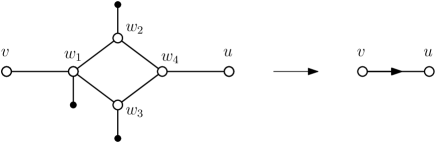
- Proved NP-completeness of the irreversible 2-conversion set problem via a reduction from a known NP-complete problem, valid for graphs with maximum degree 4.
- Leveraged structural properties of graphs with maximum degree 3, showing equivalence to vertex feedback set problems solvable in polynomial time.
- Designed a tiling-based construction using repeating 3×3 patterns to generate irreversible 3-conversion sets on toroidal grids.
- Used modular arithmetic and cycle analysis on the torus to verify that all white regions eventually become black under the irreversible 3-threshold rule.
- Introduced case analysis based on grid dimensions modulo 3 and 4 to handle boundary conditions and minimize set size.
- Validated correctness by proving that the constructed sets eliminate all white cycles, ensuring full black conversion.
Experimental results
Research questions
- RQ1Is the problem of finding a minimum irreversible 2-conversion set NP-complete for graphs of maximum degree 4?
- RQ2Can the minimum irreversible 2-conversion set be computed in polynomial time for graphs of maximum degree 3?
- RQ3What is the minimum size of an irreversible 3-conversion set for a toroidal grid T(m,n)?
- RQ4Can a simpler and optimal construction be given for irreversible 3-conversion sets on toroidal grids compared to prior work?
- RQ5How do the sizes of optimal irreversible 3-conversion sets scale with the dimensions m and n of the toroidal grid?
Key findings
- The problem of finding a minimum irreversible 2-conversion set is NP-complete even when restricted to graphs of maximum degree 4.
- For graphs of maximum degree 3, the minimum irreversible 2-conversion set can be computed in polynomial time.
- An optimal irreversible 3-conversion set of size at most (3mn + 4)/8 exists for toroidal grids T(m,n) when n=4 or m=4.
- For all other toroidal grids with m,n ≥ 3 and not both m,n equal to 4, an optimal irreversible 3-conversion set of size at most (mn + 4)/3 exists.
- The construction achieves optimality by eliminating all white cycles through strategic placement of black squares and pattern tiling.
- The method simplifies prior constructions by Pike and Zou, offering a more uniform and analyzable tiling approach with proven correctness via topological cycle analysis on the torus.
Read this paper
Open the full text in the Nubint reader and ask about any passage as you read.
Read this paper on NubintThis review was generated by AI from the original paper. Please check the paper before citing it.