
[Paper Review] JADES: The production and escape of ionizing photons from faint Lyman-alpha emitters in the epoch of reionization
This study analyzes 16 faint Lyman-α emitters at z>5.8 in JWST/JADES data to measure Lyα and LyC production/escape, ionization state, and implications for cosmic reionization.
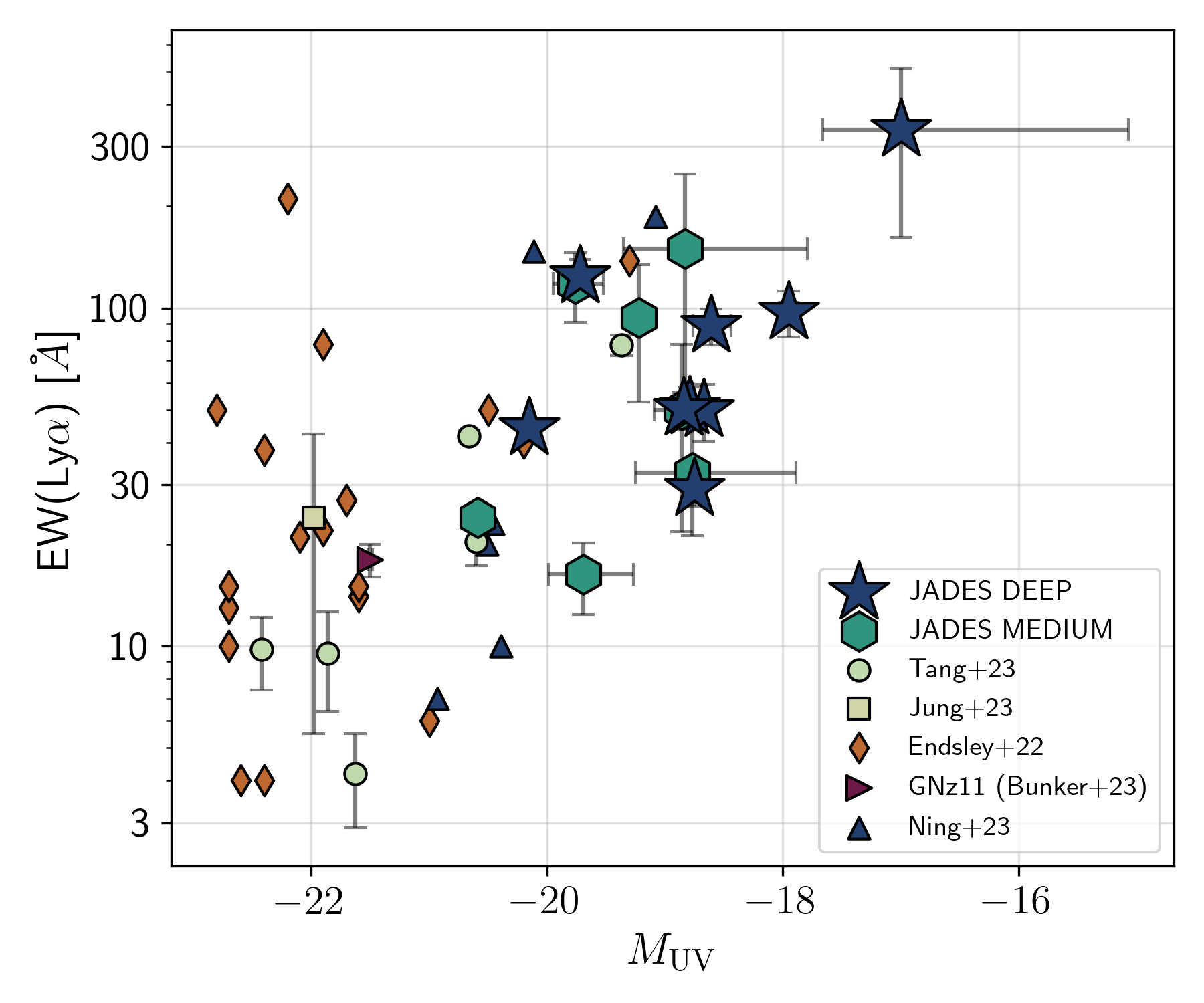
We present the properties of 17 faint Ly$α$ emitting galaxies (LAEs) at $z>5.8$ from the JWST Advanced Deep Extragalactic Survey (JADES) in the Hubble Ultra Deep Field/GOODS-S. These LAEs span a redshift range $z\approx5.8-8.0$ and a UV magnitude range $M_{UV}\approx-17$ to $-20.6$, with the Ly$α$ equivalent width (EW) in the range $\approx 25-350$ Å. The detection of other rest-optical emission lines in the spectra of these LAEs enables the determination of accurate systemic redshifts and Lyα velocity offsets, as well as the physical and chemical composition of their stars and interstellar media. These faint LAEs are consistent with metal-poor systems with high ionization parameters, similar to the general galaxy population at $z>6$. We measured an average ionizing photon production efficiency, log($ξ_ m{ion}$/erg$^{-1}$ Hz) $\approx25.57$ across our LAEs, which does not evolve strongly with redshift. We report an anti-correlation between the Ly$α$ escape fraction (f_ m{esc}) and the velocity offset from systemic redshift, consistent with model expectations. We further find that the strength and velocity offset of Ly$α$ are neither correlated with galaxy spectroscopic properties nor with $ξ_ m{ion}$. We find a decrease in $f_ m{esc}$(Ly$α$) with redshift, indicative of decreasing sizes of ionized bubbles around LAEs at high redshifts. We used a range of galaxy properties to predict Lyman continuum $f_ m{esc}$ for our LAEs, finding that the ionizing photon output into the intergalactic medium remains roughly constant across the observed Ly$α$ EW, showing a mild increase at fainter M$_{UV}$ and at higher redshifts. We derived correlations between the ionizing photon output from LAEs and $M_{UV}$, Ly$α$ EW and redshifts, which can be used to constrain the ionizing photon contribution of LAEs at $z > 6$ towards cosmic reionization.
Motivation & Objective
- Investigate the physical properties of faint Lyman-α emitters (LAEs) during the reionization era (z ≈ 5.8–8.0).
- Determine systemic redshifts, Lyα velocity offsets, chemical abundances, ionization parameters, and dust content from rest-frame optical lines.
- Estimate ionizing photon production efficiency and LyC escape implications for the reionization budget.
- Explore how Lyα properties relate to galaxy properties and the evolving intergalactic medium (IGM).
- Provide observationally driven correlations to improve reionization modeling.
Proposed method
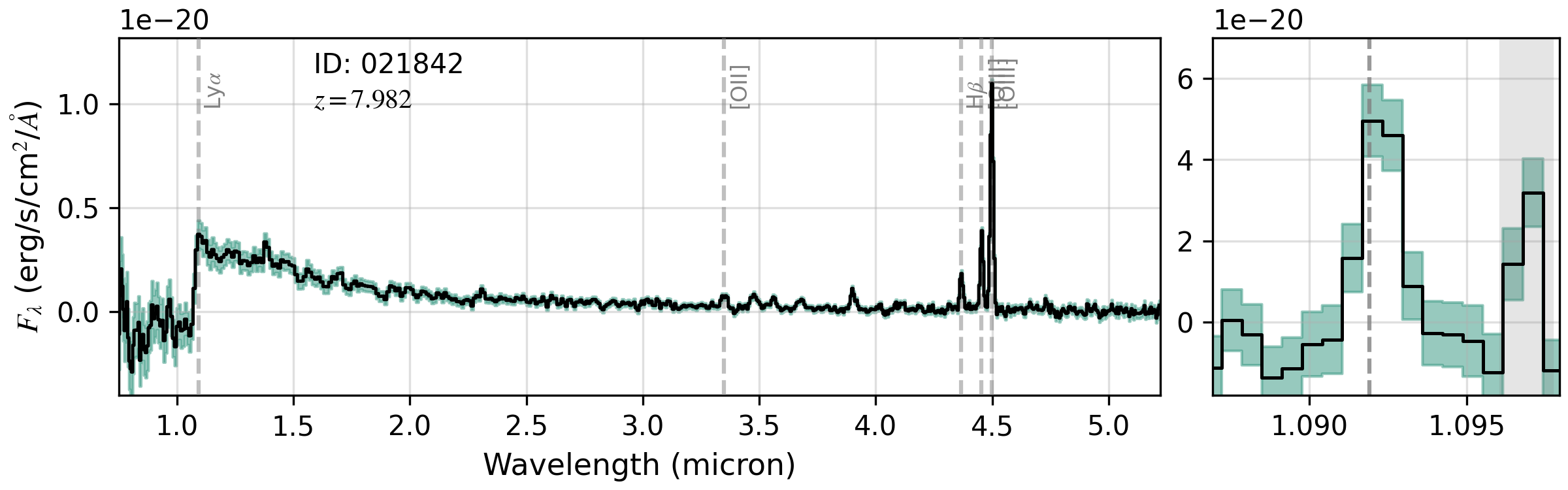
- Use JWST NIRSpec spectra from the JADES Deep and Medium tiers to identify 16 LAEs with z>5.8.
- Measure Lyα fluxes from R100 and higher-resolution R1000 data, prioritizing G140M grating for Lyα properties.
- Derive systemic redshifts from strong rest-frame optical lines (Hβ, [O iii], Hα) in G395M/G235M gratings.
- Compute rest-frame UV magnitudes (MUV) from R100 spectra and UV slopes β by fitting continuum between 1340–2600 Å.
- Estimate Balmer decrements (Hα/Hβ, or Hβ/Hγ) to derive dust attenuation under an SMC curve.
- Calculate ionizing photon production efficiency ξion from intrinsic L1500 and N(H0) inferred from Balmer lines (Case-B, Te=10^4 K, ne=100 cm^-3).
- Determine Lyα escape fractions from dust-corrected Lyα/Hα ratios assuming Case-B recombination.
Experimental results
Research questions
- RQ1What are the ionization states, metallicities, and dust contents of faint LAEs at z>5.8 as traced by rest-frame optical lines?
- RQ2How do Lyα properties (strength, velocity offset) correlate with systemic properties and LyC escape potential?
- RQ3What is the ionizing photon production efficiency (ξion) for these faint LAEs, and does it evolve with redshift?
- RQ4How does Lyα escape evolve with redshift, and what does this imply about ionized bubble sizes in the IGM?
- RQ5Can observed LAE properties be used to build realistic, observationally-driven reionization models?
Key findings
- LAEs show metal-poor, high-ionization parameter–like conditions, consistent with the general z>6 galaxy population.
- Average ionizing photon production efficiency is log(ξion/erg^-1 Hz) ≈ 25.56 across the sample and shows little strong redshift evolution.
- An anti-correlation is found between Lyα escape fraction and velocity offset from systemic redshift, aligning with theoretical expectations.
- Lyα strength and velocity offset do not show a strong correlation with other spectroscopic properties or with ξion.
- Lyα escape fractions decrease with redshift, suggesting smaller ionized bubbles around LAEs at earlier times.
- Using multiple galaxy properties, LyC escape predictions indicate that the ionizing output into the IGM from these LAEs remains roughly constant with UV magnitude and Lyα EW, with a mild redshift increase.
- Correlations are derived between ionizing photon output from LAEs and UV magnitude, Lyα strength, and redshift to inform reionization models.
Better researchstarts right now
From reading papers to final review, dramatically reduce your research time.
No credit card · Free plan available
This review was created by AI and reviewed by human editors.