
[Paper Review] Most of the photons that reionized the Universe came from dwarf galaxies
The paper reports first spectroscopic observations of ultra-faint galaxies at z~6-8, finding high ionizing efficiency and that faint dwarfs could drive cosmic reionization with modest escape fractions.
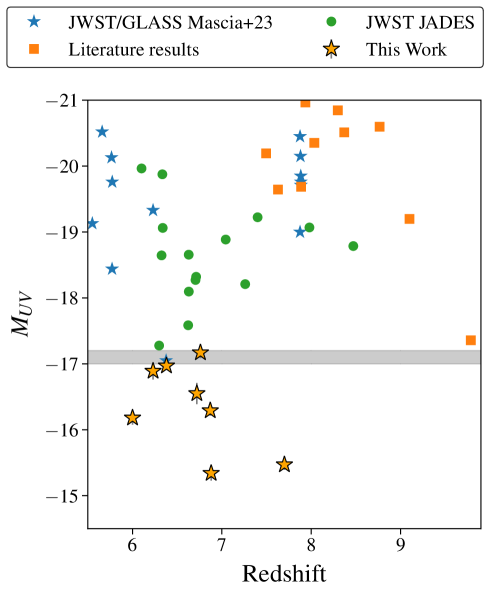
The identification of sources driving cosmic reionization, a major phase transition from neutral Hydrogen to ionized plasma around 600-800 Myr after the Big Bang (Dayal et al. 2018, Mason et al. 2019, Robertson et al. 2022), has been a matter of intense debate (Robertson et al. 2022). Some models suggest that high ionizing emissivity and escape fractions ($f_{ m esc}$) from quasars support their role in driving cosmic reionization (Madau & Haardt 2015, Mitra et al. 2018). Others propose that the high $f_{ m esc}$ values from bright galaxies generates sufficient ionizing radiation to drive this process (Naidu et al. 2020). Finally, a few studies suggest that the number density of faint galaxies, when combined with a stellar-mass-dependent model of ionizing efficiency and $f_{ m esc}$, can effectively dominate cosmic reionization (Finkelstein et al. 2019, Dayal et al. 2020). However, so far, low-mass galaxies have eluded comprehensive spectroscopic studies owing to their extreme faintness. Here we report an analysis of eight ultra-faint galaxies (in a very small field) during the epoch of reionization with absolute magnitudes between $M_{ m UV}$ $\sim -17$ to $-15$ mag (down to 0.005 $L^{\star}$. We find that faint galaxies during the Universe's first billion years produce ionizing photons with log($ξ_{\mathrm{ion}}$/ Hz erg$^{-1}$) =$25.80\pm 0.14$, a factor of 4 higher than commonly assumed values (Robertson et al. 2015). If this field is representative of the large scale distribution of faint galaxies, the rate of ionizing photons exceeds that needed for reionization, even for escape fractions of order five per cent.
Motivation & Objective
- Motivate and quantify the role of ultra-faint galaxies in cosmic reionization.
- Measure the ionizing photon production efficiency (xi_ion) for faint galaxies at z>6.
- Constrain the rest-frame UV luminosity function (UV LF) and assess the contribution of faint galaxies to reionization.
- Estimate the Lyman-continuum escape fraction (f_esc) indirectly and analyze metallicity, ages, and sSFR of these systems.
Proposed method
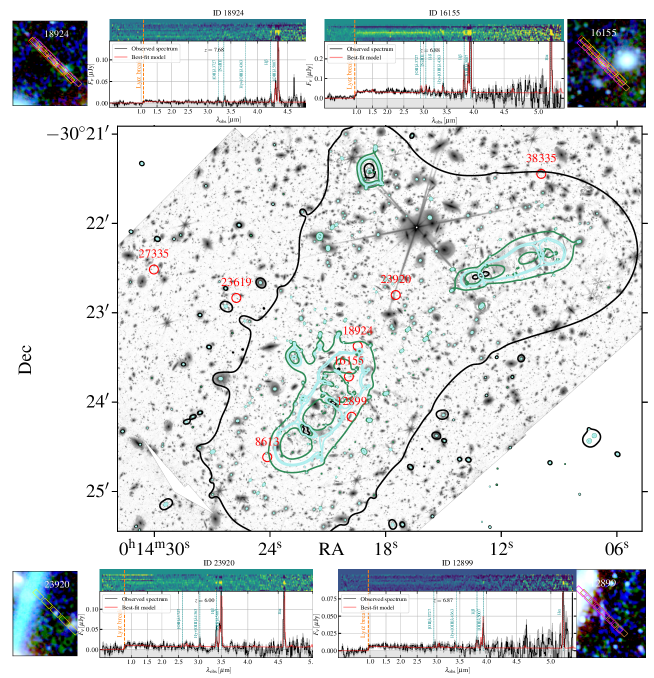
- Ultra-deep NIRSpec spectroscopy of 8 ultra-faint galaxies in Abell 2744 using the MSA configuration.
- Strong gravitational lensing (magnifications mu ~ 2–27) to probe intrinsic M_UV ~ -15 to -17 galaxies.
- Photometric selection combining JWST NIRCam and HST imaging with color-color cuts and EAZY SED fitting to establish z~6–8 candidates.
- Joint spectro-photometric SED fitting with Bagpipes and BEAGLE to derive stellar masses, ages, metallicities, and SFHs.
- Emission-line analysis (H-alpha, [NII], [OIII], H-beta, H-gamma, [OII]) to measure redshifts and calibrate ionizing photon production.
- Calculation of xi_ion from L(H-alpha) and L_UV; indirect inference of f_esc from UV slopes and Sigma_SFR, with supporting metallicity estimates.
Experimental results
Research questions
- RQ1What is the ionizing photon production efficiency (xi_ion) of ultra-faint galaxies at z>6?
- RQ2Do ultra-faint galaxies provide enough ionizing photons to sustain reionization given plausible escape fractions?
- RQ3How does the UV luminosity function extend to M_UV ~ -15 at z~7, and what is the impact on the ionizing emissivity?
- RQ4What are the physical properties (metallicity, SFR, ages, sizes) of these faint systems and how do they relate to reionization?
Key findings
- Faint galaxies have log(xi_ion / Hz erg^-1) = 25.8 ± 0.05, about a factor of 4 higher than canonical values.
- Total ionizing photon production by galaxies would suffice to reionize the Universe at z~7 with f_esc as low as 5%.
- Intrinsic UV magnitudes reach as faint as M_UV ≈ -15.34 (≈0.005 L* at z=7), extending the UV LF to very faint magnitudes.
- Stellar masses span log(M*/M_sun) ≈ 5.88 to 7.12, with very young ages (~a few Myr) and blue UV slopes (β ≈ -2.07 to -2.53).
- H-alpha based SFRs exceed UV-based SFRs (SFR(H-alpha)/SFR(UV) ≈ 5–60), indicating recent star-formation bursts.
- Sizes are compact (effective radii ~30–300 pc after lensing correction), consistent with a low-mass, high-sSFR population.
- Gas-phase metallicities are extremely low (12+log(O/H) ≈ 6.70–7.46; 1–6% solar), typical of metal-poor, ionizing-dominated systems.
Better researchstarts right now
From reading papers to final review, dramatically reduce your research time.
No credit card · Free plan available
This review was created by AI and reviewed by human editors.