
[Paper Review] Large-scale universality in quantum reaction-diffusion from Keldysh field theory
This paper develops a Keldysh field theory framework to derive a universal kinetic equation for quantum reaction-diffusion in Fermi gases with $A+A\to\emptyset$ annihilation. It shows that in the reaction-limited regime, the particle density decays algebraically with a dimension-dependent exponent that deviates from mean-field predictions, and it systematically derives the time-dependent generalized Gibbs ensemble (TGGE) from diagrammatics, validating the TGGE assumption through field-theoretic methods.
We consider the quantum reaction-diffusion dynamics in $d$ spatial dimensions of a Fermi gas subject to binary annihilation reactions $A+A o \emptyset$. These systems display collective nonequilibrium long-time behavior, which is signalled by an algebraic decay of the particle density. Building on the Keldysh formalism, we devise a field theoretical approach for the reaction-limited regime, where annihilation reactions are scarce. By means of a perturbative expansion of the dissipative interaction, we derive a description in terms of a large-scale universal kinetic equation. Our approach shows how the time-dependent generalized Gibbs ensemble assumption, which is often employed for treating low-dimensional nonequilibrium systems, emerges from systematic diagrammatics. It also allows to exactly compute -- for arbitrary spatial dimension -- the decay exponent of the particle density. The latter is based on the large-scale description of the quantum dynamics and it differs from the mean-field prediction even in dimension larger than one. We moreover consider spatially inhomogeneous setups involving an external potential. In confined systems the density decay is accelerated towards the mean-field algebraic behavior, while for deconfined scenarios the power-law decay is replaced by a slower non-algebraic decay.
Motivation & Objective
- To establish a field-theoretic foundation for large-scale universal behavior in quantum reaction-diffusion systems.
- To derive the time-dependent generalized Gibbs ensemble (TGGE) from systematic diagrammatics in the reaction-limited regime.
- To compute the exact particle density decay exponent in arbitrary spatial dimensions $d$ beyond mean-field predictions.
- To investigate the impact of spatial inhomogeneity, such as trapping potentials, on the decay dynamics.
- To clarify the breakdown of power-law decay in deconfined systems and its relation to non-algebraic relaxation.
Proposed method
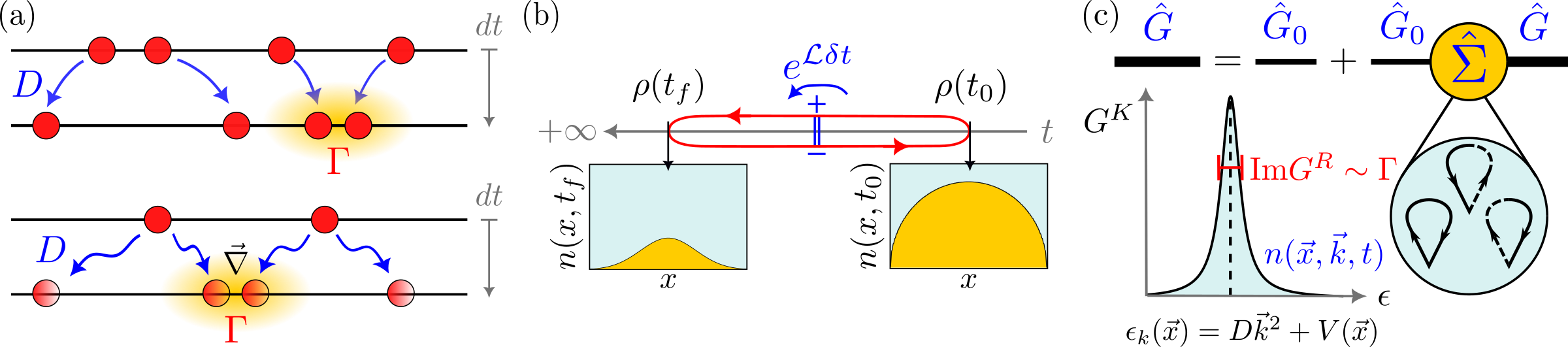
- Employing the Keldysh path integral formalism to represent the quantum master equation for dissipative dynamics.
- Performing a perturbative expansion of the dissipative interaction vertices in the action, retaining leading-order space-time derivatives.
- Deriving a large-scale universal kinetic equation equivalent to a Boltzmann-type equation for the Wigner function $n(\vec{x},\vec{k},t)$.
- Mapping the Keldysh Green's function $G^K$ to the Wigner distribution via spectral representation and Wigner transform.
- Using Feynman diagrams, particularly tadpoles, to compute the finite lifetime of quasiparticles and connect to the TGGE ansatz.
- Analyzing quench protocols (trap release and double-to-single-well quench) numerically to extract effective decay exponents.
Experimental results
Research questions
- RQ1How does the particle density decay in quantum reaction-diffusion systems in arbitrary spatial dimensions $d$ beyond mean-field theory?
- RQ2Can the widely used time-dependent generalized Gibbs ensemble (TGGE) assumption be systematically derived from field-theoretic principles?
- RQ3What is the origin of the non-mean-field decay exponent in $d>1$ dimensions, and how does it emerge from the large-scale quantum dynamics?
- RQ4How do spatial inhomogeneities, such as trapping potentials, affect the long-time decay behavior of particle density?
- RQ5Why does the power-law decay break down in deconfined systems, and what replaces it?
Key findings
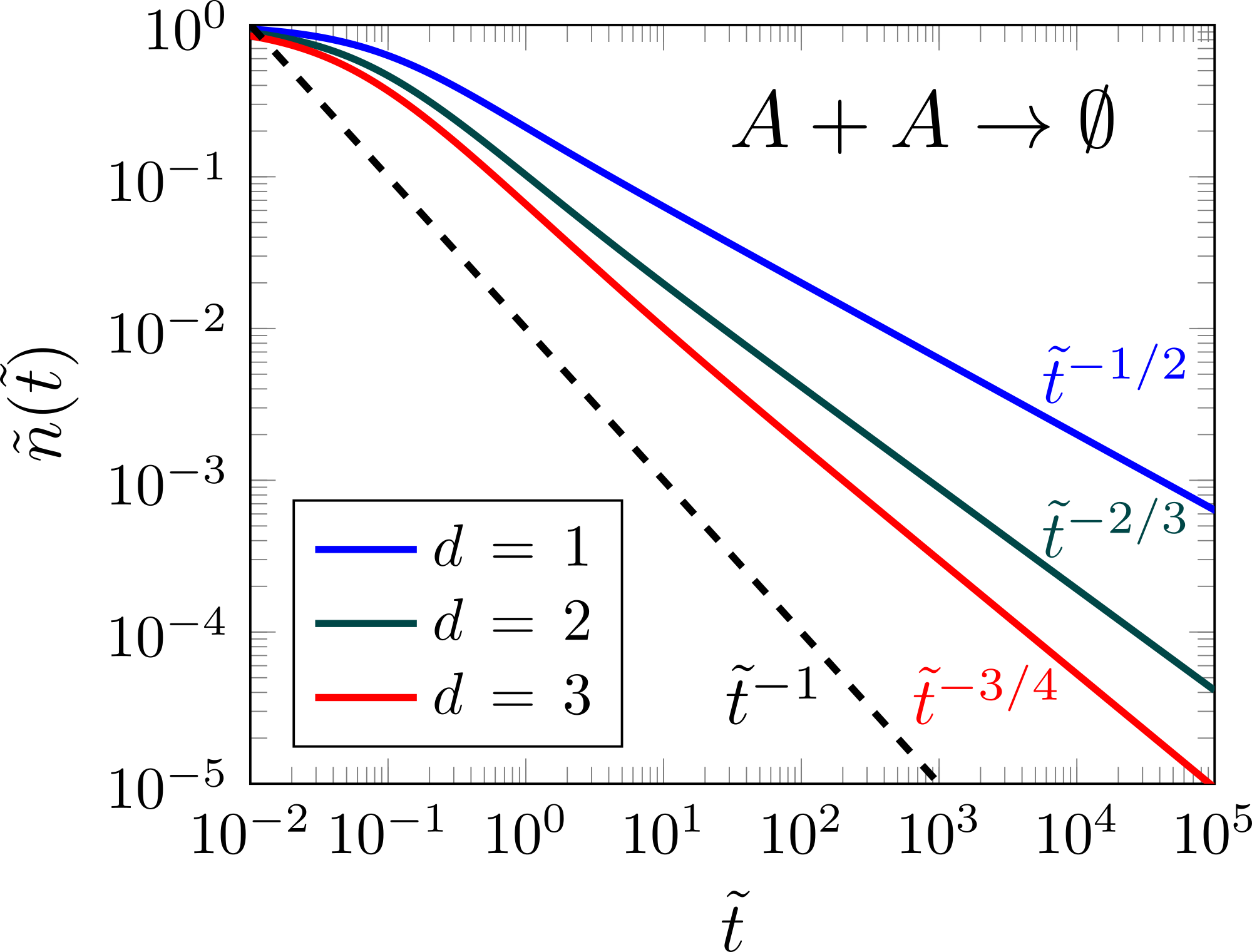
- The particle density decays algebraically with a decay exponent that deviates from the mean-field prediction even in $d>1$ dimensions, indicating non-trivial quantum corrections.
- The time-dependent generalized Gibbs ensemble (TGGE) emerges naturally from the Keldysh diagrammatics at leading order in space-time gradients, providing a field-theoretic justification for its use.
- The exact decay exponent is computed analytically via the large-scale field theory, showing universal behavior independent of microscopic details.
- In confined systems (double-to-single-well quench), the decay exponent is accelerated toward the mean-field value due to enhanced mixing.
- In deconfined scenarios (trap release), the power-law decay is replaced by a slower, non-algebraic decay, with the effective exponent decreasing over time.
- For finite trap release parameters $\Omega$, an intermediate power-law regime with a maximum effective exponent $\xi_M$ is observed, which shrinks and shifts earlier with increasing $\Omega$.
Better researchstarts right now
From reading papers to final review, dramatically reduce your research time.
No credit card · Free plan available
This review was created by AI and reviewed by human editors.