
[Paper Review] Universality in driven open quantum matter
This paper establishes a unified theoretical framework for universality in driven open quantum matter using Lindblad-Keldysh field theory, revealing how symmetries, state purity, and scaling laws govern nonequilibrium stationary states. It identifies universal behaviors across quantum platforms—including Rydberg atoms, cold atoms, and superconducting qubits—demonstrating new realizations of nonequilibrium universality, including KPZ scaling, self-organized criticality, and quantum criticality, with no equilibrium counterparts.
Universality is a powerful concept, which enables making qualitative and quantitative predictions in systems with extensively many degrees of freedom. It finds realizations in almost all branches of physics, including in the realm of nonequilibrium systems. Our focus here is on its manifestations within a specific class of nonequilibrium stationary states: driven open quantum matter. Progress in this field is fueled by a number of uprising platforms ranging from light-driven quantum materials over synthetic quantum systems like cold atomic gases to the functional devices of the noisy intermediate scale quantum era. These systems share in common that, on the microscopic scale, they obey the laws of quantum mechanics, while detailed balance underlying thermodynamic equilibrium is broken due to the simultaneous presence of Hamiltonian unitary dynamics and nonunitary drive and dissipation. The challenge is then to connect this microscopic physics to macroscopic observables, and to identify universal collective phenomena that uniquely witness the breaking of equilibrium conditions, thus having no equilibrium counterparts. In the framework of a Lindblad-Keldysh field theory, we discuss on the one hand the principles delimiting thermodynamic equilibrium from driven open stationary states, and on the other hand show how unifying concepts such as symmetries, the purity of states, and scaling arguments are implemented. We then present instances of universal behavior structured into three classes: new realizations of paradigmatic nonequilibrium phenomena, including a survey of first experimental realizations; novel instances of nonequilibrium universality found in these systems made of quantum ingredients; and genuinely quantum phenomena out of equilibrium, including in fermionic systems. We also discuss perspectives for future research on driven open quantum matter.
Motivation & Objective
- To establish a unifying theoretical framework for universality in driven open quantum systems out of thermal equilibrium.
- To identify universal collective phenomena in driven open quantum matter that lack equilibrium analogs, such as KPZ universality and quantum criticality.
- To connect microscopic Lindblad dynamics to macroscopic observables through symmetries, scaling, and Green’s functions.
- To explore experimental realizations of nonequilibrium universality in platforms like Rydberg atom arrays and cold atomic gases.
- To extend concepts of criticality and symmetry breaking to open quantum systems with nonunitary dynamics and dissipation.
Proposed method
- Formulates a Lindblad-Keldysh field theory for driven open quantum systems, mapping the dynamics to a Keldysh action with classical and quantum fields.
- Applies Keldysh rotation to derive retarded, advanced, and Keldysh Green’s functions, enabling the description of nonequilibrium correlation functions.
- Uses canonical power counting and renormalization group (RG) techniques to analyze scaling behavior in deterministic and semiclassical limits.
- Identifies universality classes via symmetry analysis, including spontaneous breaking of classical symmetries and the dissipative Goldstone theorem.
- Analyzes specific models such as the compact KPZ equation, directed percolation, and dark state bistability to extract universal scaling exponents.
- Applies the framework to fermionic systems, topological phase transitions, and dissipative impurities, revealing new quantum universality classes.
Experimental results
Research questions
- RQ1How do symmetries and conservation laws in the Keldysh action govern universal behavior in driven open quantum systems?
- RQ2What are the universal scaling laws and critical exponents in driven open condensates, and how do they differ from equilibrium counterparts?
- RQ3Can KPZ universality emerge in two-dimensional driven open Bose-Einstein condensates, and what stabilizes it under spatial anisotropy?
- RQ4What is the role of dark states in enabling universal nonequilibrium dynamics, particularly in the context of quantum Zeno effects and purification?
- RQ5How does quantum criticality manifest in driven open systems, and what distinguishes it from noise-driven Luttinger liquids?
Key findings
- The paper establishes that universality in driven open quantum matter arises from symmetries and scaling in the Keldysh action, even in the absence of detailed balance.
- KPZ universality is realized in one- and two-dimensional driven open condensates, with the anisotropic KPZ equation governing critical behavior in 2D under strong spatial anisotropy.
- Noise-activated vortex unbinding stabilizes ordered phases in two-dimensional driven open condensates, enabling observability of KPZ scaling.
- In one-dimensional systems, KPZ scaling is destroyed by noise-activated space-time vortices, signaling a transition to turbulence.
- The paper identifies a new class of quantum critical fixed points in driven open Bose gases, with distinct scaling behavior from equilibrium quantum criticality.
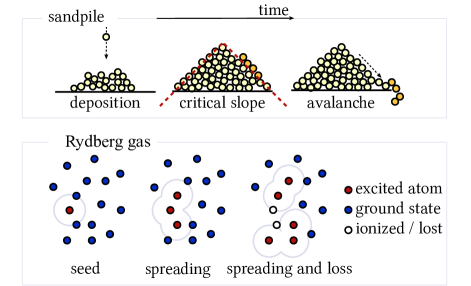
- Dark state bistability in driven systems leads to first-order phase transitions with universal scaling, realizable in Rydberg atom and superconducting qubit platforms.
Read this paper
Open the full text in the Nubint reader and ask about any passage as you read.
Read this paper on NubintThis review was generated by AI from the original paper. Please check the paper before citing it.