
[Paper Review] Magic of quantum hypergraph states
This paper provides an analytical framework for quantifying magic—nonstabilizerness—in quantum hypergraph states using stabilizer R{\'e}nyi-\alpha entropies (SRE). It proves that hypergraph states with constant average degree cannot achieve maximal magic, but typical random hypergraph states concentrate near maximal magic. Counterintuitively, highly symmetric 3-complete hypergraph states exhibit only constant or exponentially small magic for \alpha \geq 2, revealing a nontrivial trade-off between symmetry and magic resourcefulness.
Magic, or nonstabilizerness, characterizes the deviation of a quantum state from the set of stabilizer states and plays a fundamental role from quantum state complexity to universal fault-tolerant quantum computing. However, analytical or even numerical characterizations of magic are very challenging, especially in the multi-qubit system, even with a moderate qubit number. Here we systemically and analytically investigate the magic resource of archetypal multipartite quantum states -- quantum hypergraph states, which can be generated by multi-qubit Controlled-phase gates encoded by hypergraphs. We first give the magic formula in terms of the stabilizer R$\mathrm{\acute{e}}$nyi-$α$ entropies for general quantum hypergraph states and prove the magic can not reach the maximal value, if the average degree of the corresponding hypergraph is constant. Then we investigate the statistical behaviors of random hypergraph states and prove the concentration result that typically random hypergraph states can reach the maximal magic. This also suggests an efficient way to generate maximal magic states with random diagonal circuits. Finally, we study some highly symmetric hypergraph states with permutation-symmetry, such as the one whose associated hypergraph is $3$-complete, i.e., any three vertices are connected by a hyperedge. Counterintuitively, such states can only possess constant or even exponentially small magic for $α\geq 2$. Our study advances the understanding of multipartite quantum magic and could lead to applications in quantum computing and quantum many-body physics.
Motivation & Objective
- To systematically characterize the magic resource in multipartite quantum hypergraph states, which are generalizations of graph states and key in quantum advantage and measurement-based quantum computing.
- To address the challenge of quantifying magic in highly entangled, multi-qubit states where existing methods fail due to exponential scaling.
- To determine whether highly symmetric hypergraph states, such as 3-complete states, can serve as high-magic resource states for universal quantum computation.
- To establish a connection between the structural properties of hypergraphs (e.g., degree distribution, symmetry) and the resulting magic content via SRE measures.
Proposed method
- The authors express magic in terms of stabilizer R{\'e}nyi-\alpha entropy (SRE), which quantifies the weight distribution of a state's projection onto Pauli strings.
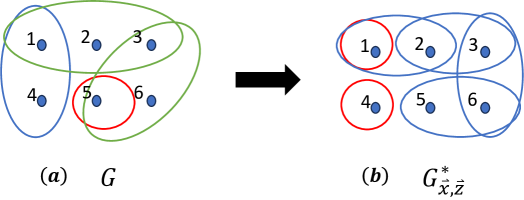
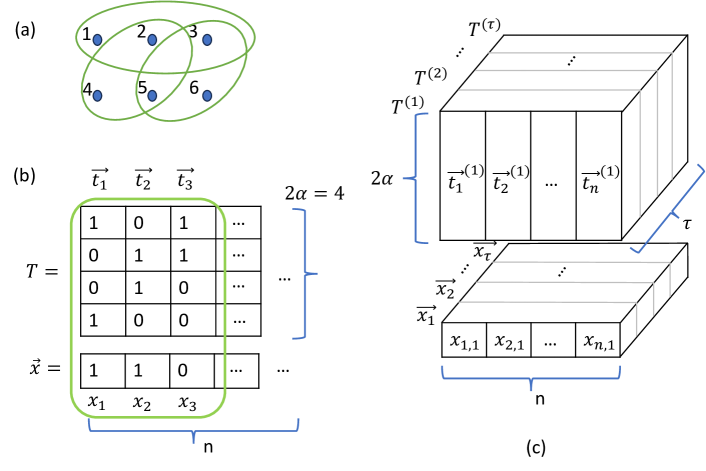
- They derive a pictorial representation linking SRE to induced hypergraphs from the original hypergraph, enabling analytical treatment of Pauli string overlaps.
- The study employs counting techniques in binary vector spaces to transform statistical properties of magic into combinatorial problems.
- For symmetric states like the 3-complete hypergraph, they exploit permutation symmetry to simplify trace calculations of Pauli-Liouville moments.
- They compute exact SRE values for different \alpha using analytical derivations of trace moments, particularly for \alpha = 2 and \alpha = 1/2.
- The concentration of magic in random hypergraph states is proven by analyzing the typical behavior of Pauli string overlaps across random diagonal circuits.
Experimental results
Research questions
- RQ1Can quantum hypergraph states achieve maximal magic, and under what structural conditions?
- RQ2How does the average degree of a hypergraph influence the upper bound of magic in the corresponding hypergraph state?
- RQ3Do highly symmetric hypergraph states, such as 3-complete states, possess high magic despite their symmetry?
- RQ4To what extent do random hypergraph states concentrate near maximal magic, and can they be used as efficient resource states?
- RQ5How do different SRE measures (e.g., \alpha = 2 vs. \alpha = 1/2) differ in their sensitivity to symmetry and entanglement in hypergraph states?
Key findings
- Hypergraph states with constant average degree cannot achieve maximal magic, as the SRE is upper-bounded and does not scale to the theoretical maximum.
- Typical random hypergraph states generated by random diagonal circuits concentrate near maximal magic, exhibiting behavior similar to Haar random states.
- For the 3-complete hypergraph state, the SRE for \alpha = 2 is bounded by a constant, and for \alpha = 1/2, it grows as 2^{(2n-7-(-1)^n)/4}, showing exponential separation between different \alpha measures.
- The SRE for the 3-complete state is exponentially different between \alpha = 2 and \alpha = 1/2, indicating that different SRE measures can yield drastically different conclusions about magic content.
- The Pauli-Liouville moment \mathbf{m}_2(\ket{G_{3\textrm{-com}}}) is bounded by \frac{1}{8} + \frac{7}{2^{n+\frac{3-(-1)^n}{2}}}, approaching \frac{1}{8} for large n.
- The SRE for \alpha = 1/2 in the 3-complete state is \mathbf{m}_{1/2}(\ket{G_{3\textrm{-com}}}) = 2^{\frac{2n-7-(-1)^n}{4}} + 1 - 2^{-n+\frac{1+(-1)^n}{2}}, which grows with n but remains submaximal.
Better researchstarts right now
From reading papers to final review, dramatically reduce your research time.
No credit card · Free plan available
This review was created by AI and reviewed by human editors.