
[Paper Review] Quantum Magic via Perfect Pauli Sampling of Matrix Product States
Introduces a perfect Pauli-string sampling method for Matrix Product States to efficiently estimate Stabilizer Rényi Entropies (SREs) and quantify nonstabilizerness (magic) in N-qubit states, enabling study of dynamics and Ising model benchmarks.
We introduce a novel breakthrough approach to evaluate the nonstabilizerness of an $N$-qubits Matrix Product State (MPS) with bond dimension $χ$. In particular, we consider the recently introduced Stabilizer Rényi Entropies (SREs). We show that the exponentially hard evaluation of the SREs can be achieved by means of a simple perfect sampling of the many-body wave function over the Pauli string configurations. The sampling is achieved with a novel MPS technique, which enables to compute each sample in an efficient way with a computational cost $O(Nχ^3)$. We benchmark our method over randomly generated magic states, as well as in the ground-state of the quantum Ising chain. Exploiting the extremely favourable scaling, we easily have access to the non-equilibrium dynamics of the SREs after a quantum quench.
Motivation & Objective
- Motivate the need to quantify nonstabilizerness (magic) beyond entanglement in many-body states.
- Develop an efficient sampling-based approach to compute Stabilizer Rényi Entropies (SREs) for MPS.
- Make the computation scale favorably with system size and MPS bond dimension.
- Benchmark the method on random MPS, Ising ground states, and quench dynamics.
Proposed method
- Define Stabilizer Rényi Entropies (SREs) as Renyi entropies of the Pauli-string distribution im[ ho](p) over Pauli strings.
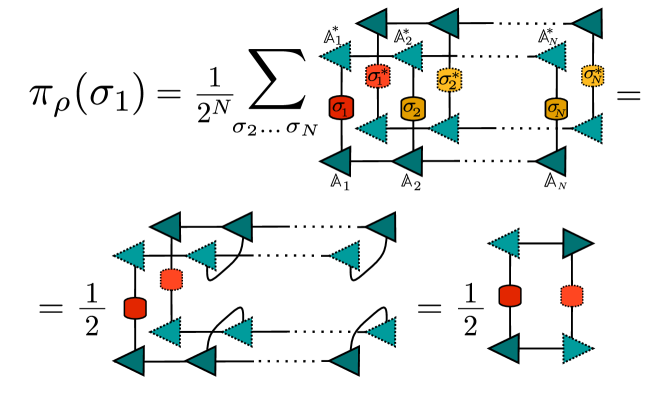
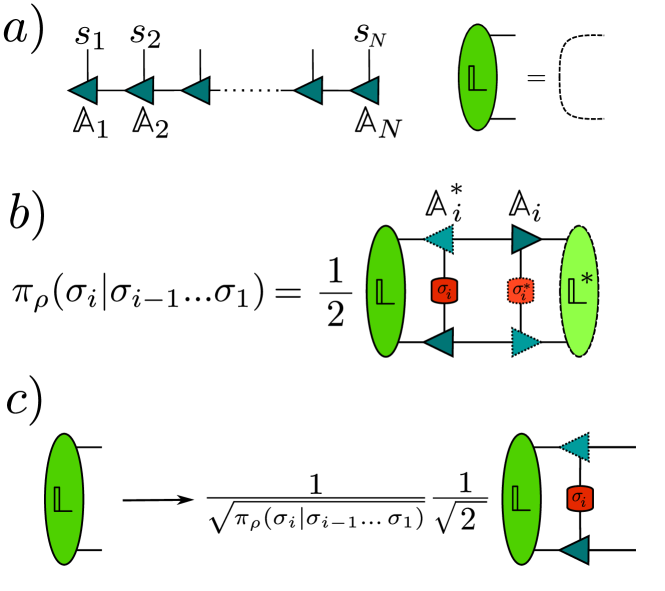
- Rewrite the Pauli-string distribution as a product of conditional probabilities to enable sequential sampling (Pauli sampling).
- Compute conditional probabilities using efficient MPS contractions and update an effective environment tensor during sampling.
- Provide an iterative, right-normalized MPS procedure to sample Pauli strings with probability (p)(p) and accumulate the overall sampling probability.
- Show that sampling cost scales as O(N χ^3) per sample, with total cost O(N χ^3 ) for N samples.
- Discuss error analysis for n>1 and n=1, including variance bounds and sampling requirements.
Experimental results
Research questions
- RQ1Can Stabilizer Rényi Entropies (SREs) be efficiently computed for N-qubit MPS with finite bond dimension χ?
- RQ2Does perfect Pauli-string sampling provide an unbiased and scalable estimator for SREs independent of Hilbert-space size?
- RQ3How does the method perform on random MPS states, Ising model ground states, and non-equilibrium dynamics after quenches?
- RQ4What is the sensitivity of SREs to confinement phenomena in Ising-type models during dynamics?
Key findings
- The Pauli sampling method yields unbiased estimators for SREs with sampling cost scaling as O(N χ^3) per sample.
- Experiments with random MPS and Ising ground states show agreement with theoretical/fermionic results within error bars.
- The approach enables access to non-equilibrium SRE dynamics after quenches, including regimes with confinement.
- SREs (magic density) scale extensively with system size, allowing a density m_n = M_n/N to be meaningful.
- Sampling remains practical for large χ (e.g., χ up to ~128) and N up to tens of qubits, with time per sample around 0.1 sec on a single node.
- For n=1, the variance analysis suggests a polynomial scaling of sampling requirements with system size.
Read this paper
Open the full text in the Nubint reader and ask about any passage as you read.
Read this paper on NubintThis review was generated by AI from the original paper. Please check the paper before citing it.