
[Paper Review] Minimum-regret hydrogen supply chain strategies to foster the energy transition of European hard-to-abate industries
This study develops a minimum-regret optimization model to design cost-effective, resilient low-carbon hydrogen supply chains (HSCs) for European hard-to-abate industries under uncertainty in hydrogen demand (2.4–35 Mt/a) and biomass availability. It finds that investing in large-scale SMR-CCS and electrolyzer capacity by 2030 (≈9.6 Mt/a) is essential for flexibility, while biomass-based H2 is most cost-efficient only if feedstock availability is guaranteed.
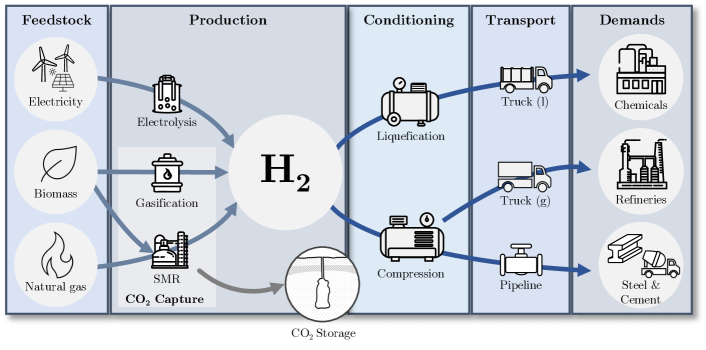
Low-carbon hydrogen (H2) is envisioned to play a central role in decarbonizing European hard-to-abate industries, such as refineries, ammonia, methanol, steel, and cement. To enable its widespread use, H2 supply chain (HSC) infrastructure is required. Mature and economically viable low-carbon H2 production pathways include steam methane reforming (SMR) of natural gas coupled with carbon dioxide capture and storage (CCS), water-electrolysis from renewable electricity, biomethane reforming, and biomass gasification. However, uncertainties surrounding demand and feedstock availabilities hamper their proliferation. Here, we investigate the impact of uncertainty in H2 demand and biomass availability on the optimal HSC design. The HSC is modeled as a network of H2 production and consumption sites that are interconnected with H2 and biomass transport technologies. A CCS supply chain is modeled alongside the HSC. The cost-optimal HSC design is determined based on a linear optimization problem that considers a regional resolution and a multi-year time horizon (2022-2050). We adopt a scenario-based uncertainty quantification approach and define discrete H2 demand and biomass availability scenarios. Applying a minimum-regret strategy, we show that sufficiently large low-carbon H2 production capacities (about 9.6 Mt/a by 2030) are essential to flexibly scale up HSCs and accommodate H2 demands of up to 35 Mt/a by 2050. While biomass-based H2 production emerges as the most cost-efficient low-carbon H2 production pathway, investments are not recommended unless the availability of biomass feedstocks is guaranteed. Instead, investments in SMR-CCS and electrolysis often offer greater flexibility. In addition, we highlight the importance of CCS infrastructure, which is required across scenarios.
Motivation & Objective
- Address the challenge of designing resilient, cost-optimized hydrogen supply chains (HSCs) for European hard-to-abate industries under deep uncertainty in future hydrogen demand and biomass availability.
- Investigate how uncertainty in demand and feedstock availability affects the optimal design of low-carbon HSCs, including CO2 capture, transport, and storage (CCS) infrastructure.
- Evaluate the role of different low-carbon hydrogen production pathways—steam methane reforming with CCS (SMR-CCS), electrolysis, biomethane reforming, and biomass gasification—under varying technological and economic assumptions.
- Assess the strategic importance of early investment in CO2 transport and storage infrastructure to meet 2050 net-zero emissions targets.
- Provide a minimum-regret planning strategy that balances cost efficiency with long-term adaptability to future demand and resource scenarios.
Proposed method
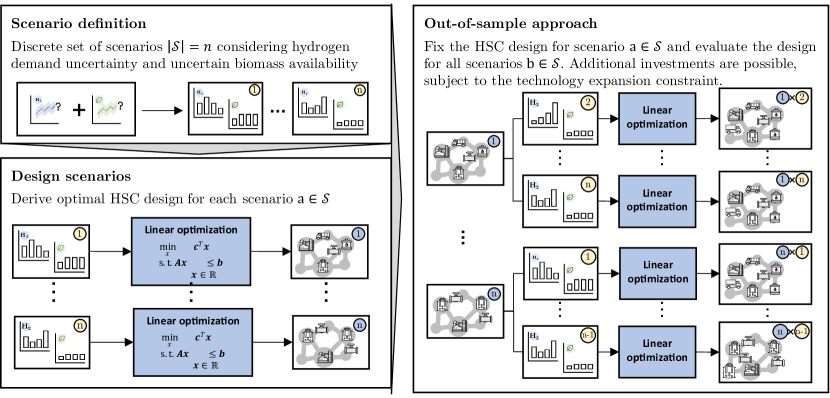
- Formulates a multi-period, multi-regional linear optimization model spanning 2022–2050 to determine the cost-optimal HSC design, including hydrogen and biomass transport, and CO2 capture, transport, and storage (CCS) infrastructure.
- Applies a scenario-based uncertainty quantification approach with discrete scenarios for hydrogen demand (low, medium, high) and biomass availability (low, medium, high), enabling robust decision-making under uncertainty.
- Employs a minimum-regret strategy to identify investment decisions that minimize the worst-case cost deviation across all scenarios, ensuring long-term adaptability.
- Incorporates detailed techno-economic parameters for hydrogen production technologies (SMR-CCS, electrolysis, biomethane reforming, biomass gasification), including capital costs, lifetimes, and efficiency assumptions.
- Models CO2 infrastructure as a critical component, with separate capture, transport (trucks and pipelines), and storage capacities, reflecting real-world constraints and costs.
- Conducts sensitivity analyses on key parameters—electrolyzer costs, CO2 transport costs, and decarbonization targets (e.g., 90% vs. net-zero by 2050)—to assess robustness and policy implications.
Experimental results
Research questions
- RQ1What is the optimal scale and mix of low-carbon hydrogen production capacities needed to meet future demand across a range of uncertainty scenarios?
- RQ2How does uncertainty in biomass availability affect the cost-optimal HSC design, and when is biomass-based hydrogen production economically viable?
- RQ3To what extent do investments in SMR-CCS and electrolyzers provide greater strategic flexibility compared to biomass-based pathways?
- RQ4How critical is early investment in CO2 transport and storage infrastructure for achieving net-zero emissions by 2050?
- RQ5How do changes in key cost assumptions—such as electrolyzer capital costs or CO2 transport costs—affect the optimal HSC configuration and investment timing?
Key findings
- Investing in a minimum of 9.6 Mt/a of low-carbon hydrogen production capacity by 2030 is essential to ensure flexibility and cost-effectiveness across all future demand scenarios, including up to 35 Mt/a by 2050.
- Biomass-based hydrogen production is the most cost-efficient pathway, but only if biomass feedstock availability is guaranteed; otherwise, SMR-CCS and electrolyzers become more favorable due to higher flexibility.
- In scenarios with optimistic CO2 transport cost assumptions (e.g., zero capital cost), SMR-CCS capacity increases by up to 26% and biomass-based H2 capacity decreases by up to 16%, highlighting the strategic importance of CO2 infrastructure.
- CO2 capture and storage (CCS) infrastructure is required across all scenarios to meet the 2050 net-zero target, with average CCS capacity reductions of 24% when the target is relaxed to 90% decarbonization.
- Even under optimistic electrolyzer cost assumptions (reduced capital cost and extended lifetime), the share of electrolysis in the HSC increases by less than 8%, indicating that cost reductions alone do not shift the technology mix significantly.
- The minimum-regret strategy identifies a robust investment path that balances cost and adaptability, ensuring that HSCs can meet climate targets regardless of future demand or resource availability shocks.
Better researchstarts right now
From reading papers to final review, dramatically reduce your research time.
No credit card · Free plan available
This review was created by AI and reviewed by human editors.