
[Paper Review] Import options for chemical energy carriers from renewable sources to Germany
This study evaluates cost-competitive import options for renewable chemical energy carriers—hydrogen, methane, ammonia, methanol, and Fischer-Tropsch fuel—to Germany using GIS-based renewable energy potential and hourly weather data. It finds that for each carrier, at least one international export route is cheaper than domestic production, with hydrogen pipelines from Denmark, Spain, and North Africa offering the lowest costs at €36–42/MWh LHV, while indirect routes via ammonia or methanol are less efficient due to capital and energy losses.
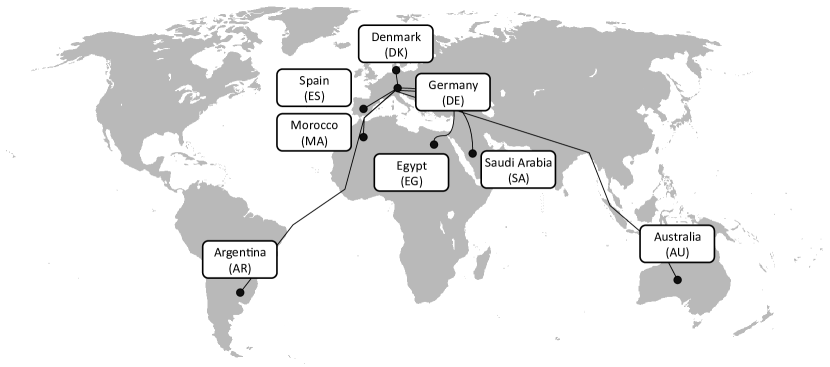
Import and export of fossil energy carriers are cornerstones of energy systems world-wide. If energy systems are to become climate neutral and sustainable, fossil carriers need to be substituted with carbon neutral alternatives or electrified if possible. We investigate synthetic chemical energy carriers, H2, CH4, MeOH, NH3 and Fischer-Tropsch fuels (FTF), produced using electricity from RES as fossil substitutes. [...] We model the sourcing of feedstock chemicals, synthesis and transport along nine different Energy Supply Chains to Germany (DE) and compare import options for seven locations around the world against each other and with domestically sourced alternatives on the basis of their respective cost per unit of H2 and energy delivered. We find that for each type of chemical energy carrier, there is an import option with lower costs compared to domestic production in DE. No single exporting country or energy carrier has a unique cost advantage, since for each energy carrier and country there are cost-competitive alternatives. This allows exporter and infrastructure decisions to be made based on other criteria than energy and cost. The lowest cost means for importing of energy and H2 are by H2 pipeline from Denmark, Spain and Western Asia and Northern Africa starting at 36 EUR/MWhLHV to 42 EUR/MWh-LHV or 1.0 EUR/kg-H2 to 1.3 EUR/kg-H2 (in 2050, assuming 5 % p.a. capital cost). For complex energy carriers derived from H2 like CH4, NH3, MeOH or FTF, imports from Argentina by ship to DE are lower cost than closer exporters in the European Union or Western Asia and Northern Africa. For meeting H2 demand, direct H2 imports are more attractive than indirect routes using CH4, MeOH or NH3 imports and subsequent decomposition to H2 because of high capital investment costs and energetic losses. We make our model and data available under open licenses for adaptation and reuse.
Motivation & Objective
- To assess the economic viability of importing renewable chemical energy carriers to Germany as climate-neutral alternatives to fossil fuels.
- To compare international import options for hydrogen, methane, ammonia, methanol, and Fischer-Tropsch fuel against domestic production in Germany.
- To evaluate the role of transport infrastructure—pipelines, ships, and synthetic pathways—on overall system costs.
- To identify cost-competitive export regions and energy carriers based on renewable electricity availability and logistics.
- To enable policy and infrastructure decisions based on cost and non-cost factors by establishing a comprehensive cost comparison framework.
Proposed method
- Conducts GIS-based analysis of global renewable energy potential (solar and wind) using reanalysis weather data to derive hourly time-series for electricity generation.
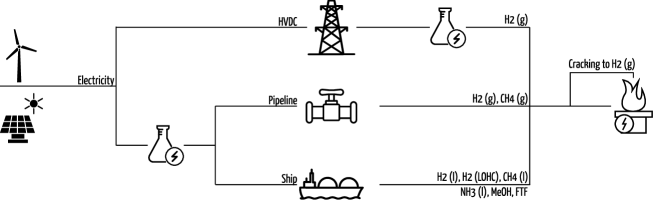
- Models nine distinct Energy Supply Chain (ESC) configurations for importing chemical energy carriers from seven global locations to Germany.
- Applies a techno-economic model to calculate levelized cost of energy (LCOE) per unit of hydrogen and energy delivered, including synthesis, transport, and infrastructure costs.
- Incorporates detailed transport modeling for pipelines (hydrogen) and ships (liquid carriers), accounting for energy losses, boil-off, loading/unloading times, and round-trip efficiency.
- Implements must-run constraints for synthesis plants to ensure minimum operational capacity at all times, reflecting technical requirements of industrial processes.
- Uses a modular framework to compare direct hydrogen import via pipeline with indirect routes via ammonia, methanol, or methane, including conversion losses and capital costs.
Experimental results
Research questions
- RQ1Which international export regions offer the lowest-cost import options for renewable hydrogen, methane, ammonia, methanol, and Fischer-Tropsch fuel to Germany?
- RQ2How do the costs of direct hydrogen import via pipeline compare to indirect routes using ammonia, methanol, or methane as hydrogen carriers?
- RQ3What is the impact of transport distance, infrastructure type (pipeline vs. ship), and energy losses on the total cost of imported synthetic fuels?
- RQ4Are there cost advantages for distant exporters (e.g., North Africa, South America) over closer European or North American suppliers for complex energy carriers?
- RQ5To what extent do capital costs and energetic losses in conversion processes affect the overall cost-effectiveness of indirect hydrogen supply chains?
Key findings
- For every chemical energy carrier, at least one international import option is cheaper than domestic hydrogen production in Germany, with no single country or carrier dominating cost-wise.
- The lowest-cost hydrogen import option is via pipeline from Denmark, Spain, or North Africa, with costs of €36–42/MWh LHV (or €1.0–1.3/kg H₂) by 2050 under a €5,000/kW capital cost assumption.
- For complex carriers like ammonia, methanol, and Fischer-Tropsch fuel, imports from North Africa are cheaper than from closer European or North American suppliers due to lower renewable electricity costs.
- Direct hydrogen import via pipeline is more cost-effective than indirect routes using ammonia, methanol, or methane, primarily due to lower capital investment and reduced energetic losses from multiple conversion steps.
- Shipping efficiency for liquid hydrogen and ammonia is significantly reduced by boil-off and round-trip logistics, with the adjusted outbound journey time accounting for idle periods to maintain annual trip frequency.
- The model and data are released under open licenses to support reuse and adaptation for future energy system planning and policy analysis.
Read this paper
Open the full text in the Nubint reader and ask about any passage as you read.
Read this paper on NubintThis review was generated by AI from the original paper. Please check the paper before citing it.