
[Paper Review] Molecular Insights into Chemical Reactions at Aqueous Aerosol Interfaces
This paper presents a molecular-scale framework integrating theory and experiment to unravel gas uptake and interfacial reactions in aqueous aerosols, using N₂O₅ as a probe. It reveals that interfacial composition—especially ions and surfactants—controls reaction branching, with cationic surfactants like TBA⁺ dramatically extending Br₃⁻ lifetime and suppressing Br₂ formation, highlighting the critical role of interfacial microenvironments in atmospheric multiphase chemistry.
Atmospheric aerosols facilitate reactions between ambient gases and dissolved species. Here, we review our efforts to interrogate the uptake of these gases and the mechanisms of their reactions both theoretically and experimentally. We highlight the fascinating behavior of $\mathrm{N}_2\mathrm{O}_5$ in solutions ranging from pure water to complex mixtures, chosen because its aerosol-mediated reactions significantly impact global ozone, hydroxyl, and methane concentrations. As a hydrophobic, weakly soluble, and highly reactive species, $\mathrm{N}_2\mathrm{O}_5$ is a sensitive probe of the chemical and physical properties of aerosol interfaces. We employ contemporary theory to disentangle the fate of $\mathrm{N}_2\mathrm{O}_5$ as it approaches pure and salty water, starting with adsorption and ending with hydrolysis to HNO$_3$, chlorination to $\mathrm{ClNO}_2$, or evaporation. Flow reactor and gas-liquid scattering experiments probe even greater complexity as added ions, organic molecules, and surfactants alter interfacial composition and reaction rates. Together, we reveal a new perspective on multiphase chemistry in the atmosphere.
Motivation & Objective
- To develop a molecular-level understanding of gas uptake and interfacial reactions in atmospheric aerosols, focusing on the complex behavior of N₂O₅.
- To bridge the gap between macroscopic aerosol chemistry and atomistic interfacial processes by integrating theoretical modeling with advanced experimental techniques.
- To investigate how interfacial composition—particularly ions, organic molecules, and surfactants—affects reaction pathways and branching ratios in multiphase systems.
- To quantify the impact of surface-active cations on the stability of reactive intermediates like Br₃⁻ and their role in modulating product yields.
- To establish a general framework for predicting reactivity in complex, heterogeneous atmospheric interfaces using combined theoretical and experimental approaches.
Proposed method
- Employing many-body molecular dynamics simulations to model N₂O₅ diffusion, adsorption, and reaction at air-water interfaces with atomic resolution.
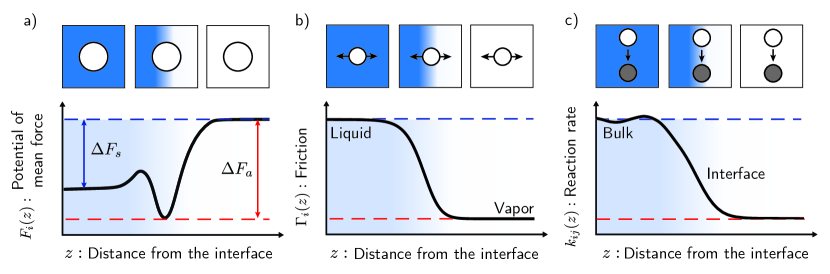
- Using a reduced reaction-diffusion framework with resistor-model approximations to connect molecular-scale dynamics to macroscopic gas uptake kinetics.
- Conducting flow reactor and gas-liquid scattering experiments with microjets to probe interfacial reactivity under controlled conditions.
- Measuring interfacial composition and reactivity using inert gas scattering to determine surface coverage and molecular organization.
- Applying machine learning and accurate interatomic potentials to enhance the predictive power of molecular simulations in complex, dynamic interfaces.
- Comparing results across pure water, salty solutions (e.g., LiBr), and surfactant-containing systems (e.g., TBABr) to isolate the effects of specific interfacial components.
![Figure 1 : The physical and chemical processes that lead to irreversible loss of a gas particle to an aqueous aerosol, with molecular dynamics snapshots illustrating each for a representative $\mathrm{N}_{2}\mathrm{O}_{5}$ gas molecule. Adapted with permission from Reference [ 39 ] . Copyright 2021](https://ar5iv.labs.arxiv.org/html/2306.13811/assets/x1.png)
Experimental results
Research questions
- RQ1How does the interfacial composition of aqueous aerosols influence the uptake and reactivity of N₂O₅?
- RQ2What role do cationic surfactants play in stabilizing reactive intermediates like Br₃⁻ and altering product yields in halogenation reactions?
- RQ3How do ion-specific effects and surface coverage affect the branching ratio between hydrolysis (HNO₃) and chlorination (ClNO₂) of N₂O₅?
- RQ4To what extent can theoretical models based on many-body molecular dynamics predict experimental gas uptake and reaction rates in complex aerosol systems?
- RQ5How do interfacial dynamics and molecular fluctuations govern the competition between solute-solvent and solute-solute reactions at the air-liquid interface?
Key findings
- The addition of tetrabutylammonium bromide (TBABr) to a LiBr microjet suppressed Br₂ production despite its shorter chain length, indicating that cationic surfactants can inhibit reactive halogen release.
- The lifetime of the Br₃⁻ intermediate increased from <10 μs to >100,000 μs in the presence of TBA⁺, explaining the observed suppression of Br₂ formation.
- Surfactants like TBA⁺ significantly extend the lifetime of reactive intermediates such as Br₃⁻, demonstrating that interfacial microstructure controls product stability.
- Inert gas scattering confirmed that TBA⁺ achieved 60% surface coverage in the microjet, providing a quantitative measure of interfacial organization.
- The presence of TBA⁺ enhanced O₃ uptake and prolonged the lifetime of [BrOOO]⁻, indicating broader effects on interfacial reactivity beyond just halogen chemistry.
- Theoretical modeling combined with experiment reveals that interfacial composition—especially ion and surfactant identity—dictates reaction pathways and branching ratios in aerosol-mediated chemistry.
Better researchstarts right now
From reading papers to final review, dramatically reduce your research time.
No credit card · Free plan available
This review was created by AI and reviewed by human editors.