
[论文解读] Near-term $n$ to $k$ distillation protocols using graph codes
本文提出一种图论框架,用于设计近期待机、低开销的 $n$ 到 $k$ 纠缠浓缩协议,采用双局部 Clifford 操作。通过建立稳定子码与浓缩协议之间的一一对应关系,作者实现了 $n \leq 10$ 时的可证明最优电路合成,其保真度更高、资源成本更低,尤其在 $k > 1$ 时优于先前方法。该方法结合图等价类的完整枚举与黑箱优化,得到两量子比特门数量最少、深度最低的电路,并在使用 Steane 码进行逻辑态远程传送时表现出优越性能。
Noisy hardware forms one of the main hurdles to the realization of a near-term quantum internet. Distillation protocols allows one to overcome this noise at the cost of an increased overhead. We consider here an experimentally relevant class of distillation protocols, which distill $n$ to $k$ end-to-end entangled pairs using bilocal Clifford operations, a single round of communication and a possible final local operation depending on the observed measurement outcomes. In the case of permutationally invariant depolarizing noise on the input states, we find a correspondence between these distillation protocols and graph codes. We leverage this correspondence to find provably optimal distillation protocols in this class for several tasks important for the quantum internet. This correspondence allows us to investigate use cases for so-called non-trivial measurement syndromes. Furthermore, we detail a recipe to construct the circuit used for the distillation protocol given a graph code. We use this to find circuits of short depth and small number of two-qubit gates. Additionally, we develop a black-box circuit optimization algorithm, and find that both approaches yield comparable circuits. Finally, we investigate the teleportation of encoded states and find protocols which jointly improve the rate and fidelities with respect to prior art.
研究动机与目标
- 设计适用于近期待机量子网络的实验可行、低开销的 $n$ 到 $k$ 纠缠浓缩协议。
- 通过将协议映射到图码,将双局部 Clifford 浓缩协议的搜索空间缩小,实现对等价类的完整枚举。
- 利用系统化方法,从图码构造低深度、低两量子比特门数的电路。
- 在噪声与无噪声环境下,比较图论枚举与黑箱优化(遗传算法)在电路质量上的表现。
- 评估 $n$ 到 $k$ 浓缩在逻辑态远程传送中的性能,尤其针对 $k > 1$ 的情况,使用 Steane 码。
提出的方法
- 在双局部 Clifford 浓缩协议与稳定子码之间建立一一对应关系,两种场景下均使用固定的 Clifford 电路 $C$。
- 将浓缩协议映射为具有 $n+k$ 个顶点的 $(n,k)$-图,其中边表示 CZ 门,并利用图等价类缩小搜索空间。
- 开发一种构造性方法,将图码转化为两量子比特门数量最少、深度较低的物理量子电路。
- 对图等价类进行完整枚举,以在置换不变去极化噪声下找到可证明最优的协议。
- 实现一种基于遗传算法的黑箱优化框架,用于探索噪声电路和任意 Pauli 噪声环境。
- 通过比较 $10\to7$ 浓缩与 $2\to1$ DEJMPS 及未浓缩对在 Steane 码下的表现,评估逻辑态远程传送的性能。
实验结果
研究问题
- RQ1能否将寻找最优 $n$ 到 $k$ 浓缩协议的问题简化为一个可处理的图论问题?
- RQ2在不同噪声水平下,图论枚举与黑箱优化在电路质量上的表现如何比较?
- RQ3对于 $k > 1$ 的 $n$ 到 $k$ 浓缩,其在保真度与资源效率方面是否优于重复的 $2$ 到 $1$ 浓缩?
- RQ4浓缩协议中非平凡测量投影结果的影响是什么?如何系统性地加以利用?
- RQ5基于图的电路合成在多大程度上能为近期待机量子硬件生成两量子比特门数量最少、深度最低的电路?
主要发现
- 图论方法使得对 $(n,k)$-图等价类的完整枚举成为可能,从而在置换不变去极化噪声下获得可证明最优的浓缩协议。
- 在低门噪声条件下,图枚举方法优于黑箱优化,发现的电路保真度最高、门数最少。
- 在高噪声环境下,黑箱优化方法表现更优,展现出对门错误的强鲁棒性。
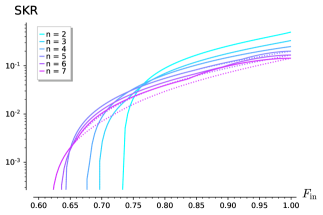
- 通过图枚举找到的 $10\to7$ 浓缩协议,在输入保真度高于 $\approx 0.85$ 时,其保真度更高、资源成本更低,优于七个独立的 $2\to1$ DEJMPS 协议。
- 在考虑成功概率后,当输入保真度高于 $\approx 0.95$ 时,$10\to7$ 协议平均所需的初始纠缠对数量少于 $2\to1$ 方法。
- 该框架实现了从图码系统化构建电路,所得电路深度短、两量子比特门数最少,适用于近期待机设备。
更好的研究,从现在开始
从阅读论文到最终审阅,大幅缩短您的研究时间。
无需绑定信用卡
本解读由 AI 生成,并经人工编辑审核。